

Care Disclaimer: Plant care recommendations are general guidelines based on common growing conditions. Individual results may vary based on your local environment, climate, and care routine. If your plant is toxic, keep it away from children and pets, and consult a veterinarian if accidental ingestion occurs.
1.Watsonia — Overview
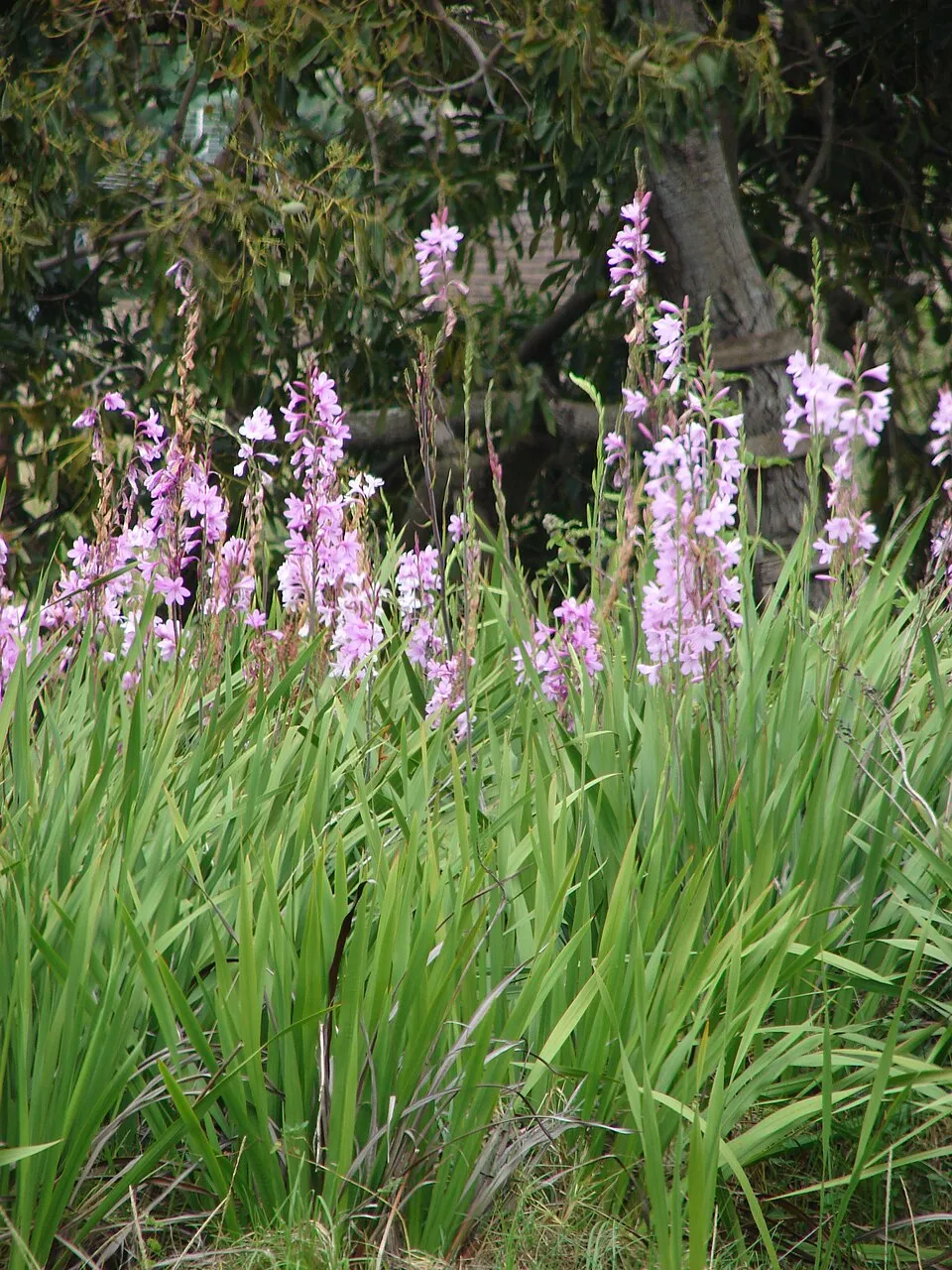
Watsonia borbonica, commonly known as the Cape bugle lily, Bourbon Watsonia, or simply Watsonia, is a magnificent perennial herbaceous plant indigenous to the biodiverse Western Cape region of South Africa. This member of the Iridaceae family, named after the 18th-century British botanist Sir William Watson, is celebrated for its dramatic, tall, and elegant flower spikes that can impressively reach heights of up to 1.5 meters. The foliage consists of long, strap-like, and erect leaves that form a robust basal clump, from which the striking flower stalk emerges.
The inflorescence is a dense spike adorned with numerous tubular flowers, typically presenting in vibrant pink or reddish-pink hues in their natural habitat, though cultivated varieties showcase a broader spectrum including white, orange, and salmon. Each flower features six tepals, with the upper three often forming a distinctive hood-like structure over the lower three. The plant sustains itself and reproduces through corms, which are specialized underground storage organs enabling it to endure the arid summer months and vigorously resprout with the onset of autumn rains.
Beyond its aesthetic appeal as a popular ornamental, Watsonia borbonica plays a vital ecological role, providing essential nectar for various pollinators and contributing significantly to the unique biodiversity of the renowned Cape Floral Kingdom. While prized for its beauty, it's worth noting its potential to naturalize extensively and sometimes be considered invasive in certain non-native environments, and its height may necessitate staking for support.
Trusted Scientific References
1. Authoritative external sources for Watsonia borbonica
1.1 Wikipedia — Watsonia borbonica
1.2 Kew POWO (Plants of the World Online)
1.3 PubMed — peer-reviewed research
1.4 NCBI Taxonomy Browser
1.5 GBIF — Global Biodiversity
1.6Watsonia should be interpreted through verified botanical identity, practical care, and responsible safety language. This recovery note adds the missing context needed for a complete profile: match light to the plant's habit, use well-drained soil, water according to season, and avoid unsupported medicinal or edible claims. For publishing, the plant can be presented as a source-backed garden plant with clear care guidance, common problem diagnosis, and conservative safety wording.
1.1.Watsonia — Key Features
- ✓ <strong>Striking perennial herbaceous</strong> — Striking perennial herbaceous plant native to South Africa.
- ✓ <strong>Characterized by tall, gladiola</strong> — like flower spikes reaching up to 1.5 meters.
- ✓ <strong>Member of the</strong> — Member of the Iridaceae family, renowned for its ornamental value.
- ✓ <strong>Reproduces and survives</strong> — Reproduces and survives via underground corms.
- ✓ <strong>Traditionally used for anti</strong> — inflammatory support and as a diuretic.
- ✓ <strong>Contains active phytochemicals</strong> — Contains active phytochemicals such as flavonoids and saponins.
- ✓ <strong>Supports urinary tract</strong> — Supports urinary tract health in traditional applications.
- ✓ <strong>Can provide relief</strong> — Can provide relief for minor skin irritations when applied topically.
- ✓ <strong>Requires full sun and well</strong> — drained soil for optimal growth.
- ✓ <strong>Generally considered deer</strong> — Generally considered deer resistant in cultivated settings.
1.2.Watsonia — Quick Summary
- ✓ Native to South Africa, Watsonia borbonica is an elegant ornamental perennial known for its tall, vibrant flower spikes.
- ✓ Traditionally valued for its anti-inflammatory, diuretic, and urinary tract supporting properties.
- ✓ Contains beneficial compounds like flavonoids and saponins, which contribute to its therapeutic potential.
- ✓ Cultivation requires full sun, well-drained soil, and consistent care for its corms.
- ✓ Caution is advised due to potential skin irritation from handling and a lack of extensive modern safety research for internal use.
- ✓ It is a significant component of the Cape Floral Kingdom's biodiversity, attracting pollinators.
2.Watsonia — Scientific Identity
3.Watsonia — Quick Facts
4.Watsonia — Appearance & Identification
5.Watsonia — Native Habitat
6.Watsonia — Water Requirements
- ✓ Plant corms in late summer to early winter, about 3 inches deep and 12 inches apart, for autumn sprouting and spring blooms.
- ✓ Ensure full sun exposure (at least 6 hours daily) for optimal growth and flowering.
- ✓ Provide well-drained soil enriched with compost to prevent corm rot and promote vigorous growth.
- ✓ Water consistently during summer months to encourage robust growth and enhance cold hardiness.
- ✓ After flowering, remove spent flower stalks but leave the foliage intact until it yellows to strengthen the corms for the next cycle.
- ✓ Divide mature, overcrowded clumps every few years during the dormant period to maintain flowering vigor.
- ✓ In colder climates (below USDA Zone 8a), corms can be dug up in fall, stored dry at 35-41°F (2-5°C) in a peat and potting soil mix, and replanted in spring.
- ✓ Watsonia borbonica is generally deer resistant, making it a good choice for gardens prone to deer browsing.
Reviewed by the Flora Medical Global Botanical Review Panel
Multi-disciplinary editorial group · Botany · Ethnobotany · Herbal-medicine literature
Who reviewed this: This page was checked by the Flora Medical Global Botanical Review Panel — an in-house editorial group of botany graduates, ethnobotany researchers, and horticulture practitioners who collectively maintain our 7,000+ plant encyclopedia. Meet the team.
Our 4-step verification process
1. Taxonomic verification
Scientific names and synonyms cross-checked against Kew POWO, World Flora Online, and The Plant List.
2. Phytochemical & medicinal cross-reference
Active compounds, traditional uses, and reported activities are cross-referenced with PubMed, USDA Dr. Duke's database, and peer-reviewed ethnobotanical literature.
3. Conservation & distribution check
Distribution, ecology, and conservation status confirmed against GBIF occurrence records and the IUCN Red List.
4. Editorial & safety review
Every entry passes an editorial pass for clarity, originality, and safety notices (toxicity, contraindications, dosage caveats) before publication.
Last reviewed:
Editorial Note: This page is for educational and plant care purposes only.
Written by: Flora Medical Global Editorial Team
Reviewed by: Flora Medical Global Botanical Review Panel
Last Updated: June 15, 2026







Watsonia — Comments & Community Reviews
Rate this plant