
Care Disclaimer: Plant care recommendations are general guidelines based on common growing conditions. Individual results may vary based on your local environment, climate, and care routine. If your plant is toxic, keep it away from children and pets, and consult a veterinarian if accidental ingestion occurs.
1.Whiteheadia Bifolia — Overview
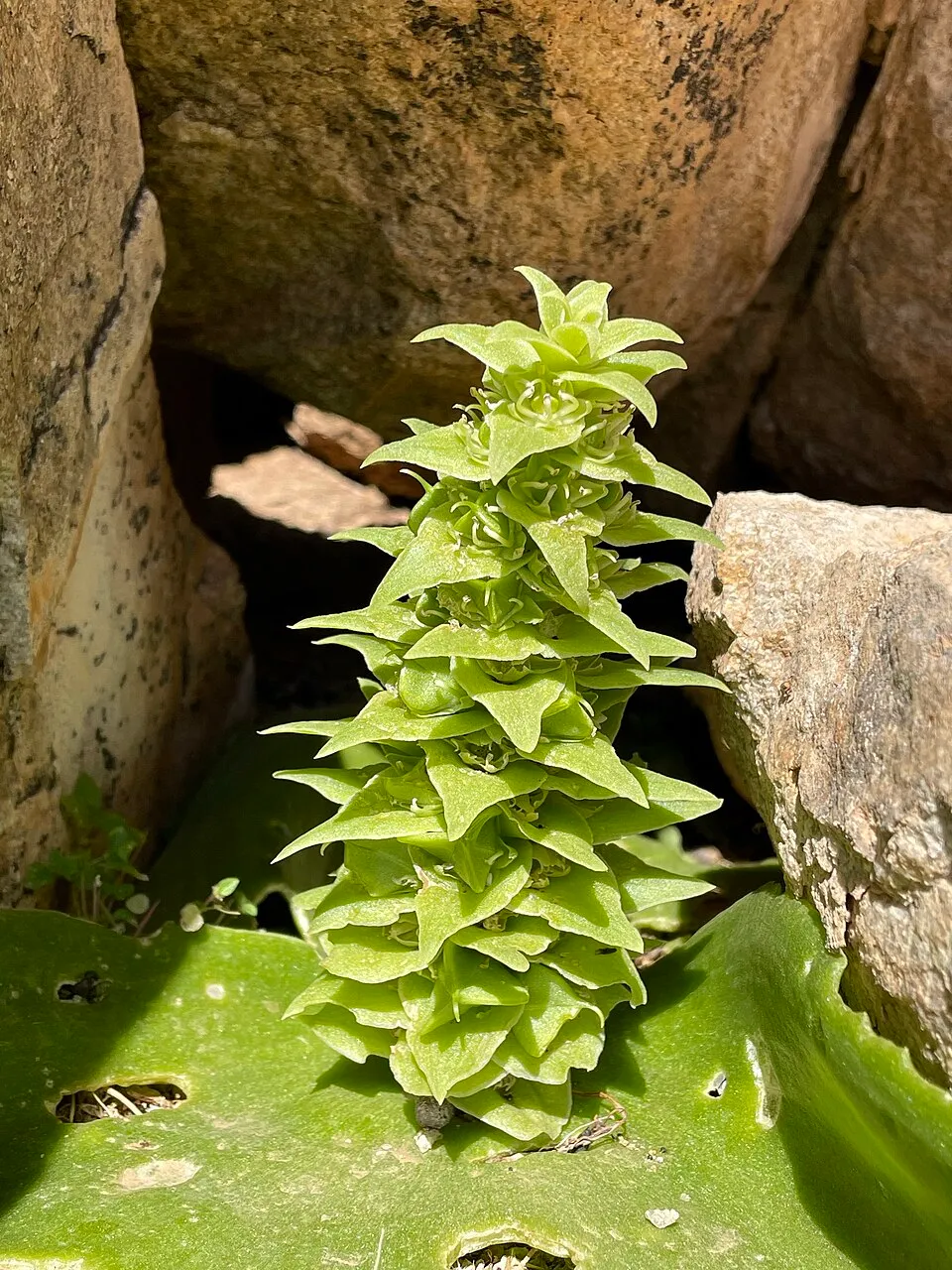
Whiteheadia Bifolia, commonly known as the Pagoda Lily, is a fascinating perennial herbaceous plant native to the arid regions of South Africa and Southern Namibia. Historically classified within the genus Whiteheadia, modern taxonomic revisions often place it within the larger Massonia genus, belonging to the Hyacinthaceae family (formerly part of Liliaceae).
This captivating plant is characterized by its unique morphology, featuring two large, flat, ground-resting leaves that can extend up to 10 cm in length, boasting a smooth, glossy texture and vibrant green coloration. From these prominent leaves emerges a distinct flower stalk, reminiscent of a hyacinth, typically reaching heights between 0.5 to 1 meter.
The inflorescence of Whiteheadia Bifolia is distinctive, consisting primarily of green bracts that support tiny, whitish-green tepals, contributing to its 'floral blandness.' This subdued coloration, coupled with geoflory (flowering close to the ground), robustness, exerted reproductive organs, and a yeasty or musty scent, are classic adaptations for non-flying mammal pollination. Indeed, Whiteheadia Bifolia is famously pollinated by the Namaqua Rock Mouse (Aethomys namaquensis), which visits the flowers, attracted by abundant, viscous nectar, particularly at night.
While other pollinators like bees and butterflies may visit, the primary role of rodents in its reproductive cycle is a significant ecological feature.
Whiteheadia Bifolia thrives in well-drained, fertile soils rich in organic matter, demonstrating remarkable adaptability to various light exposures from full sun to partial shade. Its deep root system confers considerable drought resistance, a vital trait for its native arid habitats, though consistent watering during active growth enhances vitality and flowering.
The plant's robust growth habit and ornamental appeal make it a unique specimen for specialized gardens, highlighting its resilience and intriguing botanical characteristics within its diverse natural distribution.
Trusted Scientific References
1. Authoritative external sources for Whiteheadia Bifolia
1.1 Wikipedia — Whiteheadia Bifolia
1.2 Kew POWO (Plants of the World Online)
1.3 PubMed — peer-reviewed research
1.4 NCBI Taxonomy Browser
1.5 GBIF — Global Biodiversity
1.1.Whiteheadia Bifolia — Key Features
- ✓ <strong>Unique Rodent Pollination</strong> — Primarily pollinated by the Namaqua Rock Mouse, a rare ecological interaction.
- ✓ <strong>South African Native</strong> — Indigenous to arid regions of South Africa and Southern Namibia.
- ✓ <strong>Hyacinthaceae Family Member</strong> — Part of a botanical family known for bulbs and diverse floral structures.
- ✓ <strong>Ground</strong> — Resting Leaves — Features two prominent, flat, glossy leaves that lie close to the ground.
- ✓ <strong>'Floral Blandness'</strong> — Produces small, whitish-green flowers with green bracts, lacking vibrant colors.
- ✓ <strong>Musty/Yeasty Scent</strong> — Emits a distinct odor, particularly at night, to attract nocturnal pollinators.
- ✓ <strong>Deep Root System</strong> — Confers significant drought resistance, adapting to arid native habitats.
- ✓ <strong>Potential Medicinal Properties</strong> — Traditionally noted for anti-inflammatory and digestive support, though requiring caution.
- ✓ <strong>Ornamental Appeal</strong> — Valued in specialized gardens for its unusual form and ecological story.
- ✓ <strong>Taxonomic Reclassification</strong> — Often reclassified from Whiteheadia to the genus Massonia.
1.2.Whiteheadia Bifolia — Quick Summary
- ✓ Whiteheadia Bifolia (Pagoda Lily) is a unique South African perennial known for its rodent pollination.
- ✓ Belongs to the Hyacinthaceae family, with taxonomic reclassification often placing it under Massonia.
- ✓ Offers potential traditional anti-inflammatory and digestive support, though research is limited.
- ✓ Characterized by dull flowers, ground-resting leaves, and a 'yeasty' scent attracting mice.
- ✓ Cultivation requires well-drained soil and moderate watering, with good drought resistance.
- ✓ Exercise extreme caution with all parts due to potential toxicity associated with its plant family.
2.Whiteheadia Bifolia — Scientific Identity
3.Whiteheadia Bifolia — Quick Facts
4.Whiteheadia Bifolia — Appearance & Identification
5.Whiteheadia Bifolia — Native Habitat
6.Whiteheadia Bifolia — Water Requirements
- ✓ Soil Preference — Thrives in well-drained, fertile soils, ideally enriched with organic matter to mimic its natural environment.
- ✓ Light Requirements — Adapts well to a range of exposures, from full sun to partial shade, with optimal growth often achieved in bright, indirect light.
- ✓ Watering Regimen — Requires consistent, regular watering during its active growing season, but is drought-resistant due to a deep root system; reduce watering significantly during dormancy.
- ✓ Temperature and Climate — Prefers tropical to subtropical conditions, but can tolerate arid environments; protect from extreme cold or frost.
- ✓ Fertilization — Benefits from nutrient-rich environments; apply a balanced, slow-release fertilizer during the growing season to enhance vitality.
- ✓ Propagation — Primarily propagated from seeds or by careful division of offsets from mature bulbs, ensuring minimal root disturbance.
- ✓ Bulb Management — Some species in the family are best grown with bulbs partially exposed, others buried; for Whiteheadia, plant bulbs just below the soil surface in a sandy loam mixture.
- ✓ Pest and Disease Control — Generally robust, but monitor for common bulb pests and fungal issues if drainage is poor.
Reviewed by the Flora Medical Global Botanical Review Panel
Multi-disciplinary editorial group · Botany · Ethnobotany · Herbal-medicine literature
Who reviewed this: This page was checked by the Flora Medical Global Botanical Review Panel — an in-house editorial group of botany graduates, ethnobotany researchers, and horticulture practitioners who collectively maintain our 7,000+ plant encyclopedia. Meet the team.
Our 4-step verification process
1. Taxonomic verification
Scientific names and synonyms cross-checked against Kew POWO, World Flora Online, and The Plant List.
2. Phytochemical & medicinal cross-reference
Active compounds, traditional uses, and reported activities are cross-referenced with PubMed, USDA Dr. Duke's database, and peer-reviewed ethnobotanical literature.
3. Conservation & distribution check
Distribution, ecology, and conservation status confirmed against GBIF occurrence records and the IUCN Red List.
4. Editorial & safety review
Every entry passes an editorial pass for clarity, originality, and safety notices (toxicity, contraindications, dosage caveats) before publication.
Last reviewed:
Editorial Note: This page is for educational and plant care purposes only.
Written by: Flora Medical Global Editorial Team
Reviewed by: Flora Medical Global Botanical Review Panel
Last Updated: June 15, 2026







Whiteheadia Bifolia — Comments & Community Reviews
Rate this plant