
Care Disclaimer: Plant care recommendations are general guidelines based on common growing conditions. Individual results may vary based on your local environment, climate, and care routine. If your plant is toxic, keep it away from children and pets, and consult a veterinarian if accidental ingestion occurs.
1.Wisteria Floribunda — Overview
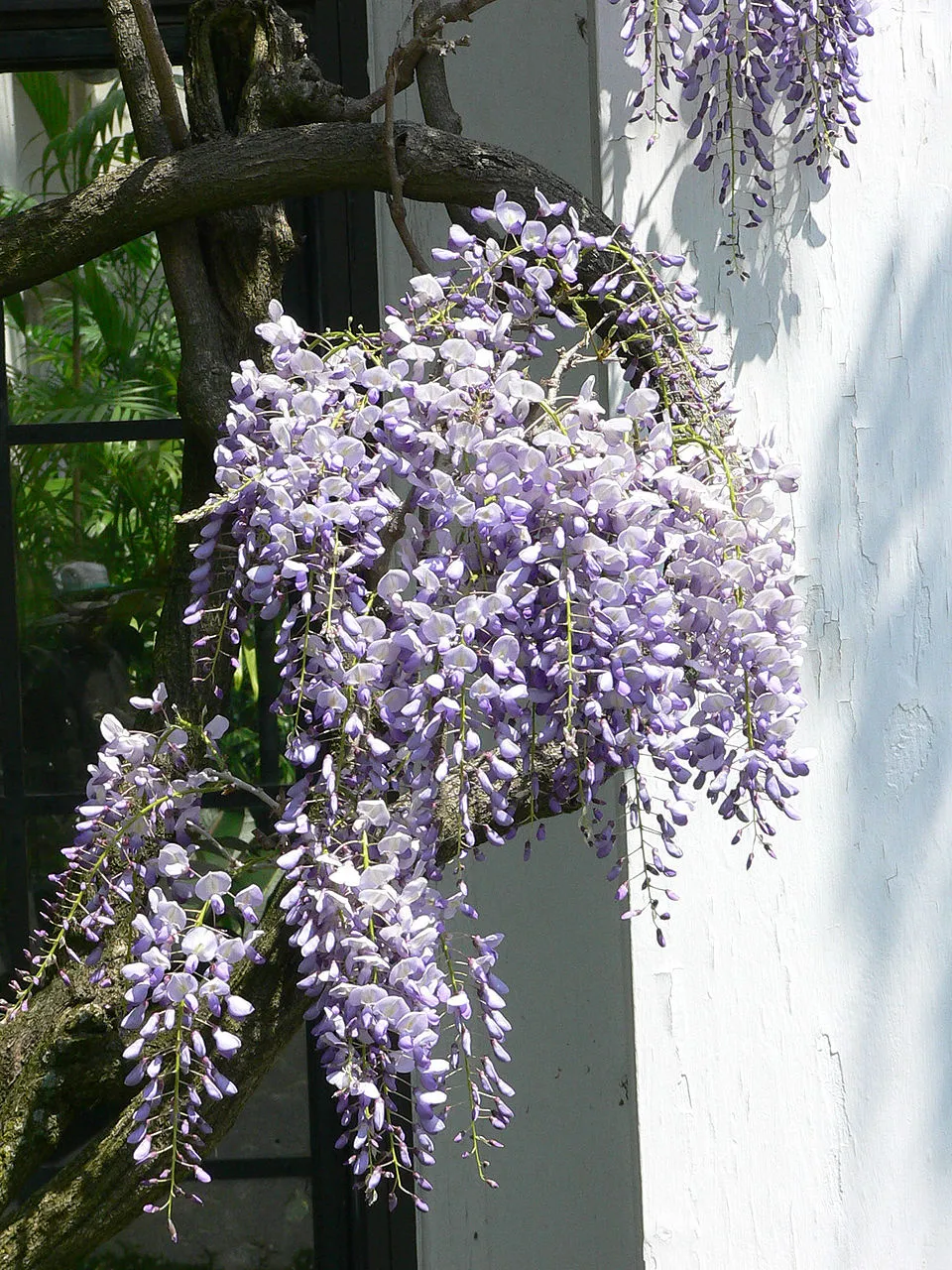
Wisteria floribunda, commonly known as Japanese Wisteria, is a magnificent deciduous woody vine belonging to the Fabaceae (Pea family). Native to the islands of Japan, particularly Honshu, Shikoku, and Kyushu, it is renowned globally for its spectacular floral displays. This vigorous climber exhibits a characteristic clockwise twining growth habit, capable of ascending to heights of over 30 feet (9 meters) and spreading extensively when provided with sturdy support structures such as pergolas, arbors, or mature trees. Its pinnately compound leaves consist of 13-19 ovate to lanceolate leaflets, which emerge with a bronze tint in spring before maturing to a lush green.
The most striking feature of Wisteria floribunda is its dramatic, pendulous racemes of fragrant, pea-like flowers, which unfurl sequentially from the base to the tip. These racemes can reach an impressive length of 1 to 3 feet (30-90 cm), showcasing a spectrum of colors including lavender, violet, pink, and white, depending on the cultivar. Flowering typically occurs in late spring to early summer, preceding or coinciding with the emergence of foliage. Following the floral display, the plant produces velvety, bean-like pods that contain its seeds.
While highly prized for its ornamental value, its aggressive growth necessitates diligent pruning and robust structural support to prevent damage to buildings or overwhelming other vegetation. Japanese Wisteria is a long-lived species, often thriving for several decades, establishing a lasting presence in landscapes.
Trusted Scientific References
1. Authoritative external sources for Wisteria floribunda
1.1 Wikipedia — Wisteria floribunda
1.2 Kew POWO (Plants of the World Online)
1.3 PubMed — peer-reviewed research
1.4 NCBI Taxonomy Browser
1.5 GBIF — Global Biodiversity
1.6Wisteria Floribunda should be interpreted through verified botanical identity, practical care, and responsible safety language. This recovery note adds the missing context needed for a complete profile: match light to the plant's habit, use well-drained soil, water according to season, and avoid unsupported medicinal or edible claims. For publishing, the plant can be presented as a source-backed garden plant with clear care guidance, common problem diagnosis, and conservative safety wording.
1.1.Wisteria Floribunda — Key Features
- ✓ <strong>Spectacular Cascading Flowers</strong> — Produces long, pendulous racemes of fragrant, pea-like flowers.
- ✓ <strong>Vigorous Woody Vine</strong> — A robust climber with a strong, twining growth habit.
- ✓ <strong>Deciduous Foliage</strong> — Pinnately compound leaves emerge bronze, maturing to vibrant green.
- ✓ <strong>Native to Japan</strong> — Indigenous to various islands of Japan.
- ✓ <strong>High Ornamental Value</strong> — Widely cultivated globally for its aesthetic appeal in gardens.
- ✓ <strong>ALL PARTS TOXIC</strong> — Contains potent lectins, making it highly poisonous if ingested.
- ✓ <strong>Long</strong> — Lived Plant — Capable of thriving for many decades in suitable conditions.
- ✓ <strong>Requires Sturdy Support</strong> — Needs strong structures like pergolas or arbors to support its growth.
- ✓ <strong>Sequential Flowering</strong> — Flowers open progressively from the base to the tip of the raceme.
- ✓ <strong>Aggressive Growth Habit</strong> — Demands regular pruning to manage its size and spread.
1.2.Wisteria Floribunda — Quick Summary
- ✓ Japanese Wisteria is a highly ornamental, vigorous woody vine known for its spectacular cascading flowers.
- ✓ All parts of Wisteria floribunda, particularly the seeds and pods, are highly toxic if ingested by humans or animals.
- ✓ Traditional medicinal uses for Wisteria species are extremely limited, primarily external, and carry significant risks due to toxicity.
- ✓ Symptoms of ingestion include severe gastrointestinal distress, dizziness, and potential collapse.
- ✓ Cultivation requires sturdy support, full sun, and regular pruning to manage its aggressive growth and promote flowering.
- ✓ It is essential to educate individuals about its toxicity and keep it out of reach of children and pets.
2.Wisteria Floribunda — Scientific Identity
3.Wisteria Floribunda — Quick Facts
4.Wisteria Floribunda — Appearance & Identification
5.Wisteria Floribunda — Native Habitat
6.Wisteria Floribunda — Water Requirements
- ✓ Site Selection — Plant Japanese Wisteria in full sun (at least 6 hours daily) for optimal flowering; avoid very shady or water-logged spots.
- ✓ Support Structure — Provide a robust, sturdy support like a heavy-duty pergola, arbor, or strong wall wires, as Wisteria floribunda is a vigorous, heavy twiner.
- ✓ Soil Requirements — Prefers well-drained, moderately fertile soil; amend heavy clay soils with organic matter to improve drainage.
- ✓ Planting Technique — For grafted plants, ensure the graft union is above the soil line; check for healthy roots before planting.
- ✓ Pruning Schedule — Requires two main prunes: a summer prune (July/August) to cut back whippy growth to 5-6 leaves, and a crucial winter prune (January/February) to shorten side shoots to 2-3 buds for flower production.
- ✓ Watering — Water regularly during the first two summers after planting, especially during dry spells; established plants are quite drought-tolerant.
- ✓ Fertilization — Fertilize sparingly with a balanced, low-nitrogen fertilizer if growth is weak, as too much nitrogen can promote foliage over flowers.
- ✓ Frost Protection — In cold gardens or areas prone to late frosts, plant against a warm wall or choose later-flowering white varieties to protect flower buds.
Reviewed by the Flora Medical Global Botanical Review Panel
Multi-disciplinary editorial group · Botany · Ethnobotany · Herbal-medicine literature
Who reviewed this: This page was checked by the Flora Medical Global Botanical Review Panel — an in-house editorial group of botany graduates, ethnobotany researchers, and horticulture practitioners who collectively maintain our 7,000+ plant encyclopedia. Meet the team.
Our 4-step verification process
1. Taxonomic verification
Scientific names and synonyms cross-checked against Kew POWO, World Flora Online, and The Plant List.
2. Phytochemical & medicinal cross-reference
Active compounds, traditional uses, and reported activities are cross-referenced with PubMed, USDA Dr. Duke's database, and peer-reviewed ethnobotanical literature.
3. Conservation & distribution check
Distribution, ecology, and conservation status confirmed against GBIF occurrence records and the IUCN Red List.
4. Editorial & safety review
Every entry passes an editorial pass for clarity, originality, and safety notices (toxicity, contraindications, dosage caveats) before publication.
Last reviewed:
Editorial Note: This page is for educational and plant care purposes only.
Written by: Flora Medical Global Editorial Team
Reviewed by: Flora Medical Global Botanical Review Panel
Last Updated: June 15, 2026







Wisteria Floribunda — Comments & Community Reviews
Rate this plant