

Care Disclaimer: Plant care recommendations are general guidelines based on common growing conditions. Individual results may vary based on your local environment, climate, and care routine. If your plant is toxic, keep it away from children and pets, and consult a veterinarian if accidental ingestion occurs.
1.Wisteria Frutescens — Overview
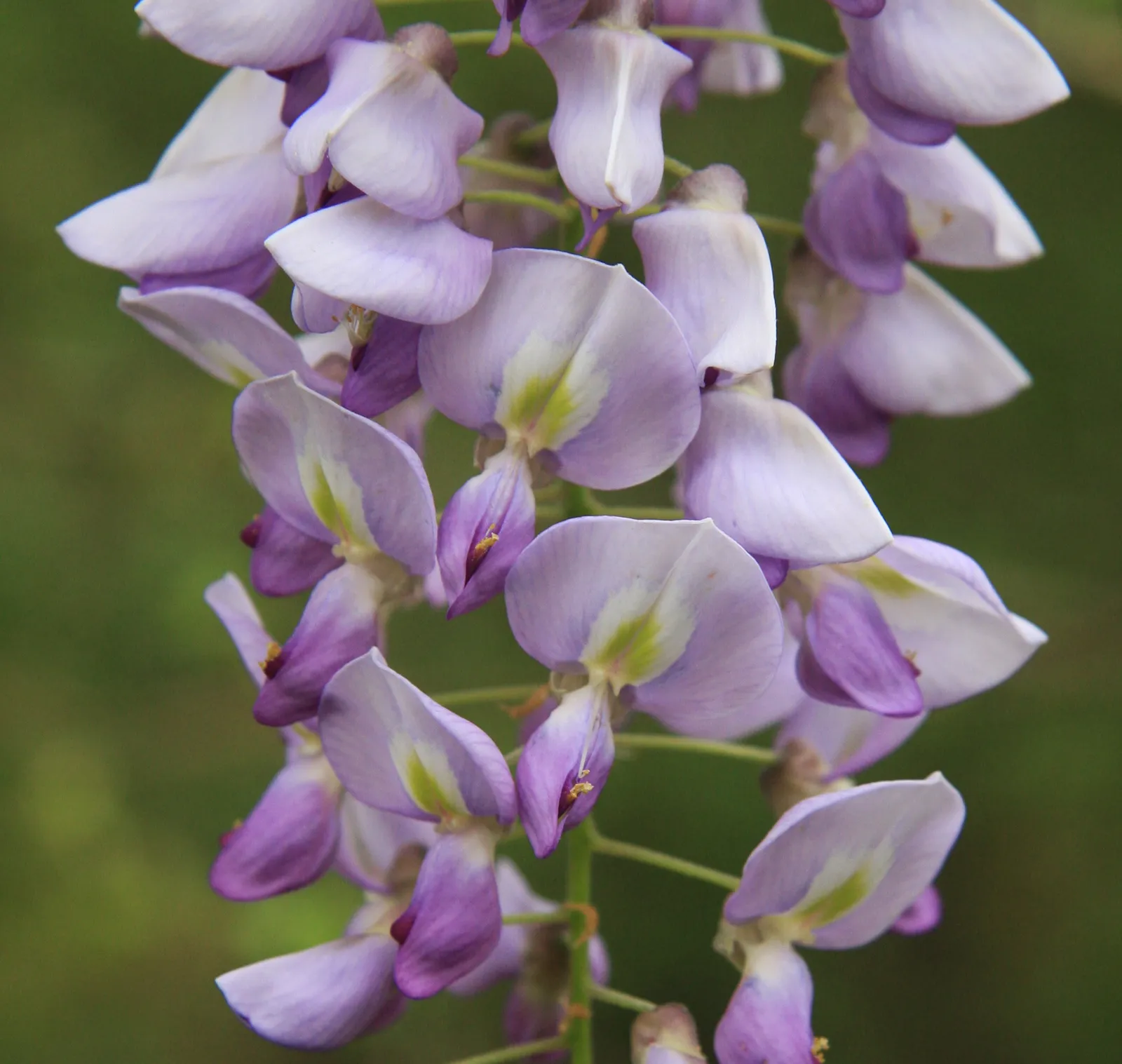
Wisteria frutescens, commonly known as American Wisteria, Texas Wisteria, or Kentucky Wisteria, is a captivating deciduous woody vine native to the southeastern United States. This member of the Fabaceae (Pea family) typically climbs to impressive heights of 15-30 feet (4.5-9 meters), though its growth is notably less aggressive and more manageable than its Asian counterparts, W. sinensis and W.
floribunda. Its foliage consists of attractive pinnately compound leaves, each bearing 9-15 oblong to ovate leaflets that emerge with a bronze hue in spring before maturing to a vibrant bright green. The most striking feature is its profusion of fragrant, pea-like flowers, presented in dense, pendulous racemes that usually span 4-6 inches (10-15 cm) long, sometimes up to 9 inches.
These beautiful lavender-blue to violet blooms typically appear in late spring to early summer, notably after the leaves have fully emerged, a key distinguishing characteristic from Asian species. Following the floral display, velvety, bean-like pods develop, persisting into the winter months and adding continued ornamental interest. Wisteria frutescens is widely distributed across many states, including Alabama, Arkansas, Florida, Georgia, Illinois, Kentucky, Louisiana, Maryland, Mississippi, Missouri, North Carolina, Ohio, Oklahoma, South Carolina, Tennessee, Texas, Virginia, and West Virginia, thriving in its native range.
Trusted Scientific References
1. Authoritative external sources for Wisteria Frutescens
1.1 Wikipedia — Wisteria Frutescens
1.2 Kew POWO (Plants of the World Online)
1.3 PubMed — peer-reviewed research
1.4 NCBI Taxonomy Browser
1.5 GBIF — Global Biodiversity
1.6Wisteria Frutescens should be interpreted through verified botanical identity, practical care, and responsible safety language. This recovery note adds the missing context needed for a complete profile: match light to the plant's habit, use well-drained soil, water according to season, and avoid unsupported medicinal or edible claims. For publishing, the plant can be presented as a source-backed garden plant with clear care guidance, common problem diagnosis, and conservative safety wording.
1.1.Wisteria Frutescens — Key Features
- ✓ <strong>Native to the</strong> — Native to the Southeastern USA.
- ✓ <strong>Deciduous woody climbing vine reaching 15</strong> — 30 feet.
- ✓ <strong>Produces fragrant, pea</strong> — like lavender-blue to violet flowers.
- ✓ <strong>Blooms in pendulous</strong> — Blooms in pendulous racemes after leaves emerge in late spring/early summer.
- ✓ <strong>Exhibits a less</strong> — Exhibits a less aggressive growth habit compared to Asian Wisteria species.
- ✓ <strong>Develops velvety, bean</strong> — like pods that are highly toxic upon ingestion.
- ✓ <strong>Features pinnately compound leaves with 9</strong> — 15 distinct leaflets.
- ✓ <strong>Primarily valued and</strong> — Primarily valued and cultivated as an ornamental landscape plant.
- ✓ <strong>Attracts various native</strong> — Attracts various native pollinators, including bees and butterflies.
- ✓ <strong>Requires full sun</strong> — Requires full sun exposure and strong structural support for optimal growth and flowering.
1.2.Wisteria Frutescens — Quick Summary
- ✓ American Wisteria is a beautiful, native deciduous woody vine.
- ✓ Primarily cultivated for its fragrant lavender-blue flowers and ornamental appeal.
- ✓ All parts are toxic, especially seeds and pods, containing lectins and glycosides.
- ✓ Not used medicinally; ingestion causes severe gastrointestinal upset.
- ✓ Requires full sun and sturdy support for optimal growth.
- ✓ A less aggressive and more manageable alternative to Asian Wisteria species.
2.Wisteria Frutescens — Scientific Identity
3.Wisteria Frutescens — Quick Facts
4.Wisteria Frutescens — Appearance & Identification
5.Wisteria Frutescens — Native Habitat
6.Wisteria Frutescens — Water Requirements
- ✓ Site Selection — Choose a location receiving at least 6 hours of direct sunlight daily for optimal flowering and robust growth of American Wisteria.
- ✓ Soil Preparation — Ensure well-drained, fertile soil, ideally with a slightly acidic to neutral pH (6.0-7.0), enriching with organic matter if the soil is poor.
- ✓ Planting Technique — Plant in spring or fall, ensuring the root ball is level with the surrounding soil, and water thoroughly after planting to settle the soil.
- ✓ Structural Support — Provide a robust trellis, pergola, arbor, or sturdy fence, as Wisteria frutescens is a vigorous climber that requires strong support for its mature weight.
- ✓ Pruning Regimen — Prune annually in late winter to early spring to shape the plant, control size, and encourage more abundant flowering, as blooms appear on new wood.
- ✓ Watering Schedule — Maintain consistent moisture, especially during dry periods and in the first few years after planting, but avoid waterlogging which can lead to root rot.
- ✓ Fertilization — Fertilize sparingly with a balanced, low-nitrogen fertilizer if soil fertility is poor; excessive nitrogen can promote lush foliage at the expense of flower production.
- ✓ Pest and Disease Management — Monitor for common vine pests like aphids or scale insects and potential fungal diseases, addressing issues promptly with appropriate organic or chemical treatments.
Reviewed by the Flora Medical Global Botanical Review Panel
Multi-disciplinary editorial group · Botany · Ethnobotany · Herbal-medicine literature
Who reviewed this: This page was checked by the Flora Medical Global Botanical Review Panel — an in-house editorial group of botany graduates, ethnobotany researchers, and horticulture practitioners who collectively maintain our 7,000+ plant encyclopedia. Meet the team.
Our 4-step verification process
1. Taxonomic verification
Scientific names and synonyms cross-checked against Kew POWO, World Flora Online, and The Plant List.
2. Phytochemical & medicinal cross-reference
Active compounds, traditional uses, and reported activities are cross-referenced with PubMed, USDA Dr. Duke's database, and peer-reviewed ethnobotanical literature.
3. Conservation & distribution check
Distribution, ecology, and conservation status confirmed against GBIF occurrence records and the IUCN Red List.
4. Editorial & safety review
Every entry passes an editorial pass for clarity, originality, and safety notices (toxicity, contraindications, dosage caveats) before publication.
Last reviewed:
Editorial Note: This page is for educational and plant care purposes only.
Written by: Flora Medical Global Editorial Team
Reviewed by: Flora Medical Global Botanical Review Panel
Last Updated: June 15, 2026







Wisteria Frutescens — Comments & Community Reviews
Rate this plant