
Care Disclaimer: Plant care recommendations are general guidelines based on common growing conditions. Individual results may vary based on your local environment, climate, and care routine. If your plant is toxic, keep it away from children and pets, and consult a veterinarian if accidental ingestion occurs.
1.Xanthosoma Garden — Overview
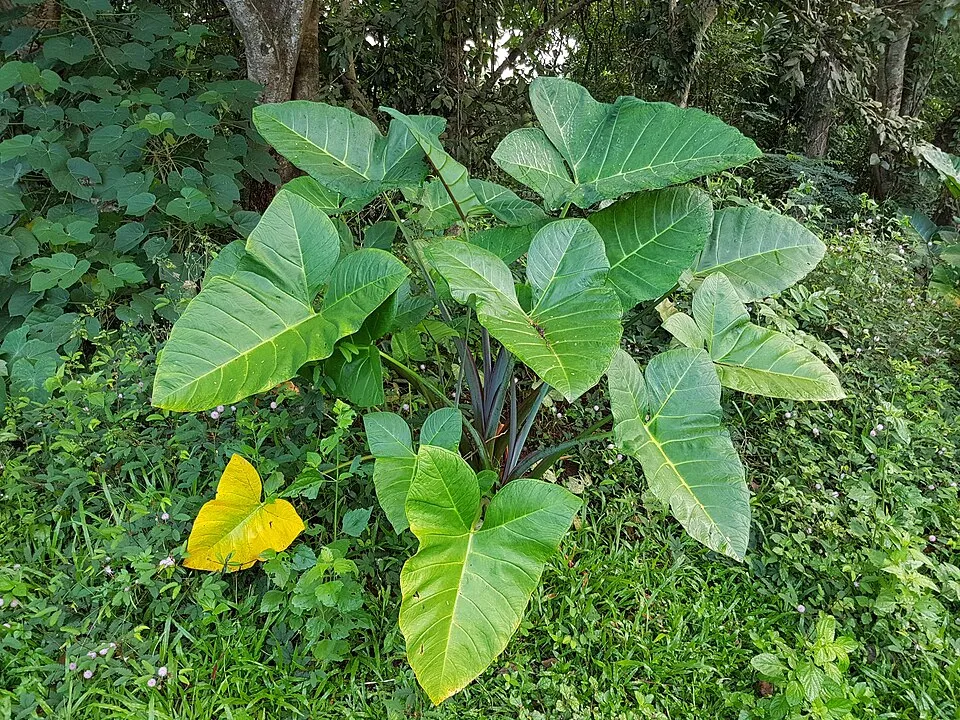
Xanthosoma sagittifolium, widely known as arrowleaf elephant ear, malanga, taro, or cocoyam, is a prominent tropical perennial belonging to the Araceae family. This robust plant typically attains impressive heights of 1.2 to 2.4 meters (4 to 8 feet), distinguished by its striking, large, and glossy green leaves. These leaves are characteristically sagittate (arrowhead-shaped) to broadly cordate, often reaching lengths of 60 to 90 cm (2 to 3 feet), and feature deeply impressed venation that significantly enhances their ornamental appeal.
The plant's thick, often subtly ribbed stem, which varies in hue from vibrant green to light brown, provides sturdy support for the extensive foliage. While primarily valued for its substantial edible corms and nutritious leaves, Xanthosoma sagittifolium also produces the characteristic inflorescence of the Araceae family—a spadix gracefully encased by a pale yellowish-white spathe, bearing a resemblance to the elegant calla lily. It is indigenous to the humid, warm ecosystems of tropical Americas, specifically regions stretching from Mexico down to Brazil, thriving in environments with consistent moisture such as rainforest understories, along riverbanks, and in marshy areas.
Its cultivation has broadened globally, establishing it as a crucial staple food crop across tropical and subtropical zones in Africa, Asia, and the Pacific Islands. Taxonomically, Xanthosoma is notably differentiated from similar aroids like Colocasia by the distinct attachment point of the petiole to the leaf blade; in Xanthosoma, the petiole typically joins at the base of the 'V' of the sagittate leaf, rather than centrally. The plant's inherent resilience and adaptability to a range of well-draining, organic-rich soil conditions make it an invaluable species for both agricultural production and ornamental landscaping endeavors.
Trusted Scientific References
1. Authoritative external sources for Xanthosoma sagittifolium
1.1 Wikipedia — Xanthosoma sagittifolium
1.2 Kew POWO (Plants of the World Online)
1.3 PubMed — peer-reviewed research
1.4 NCBI Taxonomy Browser
1.5 GBIF — Global Biodiversity
1.1.Xanthosoma Garden — Key Features
- ✓ <strong>Common Names</strong> — Arrowleaf elephant ear, malanga, taro, cocoyam.
- ✓ <strong>Scientific Name</strong> — Xanthosoma sagittifolium.
- ✓ <strong>Family</strong> — Araceae (Arum family).
- ✓ <strong>Edible Parts</strong> — Corms (tubers) and young leaves (must be cooked).
- ✓ <strong>Leaf Morphology</strong> — Large, sagittate (arrowhead-shaped) to cordate leaves with prominent venation.
- ✓ <strong>Growth Habit</strong> — Robust perennial, typically growing 1.2 to 2.4 meters (4 to 8 feet) tall.
- ✓ <strong>Native Range</strong> — Tropical Americas, from Mexico to Brazil.
- ✓ <strong>Global Cultivation</strong> — Widely cultivated as a staple food crop in tropical and subtropical regions worldwide.
- ✓ <strong>Toxicity</strong> — Contains calcium oxalate crystals, requiring thorough cooking before consumption.
- ✓ <strong>Nutritional Value</strong> — High in carbohydrates, fiber, Vitamin C, B vitamins, and essential minerals.
1.2.Xanthosoma Garden — Quick Summary
- ✓ Xanthosoma sagittifolium is a tropical perennial valued for edible corms and leaves.
- ✓ Rich in complex carbohydrates, vitamins (C, B-complex), and minerals.
- ✓ Must be thoroughly cooked to neutralize irritating calcium oxalate.
- ✓ Supports digestive health, immunity, and provides antioxidant benefits.
- ✓ Native to tropical Americas, now a global staple food crop.
- ✓ Known for its large, arrow-shaped leaves and significant nutritional profile.
2.Xanthosoma Garden — Scientific Identity
3.Xanthosoma Garden — Quick Facts
4.Xanthosoma Garden — Appearance & Identification
5.Xanthosoma Garden — Native Habitat
6.Xanthosoma Garden — Water Requirements
- ✓ Light Requirements — Prefers bright, indirect light indoors; outdoors, thrives in full sun to partial shade, avoiding harsh direct afternoon sun which can scorch foliage.
- ✓ Soil Preference — Requires well-draining, moist, humus-rich soil or potting mix; avoid dense clays and very loose, dry sands, with an ideal pH of acidic to neutral.
- ✓ Watering Schedule — Needs regular and thorough watering, keeping the soil consistently moist but not waterlogged; allow the top inch of soil to dry out slightly between waterings.
- ✓ Temperature & Humidity — Best grown in temperatures between 16-27°C (60-80°F); thrives in high humidity (60% or above), benefit from humidifiers or pebble trays indoors.
- ✓ Fertilization — Heavy feeder; fertilize every 2-3 weeks during the growing season with a weak liquid fertilizer or organic fish emulsion to promote lush foliage.
- ✓ Propagation — Primarily propagated by division of tubers, corms, or pups from mature, healthy plants in spring, ensuring each cutting has a viable growth point.
- ✓ Pruning — Minimal pruning required; simply remove old, yellowed, or unhealthy leaves to redirect plant energy to new, healthy growth.
- ✓ Repotting — Repot houseplants every few years or when root-bound, choosing a pot only one size larger in diameter with fresh, well-draining soil.
Reviewed by the Flora Medical Global Botanical Review Panel
Multi-disciplinary editorial group · Botany · Ethnobotany · Herbal-medicine literature
Who reviewed this: This page was checked by the Flora Medical Global Botanical Review Panel — an in-house editorial group of botany graduates, ethnobotany researchers, and horticulture practitioners who collectively maintain our 7,000+ plant encyclopedia. Meet the team.
Our 4-step verification process
1. Taxonomic verification
Scientific names and synonyms cross-checked against Kew POWO, World Flora Online, and The Plant List.
2. Phytochemical & medicinal cross-reference
Active compounds, traditional uses, and reported activities are cross-referenced with PubMed, USDA Dr. Duke's database, and peer-reviewed ethnobotanical literature.
3. Conservation & distribution check
Distribution, ecology, and conservation status confirmed against GBIF occurrence records and the IUCN Red List.
4. Editorial & safety review
Every entry passes an editorial pass for clarity, originality, and safety notices (toxicity, contraindications, dosage caveats) before publication.
Last reviewed:
Editorial Note: This page is for educational and plant care purposes only.
Written by: Flora Medical Global Editorial Team
Reviewed by: Flora Medical Global Botanical Review Panel
Last Updated: June 15, 2026







Xanthosoma Garden — Comments & Community Reviews
Rate this plant