

Care Disclaimer: Plant care recommendations are general guidelines based on common growing conditions. Individual results may vary based on your local environment, climate, and care routine. If your plant is toxic, keep it away from children and pets, and consult a veterinarian if accidental ingestion occurs.
1.Yew — Overview
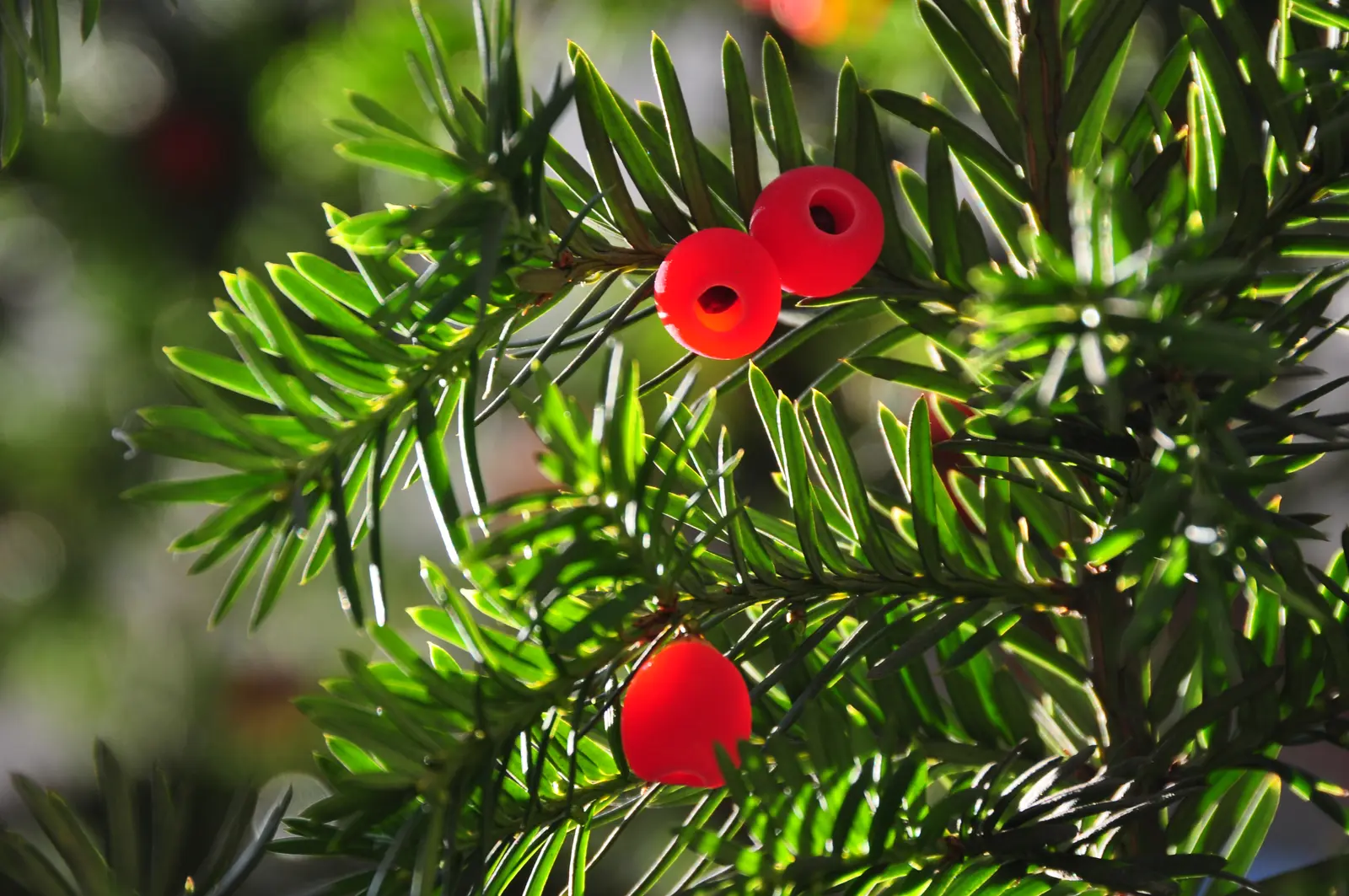
Taxus baccata, commonly known as the Common Yew or European Yew, is a distinguished coniferous tree belonging to the ancient Taxaceae family. This evergreen species is indigenous to a broad range spanning western, central, and southern Europe, extending into northwest Africa and southwest Asia. Renowned for its exceptional longevity, the yew is a remarkably slow-growing tree, frequently attaining ages between 400 and 600 years, with some venerable specimens documented to live for over a millennium.
Typically reaching heights of 10-20 meters, with rare individuals soaring up to 28 meters, its distinctive reddish-brown bark exfoliates in narrow, papery strips. The foliage consists of dark green, linear, flattened needles, usually 1-4 cm long and 2-3 mm wide, characterized by a prominent midrib. These needles are spirally arranged but often appear to be in two ranks along the shoots.
Taxus baccata is a dioecious species, meaning individual plants are either male, producing small yellowish pollen cones, or female, bearing a single ovule that matures into a striking, fleshy, bright red aril. This aril uniquely encases the toxic seed and is the only non-poisonous part of the plant. European Yews thrive in shady, moist woodland environments, preferring alkaline or neutral soils, yet demonstrating considerable adaptability to diverse growing conditions, often found in ancient churchyards.
Trusted Scientific References
1. Authoritative external sources for Taxus baccata
1.1 Wikipedia — Taxus baccata
1.2 Kew POWO (Plants of the World Online)
1.3 PubMed — peer-reviewed research
1.4 NCBI Taxonomy Browser
1.5 GBIF — Global Biodiversity
1.6Yew should be interpreted through verified botanical identity, practical care, and responsible safety language. This recovery note adds the missing context needed for a complete profile: match light to the plant's habit, use well-drained soil, water according to season, and avoid unsupported medicinal or edible claims. For publishing, the plant can be presented as a source-backed garden plant with clear care guidance, common problem diagnosis, and conservative safety wording.
1.1.Yew — Key Features
- ✓ <strong>Ancient, Long</strong> — Lived Conifer — Can live for over a thousand years, making it one of Europe's oldest trees.
- ✓ <strong>Highly Toxic</strong> — Contains potent taxane alkaloids that are lethal upon ingestion.
- ✓ <strong>Source of Paclitaxel (Taxol)</strong> — Crucial for modern chemotherapy treatments against various cancers.
- ✓ <strong>Dioecious</strong> — Individual trees are either male or female, producing pollen cones or seed-bearing arils.
- ✓ <strong>Distinctive Red Aril</strong> — The fleshy, bright red structure surrounding the seed is the only non-toxic part.
- ✓ <strong>Dense, Dark Green Foliage</strong> — Features linear, flattened needles arranged spirally on shoots.
- ✓ <strong>Shade Tolerant & Cold Hardy</strong> — Adaptable to various light conditions and resilient in cold climates.
- ✓ <strong>Native to Europe, NW Africa, SW Asia</strong> — Widely distributed across temperate regions.
- ✓ <strong>Ornamental Value</strong> — Popular for hedging, topiary, and landscaping due to its evergreen nature and ability to withstand heavy pruning.
1.2.Yew — Quick Summary
- ✓ Taxus baccata is an ancient, slow-growing, highly toxic coniferous tree.
- ✓ It is the natural source of potent anti-cancer drugs, particularly paclitaxel (Taxol).
- ✓ All parts of the plant, except the fleshy red aril (without the seed), are deadly poisonous.
- ✓ Causes rapid cardiac failure and neurological symptoms upon ingestion.
- ✓ Not safe for direct medicinal use; its value is in pharmaceutical extraction.
- ✓ Known for its extreme longevity and adaptability in temperate climates.
2.Yew — Scientific Identity
3.Yew — Quick Facts
4.Yew — Appearance & Identification
5.Yew — Native Habitat
6.Yew — Water Requirements
- ✓ Propagation — Primarily propagated through semi-hardwood cuttings taken in late summer or autumn; seeds require a complex warm-then-cold stratification for germination.
- ✓ Soil Requirements — Prefers well-drained, fertile soils with a neutral to alkaline pH (5.3-7.8), but can tolerate a range of soil types, including clay and sandy loams.
- ✓ Light Conditions — Thrives in partial to full shade, making it an excellent understory plant or hedge, though it can tolerate full sun if kept adequately moist.
- ✓ Water Needs — Requires consistent moisture, especially when young; mature plants are reasonably drought-tolerant once established but benefit from regular watering in dry periods.
- ✓ Hardiness Zones — Highly cold-hardy, suitable for USDA zones 4 through 7, tolerant of temperatures down to -30°F (-34°C).
- ✓ Pruning — Tolerates heavy pruning and shearing, making it ideal for hedging and topiary; best pruned in late winter or early spring.
- ✓ Pest and Disease Management — Generally robust, but can be susceptible to root rot in poorly drained soils, and occasional issues with mealybugs, scale, or winter burn in exposed sites.
- ✓ Trimming Disposal — All trimmings must be disposed of carefully and securely in landfills, away from livestock and pets, due to their extreme toxicity.
Reviewed by the Flora Medical Global Botanical Review Panel
Multi-disciplinary editorial group · Botany · Ethnobotany · Herbal-medicine literature
Who reviewed this: This page was checked by the Flora Medical Global Botanical Review Panel — an in-house editorial group of botany graduates, ethnobotany researchers, and horticulture practitioners who collectively maintain our 7,000+ plant encyclopedia. Meet the team.
Our 4-step verification process
1. Taxonomic verification
Scientific names and synonyms cross-checked against Kew POWO, World Flora Online, and The Plant List.
2. Phytochemical & medicinal cross-reference
Active compounds, traditional uses, and reported activities are cross-referenced with PubMed, USDA Dr. Duke's database, and peer-reviewed ethnobotanical literature.
3. Conservation & distribution check
Distribution, ecology, and conservation status confirmed against GBIF occurrence records and the IUCN Red List.
4. Editorial & safety review
Every entry passes an editorial pass for clarity, originality, and safety notices (toxicity, contraindications, dosage caveats) before publication.
Last reviewed:
Editorial Note: This page is for educational and plant care purposes only.
Written by: Flora Medical Global Editorial Team
Reviewed by: Flora Medical Global Botanical Review Panel
Last Updated: June 15, 2026







Yew — Comments & Community Reviews
Rate this plant