
Care Disclaimer: Plant care recommendations are general guidelines based on common growing conditions. Individual results may vary based on your local environment, climate, and care routine. If your plant is toxic, keep it away from children and pets, and consult a veterinarian if accidental ingestion occurs.
1.Yucca Garden — Overview
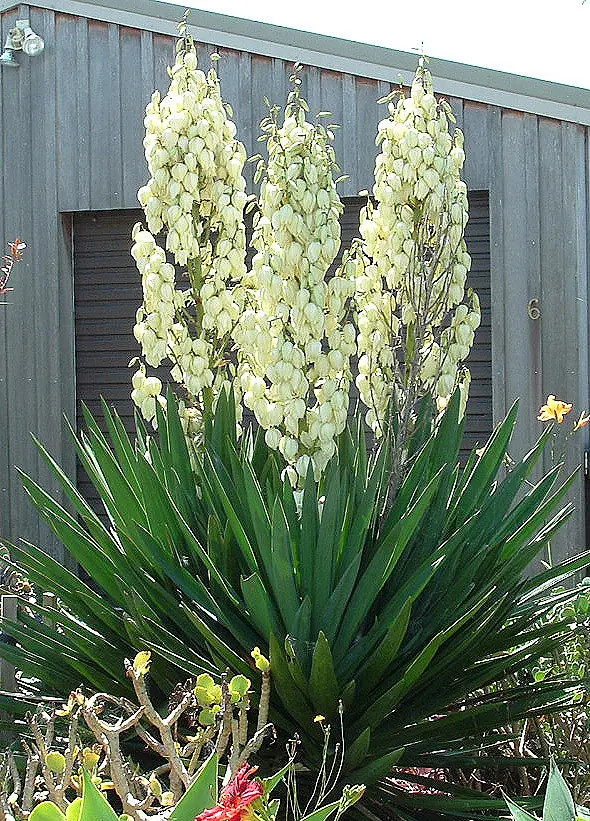
Yucca filamentosa, commonly known as Adam's needle or thread-and-needle yucca, is a captivating evergreen perennial native to the southeastern United States, thriving across USDA hardiness zones 4 through 11. This resilient member of the Asparagaceae family is characterized by its dramatic, sword-shaped leaves, which form a dense, symmetrical rosette often spanning up to 6 feet in diameter. The foliage is typically a deep, vibrant green, tough and leathery, sometimes featuring variegated patterns with creamy white or yellow margins.
A defining morphological characteristic, giving rise to its common name, are the numerous thin, white, fibrous threads that elegantly curl from the leaf margins, resembling delicate filaments. In late spring to early summer, a towering, impressive flower stalk, which can reach up to 10 feet, emerges from the rosette's center. This stalk bears a magnificent panicle of numerous pendulous, bell-shaped flowers, typically creamy white to pale yellow, often with a subtle purplish blush on their exterior, each possessing six tepals.
These blossoms attract nocturnal pollinators, particularly the Yucca moth, which facilitates its unique pollination cycle. Yucca filamentosa is exceptionally drought-tolerant and hardy, flourishing in xeriscapes and low-maintenance gardens due to its adaptability to harsh, arid conditions and poor soils. Its robust root system anchors it firmly and contributes to its resilience.
Trusted Scientific References
1. Authoritative external sources for Yucca filamentosa
1.1 Wikipedia — Yucca filamentosa
1.2 Kew POWO (Plants of the World Online)
1.3 PubMed — peer-reviewed research
1.4 NCBI Taxonomy Browser
1.5 GBIF — Global Biodiversity
1.6Yucca Garden should be interpreted through verified botanical identity, practical care, and responsible safety language. This recovery note adds the missing context needed for a complete profile: match light to the plant's habit, use well-drained soil, water according to season, and avoid unsupported medicinal or edible claims. For publishing, the plant can be presented as a source-backed garden plant with clear care guidance, common problem diagnosis, and conservative safety wording.
1.1.Yucca Garden — Key Features
- ✓ <strong>Drought</strong> — Tolerant — Thrives in arid conditions with minimal watering once established.
- ✓ <strong>Evergreen Foliage</strong> — Provides year-round interest with its striking, sword-shaped leaves.
- ✓ <strong>Architectural Form</strong> — Adds a dramatic, sculptural element to garden landscapes and xeriscapes.
- ✓ <strong>Saponin</strong> — Rich — Contains high levels of steroidal saponins, key to its medicinal actions.
- ✓ <strong>Traditional Medicinal Plant</strong> — Valued in Native American ethnobotanical practices for centuries.
- ✓ <strong>Low Maintenance</strong> — Requires minimal care, pruning, or protection from pests and diseases.
- ✓ <strong>Deer Resistant</strong> — Its tough, fibrous leaves deter deer and other browsing animals.
- ✓ <strong>Unique Leaf Filaments</strong> — Distinctive white threads curl from leaf margins, giving it a unique aesthetic.
- ✓ <strong>Showy Flowers</strong> — Produces tall stalks of creamy white, bell-shaped flowers in summer.
- ✓ <strong>Air Purification Potential</strong> — Known to absorb certain indoor air toxins, making it a good indoor plant choice.
1.2.Yucca Garden — Quick Summary
- ✓ Yucca filamentosa is a resilient, evergreen perennial renowned for its sword-shaped leaves and showy white flowers.
- ✓ Traditionally used by Native Americans for anti-inflammatory, digestive, and skin-healing purposes.
- ✓ Rich in steroidal saponins, which are the primary compounds responsible for its medicinal properties.
- ✓ Modern research explores its potential for cholesterol reduction and joint health benefits.
- ✓ Requires full sun and well-drained soil, making it an excellent drought-tolerant landscape plant.
- ✓ Generally considered safe for short-term use, but caution is advised for specific health conditions and medication interactions.
2.Yucca Garden — Scientific Identity
3.Yucca Garden — Quick Facts
4.Yucca Garden — Appearance & Identification
5.Yucca Garden — Native Habitat
6.Yucca Garden — Water Requirements
- ✓ Sunlight Exposure — Yucca filamentosa thrives in full sun, requiring at least 6 hours of direct sunlight daily for optimal growth and flowering.
- ✓ Soil Requirements — It prefers well-drained soil and tolerates a wide range of soil types, including sandy, loamy, or chalky soils, with a pH from acidic to alkaline.
- ✓ Watering Regime — This plant is highly drought-tolerant once established; water sparingly, allowing the soil to dry out completely between waterings to prevent root rot.
- ✓ Propagation — Easily propagated by offsets (pups) that form around the base of the parent plant, or by seeds, though germination can be slow.
- ✓ Pruning — Remove spent flower stalks by cutting them back to the base after flowering to maintain a tidy appearance and encourage new growth.
- ✓ Pest and Disease Resistance — Generally robust and low-maintenance, Yucca filamentosa is rarely bothered by serious pests or diseases, and it is deer-resistant.
- ✓ Hardiness and Climate — Hardy in USDA Zones 4-11, it can withstand cold temperatures and is an excellent choice for xeriscaping and dry climates.
- ✓ Container Growing — Can be successfully grown in large containers with adequate drainage, making it suitable for patios and urban gardens.
Reviewed by the Flora Medical Global Botanical Review Panel
Multi-disciplinary editorial group · Botany · Ethnobotany · Herbal-medicine literature
Who reviewed this: This page was checked by the Flora Medical Global Botanical Review Panel — an in-house editorial group of botany graduates, ethnobotany researchers, and horticulture practitioners who collectively maintain our 7,000+ plant encyclopedia. Meet the team.
Our 4-step verification process
1. Taxonomic verification
Scientific names and synonyms cross-checked against Kew POWO, World Flora Online, and The Plant List.
2. Phytochemical & medicinal cross-reference
Active compounds, traditional uses, and reported activities are cross-referenced with PubMed, USDA Dr. Duke's database, and peer-reviewed ethnobotanical literature.
3. Conservation & distribution check
Distribution, ecology, and conservation status confirmed against GBIF occurrence records and the IUCN Red List.
4. Editorial & safety review
Every entry passes an editorial pass for clarity, originality, and safety notices (toxicity, contraindications, dosage caveats) before publication.
Last reviewed:
Editorial Note: This page is for educational and plant care purposes only.
Written by: Flora Medical Global Editorial Team
Reviewed by: Flora Medical Global Botanical Review Panel
Last Updated: June 15, 2026







Yucca Garden — Comments & Community Reviews
Rate this plant