
Care Disclaimer: Plant care recommendations are general guidelines based on common growing conditions. Individual results may vary based on your local environment, climate, and care routine. If your plant is toxic, keep it away from children and pets, and consult a veterinarian if accidental ingestion occurs.
1.Yucca Filamentosa — Overview
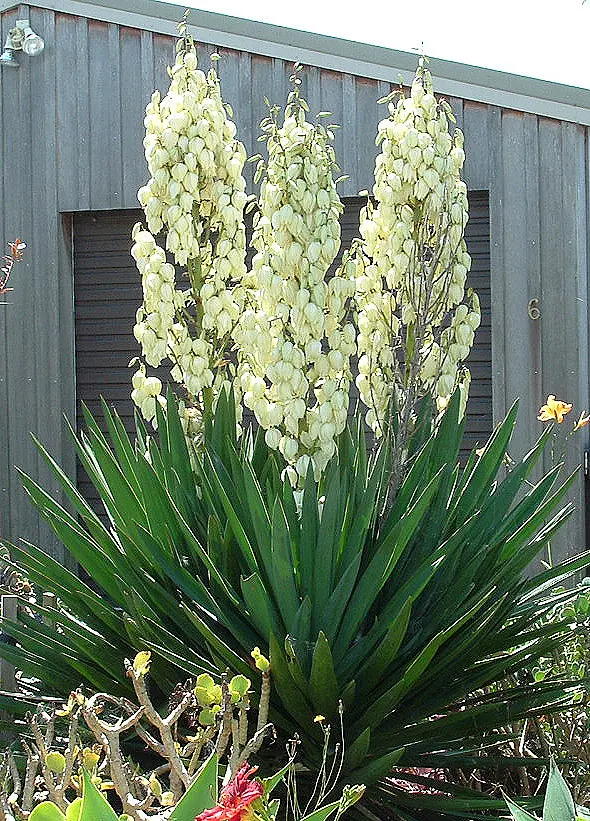
Yucca filamentosa, commonly known as Adam's Needle, is an exceptionally striking evergreen perennial native to the arid and semi-arid regions of the southeastern United States, particularly from Maryland south to Florida and west to Mississippi. This resilient member of the Asparagaceae family (subfamily Agavoideae) forms a robust basal rosette of stiff, sword-shaped leaves, typically measuring between 1.5 to 6 feet in length and 1 to 3 inches in width.
A distinctive feature of Yucca filamentosa is the fibrous margin of its leaves, which produces numerous long, curling, thread-like filaments, giving the plant its evocative common name. These unique threads contribute to its characteristic texture and visual appeal.
In mid-summer, Adam's Needle commands attention by sending forth a magnificent, dramatic flower stalk, or inflorescence, that can soar to impressive heights of 4 to 10 feet. This towering stalk is adorned with a dense cluster of pendulous, bell-shaped flowers, each approximately 2 to 3 inches across. The flowers are typically creamy white to a pale yellow, often exhibiting subtle tinges of green or purple, and emit a delicate fragrance that attracts nocturnal pollinators, most notably the Yucca moth.
Renowned for its exceptional drought tolerance and heat resistance, Yucca filamentosa is a highly favored choice for xeriscaping, rock gardens, and other low-water landscapes. It is a slow-growing but remarkably long-lived plant, cherished for its architectural silhouette and spectacular, ephemeral floral display.
Trusted Scientific References
1. Authoritative external sources for Yucca Filamentosa
1.1 Wikipedia — Yucca Filamentosa
1.2 Kew POWO (Plants of the World Online)
1.3 PubMed — peer-reviewed research
1.4 NCBI Taxonomy Browser
1.5 GBIF — Global Biodiversity
1.6Yucca Filamentosa should be interpreted through verified botanical identity, practical care, and responsible safety language. This recovery note adds the missing context needed for a complete profile: match light to the plant's habit, use well-drained soil, water according to season, and avoid unsupported medicinal or edible claims. For publishing, the plant can be presented as a source-backed garden plant with clear care guidance, common problem diagnosis, and conservative safety wording.
1.1.Yucca Filamentosa — Key Features
- ✓ <strong>Evergreen Foliage</strong> — Maintains its rigid, sword-shaped leaves year-round, providing continuous landscape interest.
- ✓ <strong>Drought Tolerant</strong> — Highly resilient to dry conditions, making it an excellent choice for water-wise gardening and xeriscapes.
- ✓ <strong>Deer Resistant</strong> — Generally unpalatable to deer and other common garden pests, reducing browse damage.
- ✓ <strong>Attracts Pollinators</strong> — Its fragrant, creamy-white flowers attract nocturnal pollinators, most notably the specialized Yucca moth.
- ✓ <strong>Low Maintenance</strong> — Requires minimal care once established, thriving in challenging soil and environmental conditions.
- ✓ <strong>Architectural Form</strong> — Offers a strong, sculptural presence with its dramatic basal rosette and towering flower stalk.
- ✓ <strong>Salt Tolerant</strong> — Capable of withstanding coastal conditions and exposure to road salt, expanding its planting versatility.
- ✓ <strong>Fibrous Leaves</strong> — Distinctive leaf margins produce unique, thread-like filaments, contributing to its common name and texture.
- ✓ <strong>Medicinal Potential</strong> — Contains bioactive compounds like saponins and flavonoids, explored for anti-inflammatory and antioxidant benefits.
1.2.Yucca Filamentosa — Quick Summary
- ✓ Yucca filamentosa, or Adam's Needle, is a striking evergreen perennial native to the southeastern US.
- ✓ Traditionally utilized by Native American tribes for digestive issues and topical skin remedies.
- ✓ Rich in steroidal saponins (yamogenin, diosgenin), flavonoids, and phenolic compounds.
- ✓ Exhibits potential anti-inflammatory, antioxidant, and purgative properties.
- ✓ Exceptionally drought-tolerant, low-maintenance, and provides significant architectural interest in landscapes.
- ✓ Requires careful consideration and professional guidance for any internal medicinal applications.
2.Yucca Filamentosa — Scientific Identity
3.Yucca Filamentosa — Quick Facts
4.Yucca Filamentosa — Appearance & Identification
5.Yucca Filamentosa — Native Habitat
6.Yucca Filamentosa — Water Requirements
- ✓ Sun Exposure — Requires full sun to partial sun exposure for optimal growth, ideally receiving at least 6 hours of direct sunlight daily.
- ✓ Soil Requirements — Thrives in well-drained, sandy, or normal soil conditions; excellent drainage is paramount as it is highly susceptible to root rot in waterlogged soil.
- ✓ Watering Regimen — Exceptionally drought-tolerant once established, necessitating minimal supplemental watering; water deeply but infrequently, especially during prolonged dry spells.
- ✓ Hardiness Zones — Adaptable and hardy across USDA Hardiness Zones 4-10, capable of tolerating a wide range of temperatures from cold winters to intense summer heat.
- ✓ Maintenance & Pruning — Low-maintenance; remove spent flower stalks close to the base after blooming and trim any old, winter-damaged leaves in early spring to encourage new, healthy growth.
- ✓ Planting Location — Ideal for rock gardens, xeriscapes, foundation plantings, and arid landscapes due to its striking architectural form and resilience.
- ✓ Fertilization — Generally requires little to no fertilization in average soils; a light application of a balanced, slow-release granular fertilizer in spring can benefit plants in poor or depleted soils.
Reviewed by the Flora Medical Global Botanical Review Panel
Multi-disciplinary editorial group · Botany · Ethnobotany · Herbal-medicine literature
Who reviewed this: This page was checked by the Flora Medical Global Botanical Review Panel — an in-house editorial group of botany graduates, ethnobotany researchers, and horticulture practitioners who collectively maintain our 7,000+ plant encyclopedia. Meet the team.
Our 4-step verification process
1. Taxonomic verification
Scientific names and synonyms cross-checked against Kew POWO, World Flora Online, and The Plant List.
2. Phytochemical & medicinal cross-reference
Active compounds, traditional uses, and reported activities are cross-referenced with PubMed, USDA Dr. Duke's database, and peer-reviewed ethnobotanical literature.
3. Conservation & distribution check
Distribution, ecology, and conservation status confirmed against GBIF occurrence records and the IUCN Red List.
4. Editorial & safety review
Every entry passes an editorial pass for clarity, originality, and safety notices (toxicity, contraindications, dosage caveats) before publication.
Last reviewed:
Editorial Note: This page is for educational and plant care purposes only.
Written by: Flora Medical Global Editorial Team
Reviewed by: Flora Medical Global Botanical Review Panel
Last Updated: June 15, 2026







Yucca Filamentosa — Comments & Community Reviews
Rate this plant