

Care Disclaimer: Plant care recommendations are general guidelines based on common growing conditions. Individual results may vary based on your local environment, climate, and care routine. If your plant is toxic, keep it away from children and pets, and consult a veterinarian if accidental ingestion occurs.
1.Yucca Rostrata — Overview
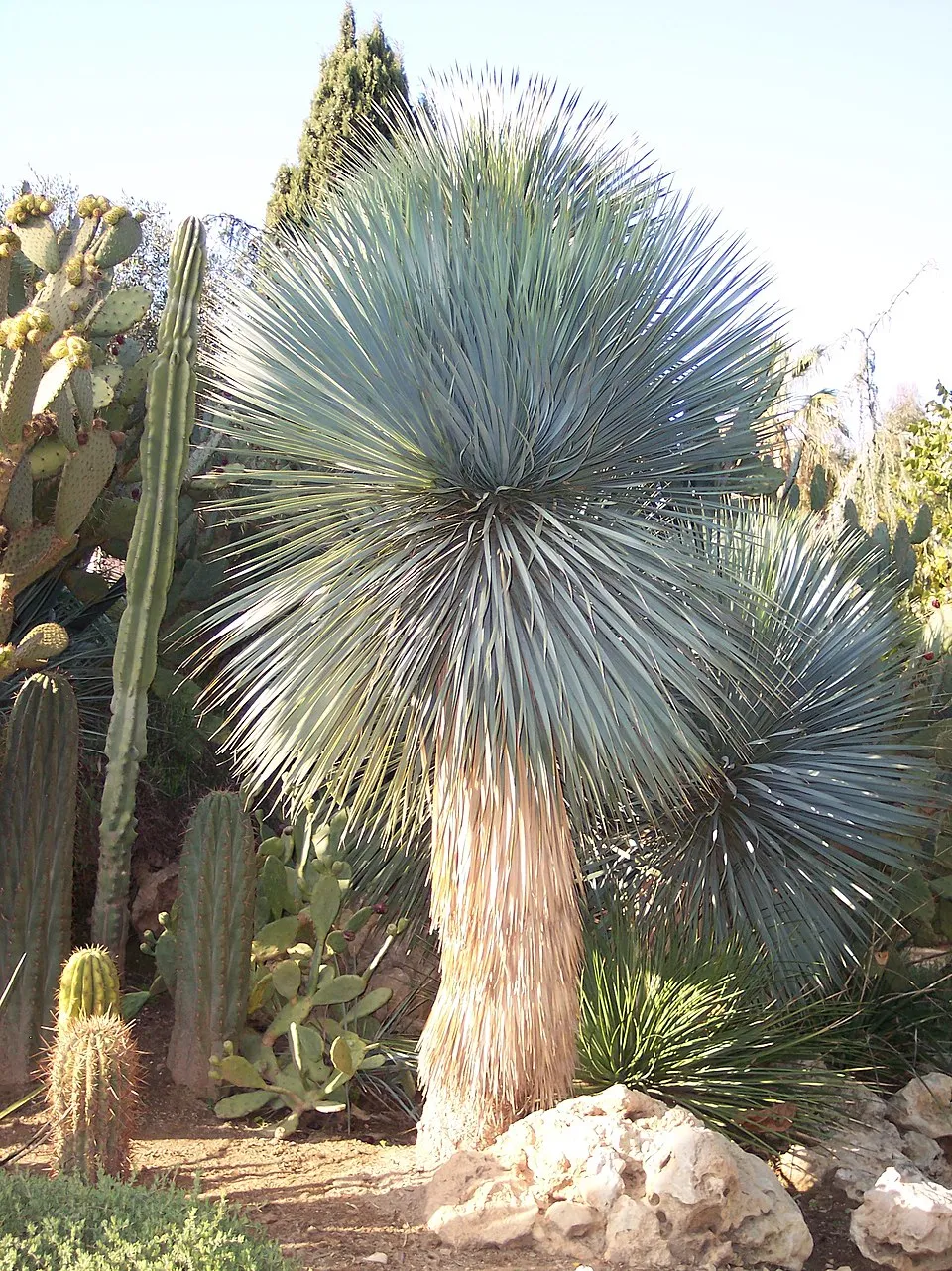
Yucca rostrata, widely known as the Beaked Yucca or Big Bend Yucca, is an iconic, slow-growing, tree-like evergreen succulent belonging to the Asparagaceae family. Native to the arid and semi-arid regions of Western Texas and Northern Mexico, particularly thriving in the Chihuahuan Desert at elevations between 3,000 and 5,000 feet, this striking plant is perfectly adapted to harsh desert environments. Its morphology is characterized by a sturdy, often single, woody trunk that can reach up to 15 feet in height, crowned by a magnificent, symmetrical, globe-shaped rosette of narrow, sword-like, silvery-blue leaves.
These rigid leaves, typically 1 to 3 feet long, radiate outwards, creating a dramatic, pom-pom-like appearance. The trunk itself is often covered with a protective layer of persistent, pale gray, dried old leaves, giving it a unique textured look. In late spring to mid-summer, mature plants produce an impressive, tall flower stalk, sometimes reaching 6 to 12 feet above the foliage, adorned with numerous creamy white to pale yellow, bell-shaped blossoms.
These flowers are pollinated by specific yucca moths, highlighting a fascinating co-evolutionary relationship. Yucca rostrata’s exceptional drought tolerance and ability to withstand significant temperature fluctuations, including sub-freezing conditions, make it a highly valued ornamental plant for xeriscaping and sustainable landscaping in USDA Hardiness Zones 5-12.
Trusted Scientific References
1. Authoritative external sources for Yucca Rostrata
1.1 Wikipedia — Yucca Rostrata
1.2 Kew POWO (Plants of the World Online)
1.3 PubMed — peer-reviewed research
1.4 NCBI Taxonomy Browser
1.5 GBIF — Global Biodiversity
1.6Yucca Rostrata should be interpreted through verified botanical identity, practical care, and responsible safety language. This recovery note adds the missing context needed for a complete profile: match light to the plant's habit, use well-drained soil, water according to season, and avoid unsupported medicinal or edible claims. For publishing, the plant can be presented as a source-backed garden plant with clear care guidance, common problem diagnosis, and conservative safety wording.
1.1.Yucca Rostrata — Key Features
- ✓ <strong>Tree</strong> — like evergreen succulent with a woody trunk.
- ✓ <strong>Distinctive symmetrical, globe</strong> — shaped rosette of leaves.
- ✓ <strong>Silvery</strong> — blue, sword-like leaves, 1-3 feet long.
- ✓ <strong>Tall flower stalk</strong> — Tall flower stalk with creamy white to pale yellow blossoms.
- ✓ <strong>Exceptional drought tolerance</strong> — Exceptional drought tolerance and cold hardiness (USDA Zones 5-12).
- ✓ <strong>Native to arid</strong> — Native to arid regions of Western Texas and Northern Mexico.
- ✓ <strong>Valued for xeriscaping</strong> — Valued for xeriscaping and ornamental garden design.
- ✓ <strong>Contains beneficial steroidal</strong> — Contains beneficial steroidal saponins and phenolic compounds.
- ✓ <strong>Slow</strong> — growing, long-lived plant.
- ✓ <strong>Attracts yucca moths</strong> — Attracts yucca moths for pollination.
1.2.Yucca Rostrata — Quick Summary
- ✓ Drought-tolerant succulent native to Texas and Mexico.
- ✓ Known for its striking, globe-shaped crown of silvery-blue leaves.
- ✓ Contains saponins, flavonoids, and phenolics with anti-inflammatory and antioxidant potential.
- ✓ Traditionally used for joint pain, cholesterol, and antiseptic purposes.
- ✓ Requires full sun and well-draining soil for optimal growth.
- ✓ Generally low maintenance but needs careful handling due to sharp leaves.
2.Yucca Rostrata — Scientific Identity
3.Yucca Rostrata — Quick Facts
4.Yucca Rostrata — Appearance & Identification
5.Yucca Rostrata — Native Habitat
6.Yucca Rostrata — Water Requirements
- ✓ Light — Requires full sun, at least 6 hours of direct sunlight daily, to maintain robust growth and vibrant foliage.
- ✓ Soil — Thrives in dry, well-draining soil; prefers sandy or gravelly textures with a neutral to alkaline pH, tolerating slightly acidic conditions.
- ✓ Watering — Water regularly (once a week) during active growth in summer/spring, allowing soil to dry completely; reduce to once a month or less in fall/winter.
- ✓ Temperature — Winter hardy in USDA Zones 5-12, tolerates heat and short periods below -10°F (-23°C) but needs protection in prolonged sub-freezing conditions.
- ✓ Fertilizer — Generally not required; if desired, apply a balanced, time-released fertilizer in spring, then water well.
- ✓ Propagation — Can be propagated from stem cuttings (allow to dry for 4-5 days before planting) or seeds, though seedlings are slow to germinate.
- ✓ Maintenance — Low maintenance; prune dead or brown lower leaves by pulling them downwards with gloved hands; repotting is infrequent due to slow growth.
- ✓ Pests & Diseases — Generally resistant, but can be susceptible to agave bugs, aphids, mealybugs, scale, and mites, especially in stressed conditions.
Reviewed by the Flora Medical Global Botanical Review Panel
Multi-disciplinary editorial group · Botany · Ethnobotany · Herbal-medicine literature
Who reviewed this: This page was checked by the Flora Medical Global Botanical Review Panel — an in-house editorial group of botany graduates, ethnobotany researchers, and horticulture practitioners who collectively maintain our 7,000+ plant encyclopedia. Meet the team.
Our 4-step verification process
1. Taxonomic verification
Scientific names and synonyms cross-checked against Kew POWO, World Flora Online, and The Plant List.
2. Phytochemical & medicinal cross-reference
Active compounds, traditional uses, and reported activities are cross-referenced with PubMed, USDA Dr. Duke's database, and peer-reviewed ethnobotanical literature.
3. Conservation & distribution check
Distribution, ecology, and conservation status confirmed against GBIF occurrence records and the IUCN Red List.
4. Editorial & safety review
Every entry passes an editorial pass for clarity, originality, and safety notices (toxicity, contraindications, dosage caveats) before publication.
Last reviewed:
Editorial Note: This page is for educational and plant care purposes only.
Written by: Flora Medical Global Editorial Team
Reviewed by: Flora Medical Global Botanical Review Panel
Last Updated: June 15, 2026







Yucca Rostrata — Comments & Community Reviews
Rate this plant