
Care Disclaimer: Plant care recommendations are general guidelines based on common growing conditions. Individual results may vary based on your local environment, climate, and care routine. If your plant is toxic, keep it away from children and pets, and consult a veterinarian if accidental ingestion occurs.
1.Zantedeschia Rehmannii — Overview
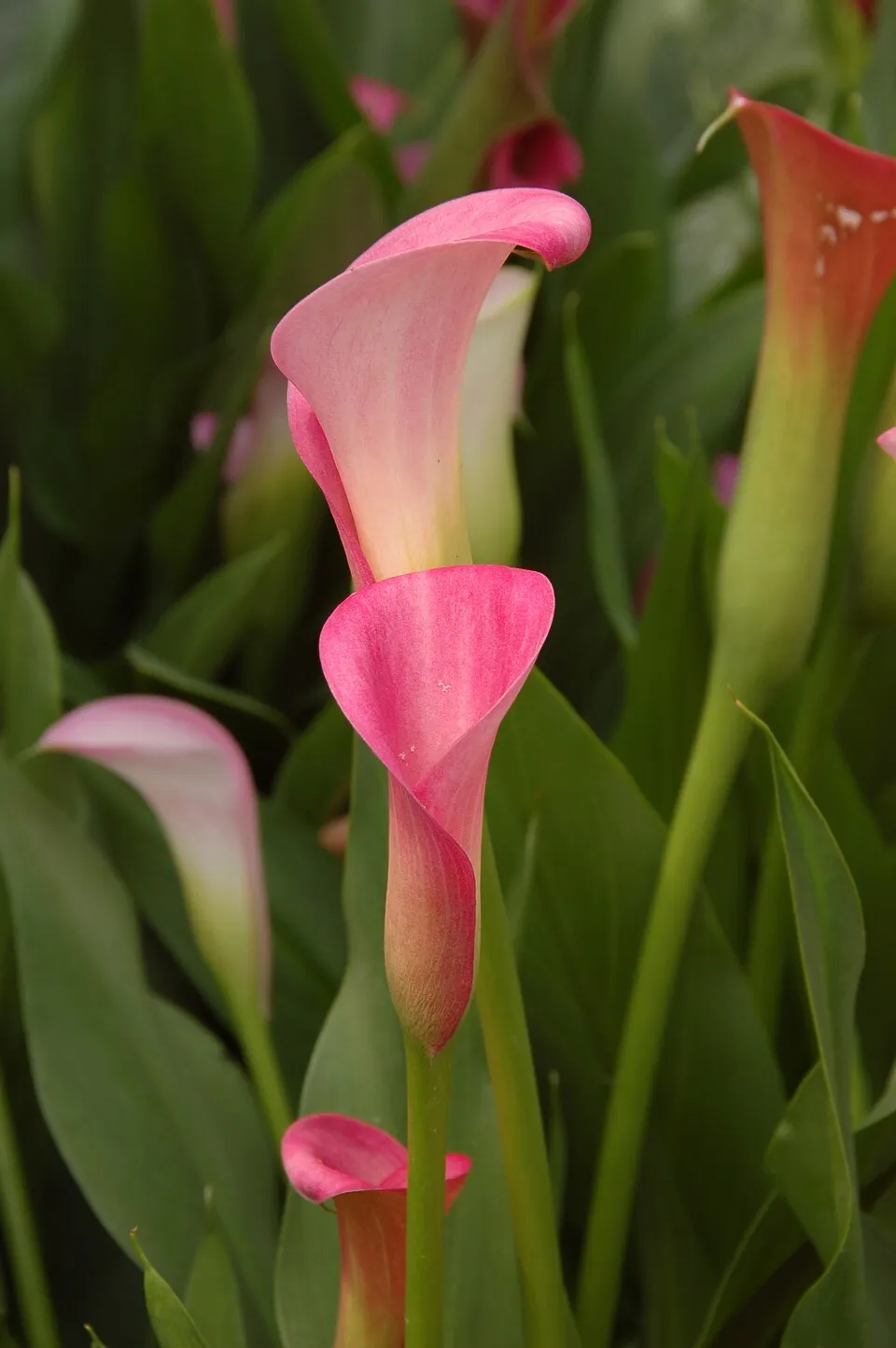
Zantedeschia rehmannii, commonly known as the Pink Arum Lily or Red Calla Lily, is an exquisite perennial herbaceous plant belonging to the Araceae family. Native to the summer rainfall regions of South Africa, it is botanically characterized by its unique morphology. The plant produces elegant, trumpet-shaped spathes—modified leaves that encircle the true, inconspicuous flowers on a central spadix. These spathes typically display a captivating palette of pink, rose, red, and occasionally purple or white, often accentuated by a darker throat.
Its foliage consists of lance-shaped to ovate leaves, which can sometimes be speckled with distinctive white spots, emerging directly from robust rhizomatous tubers. Compared to its larger relative, Zantedeschia aethiopica, Z. rehmannii is notably more compact and smaller, making it an ideal candidate for container cultivation, garden borders, and as a prized cut flower. This species thrives in well-drained, fertile soil and requires consistently warm, moist conditions during its active growth period, followed by a crucial drier dormancy phase.
Its striking colors and refined form have solidified its status as a highly sought-after ornamental plant globally. However, it is imperative to acknowledge its inherent toxicity, a characteristic prevalent among many species within the Araceae family, primarily due to the presence of calcium oxalate crystals.
Trusted Scientific References
1. Authoritative external sources for Zantedeschia rehmannii
1.1 Wikipedia — Zantedeschia rehmannii
1.2 Kew POWO (Plants of the World Online)
1.3 PubMed — peer-reviewed research
1.4 NCBI Taxonomy Browser
1.5 GBIF — Global Biodiversity
1.6Zantedeschia Rehmannii should be interpreted through verified botanical identity, practical care, and responsible safety language. This recovery note adds the missing context needed for a complete profile: match light to the plant's habit, use well-drained soil, water according to season, and avoid unsupported medicinal or edible claims. For publishing, the plant can be presented as a source-backed garden plant with clear care guidance, common problem diagnosis, and conservative safety wording.
1.1.Zantedeschia Rehmannii — Key Features
- ✓ <strong>Botanical Name</strong> — Zantedeschia rehmannii
- ✓ <strong>Common Names</strong> — Pink Arum Lily, Red Calla Lily
- ✓ <strong>Family</strong> — Araceae (Arum Family)
- ✓ <strong>Origin</strong> — South Africa (summer rainfall regions)
- ✓ <strong>Spathe Colors</strong> — Shades of pink, rose, red, purple, white
- ✓ <strong>Leaf Morphology</strong> — Lance-shaped to ovate, often with white speckles
- ✓ <strong>Growth Habit</strong> — Perennial herbaceous, compact, growing from rhizomes
- ✓ <strong>Toxicity</strong> — Contains calcium oxalate crystals; highly toxic if ingested
- ✓ <strong>Primary Use</strong> — Ornamental plant, valued for cut flowers
- ✓ <strong>Dormancy Requirement</strong> — Needs a dry, frost-free dormancy period
1.2.Zantedeschia Rehmannii — Quick Summary
- ✓ Zantedeschia rehmannii, or Pink Arum Lily, is a stunning ornamental plant native to South Africa.
- ✓ It features elegant pink, red, or purple spathes and thrives in warm, moist conditions with a dry dormancy.
- ✓ All parts of the plant are highly toxic due to calcium oxalate crystals, causing severe irritation upon contact or ingestion.
- ✓ Primarily cultivated for its aesthetic value; there are no documented traditional or modern medicinal uses for this specific species.
- ✓ Requires careful handling and placement to prevent accidental exposure to humans and pets, ensuring garden safety.
2.Zantedeschia Rehmannii — Scientific Identity
3.Zantedeschia Rehmannii — Quick Facts
4.Zantedeschia Rehmannii — Appearance & Identification
5.Zantedeschia Rehmannii — Native Habitat
6.Zantedeschia Rehmannii — Water Requirements
- ✓ Soil Preference — Requires well-drained, rich, and fertile soil that is abundant in organic matter to support vigorous growth and flowering.
- ✓ Light Requirements — Thrives best in locations receiving full sun to partial shade, with optimal flowering typically occurring when exposed to ample sunlight.
- ✓ Watering Schedule — Needs consistent and generous watering during its active growing season but must be kept significantly drier during its dormant period to prevent rhizome rot.
- ✓ Temperature & Hardiness — As a tender species, Z. rehmannii is highly sensitive to frost and must be protected from temperatures below 5°C (41°F), often requiring overwintering indoors.
- ✓ Planting Time — Dormant rhizomes are ideally planted in pots indoors from early spring onwards; established potted plants can be moved outdoors after the last risk of frost has passed.
- ✓ Dormancy Management — Once leaves die back after flowering, move the dormant rhizomes to a dry, dark, and frost-free location for winter storage until spring.
- ✓ Propagation — Easily propagated by carefully dividing mature rhizomatous clumps, a process best undertaken during the plant's dormant phase before new growth commences.
Reviewed by the Flora Medical Global Botanical Review Panel
Multi-disciplinary editorial group · Botany · Ethnobotany · Herbal-medicine literature
Who reviewed this: This page was checked by the Flora Medical Global Botanical Review Panel — an in-house editorial group of botany graduates, ethnobotany researchers, and horticulture practitioners who collectively maintain our 7,000+ plant encyclopedia. Meet the team.
Our 4-step verification process
1. Taxonomic verification
Scientific names and synonyms cross-checked against Kew POWO, World Flora Online, and The Plant List.
2. Phytochemical & medicinal cross-reference
Active compounds, traditional uses, and reported activities are cross-referenced with PubMed, USDA Dr. Duke's database, and peer-reviewed ethnobotanical literature.
3. Conservation & distribution check
Distribution, ecology, and conservation status confirmed against GBIF occurrence records and the IUCN Red List.
4. Editorial & safety review
Every entry passes an editorial pass for clarity, originality, and safety notices (toxicity, contraindications, dosage caveats) before publication.
Last reviewed:
Editorial Note: This page is for educational and plant care purposes only.
Written by: Flora Medical Global Editorial Team
Reviewed by: Flora Medical Global Botanical Review Panel
Last Updated: June 15, 2026







Zantedeschia Rehmannii — Comments & Community Reviews
Rate this plant