

Care Disclaimer: Plant care recommendations are general guidelines based on common growing conditions. Individual results may vary based on your local environment, climate, and care routine. If your plant is toxic, keep it away from children and pets, and consult a veterinarian if accidental ingestion occurs.
1.Zauschneria — Overview
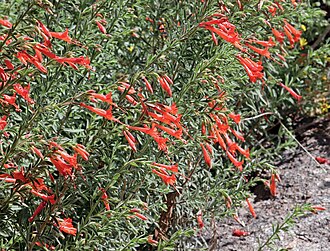
Epilobium canum, widely recognized as California Fuchsia or Zauschneria, is a captivating perennial herb indigenous to the southwestern United States and northwestern Mexico. This member of the Onagraceae family is celebrated for its spectacular, tube-shaped flowers that burst forth in fiery red to brilliant orange-red hues, creating a stunning display from late summer through autumn. These vibrant blossoms serve as a crucial nectar source, particularly for hummingbirds, during a period when other floral resources may be scarce.
The plant typically develops into dense, mounding or trailing mats, adorned with slender, linear to lance-shaped leaves that often exhibit a silvery-grey tint. Its common name, California Fuchsia, derives from the superficial resemblance of its flowers to those of true fuchsias, although they are botanically distinct. Epilobium canum displays significant genetic diversity, resulting in a variety of growth forms, from low-spreading groundcovers to more upright, bushy specimens.
It thrives in conditions of full sun and well-drained soils, demonstrating remarkable drought tolerance once established. Its minimal irrigation needs make it an ideal candidate for xeriscaping, rock gardens, and arid landscape designs, contributing both aesthetic beauty and ecological value by supporting vital pollinator populations.
Trusted Scientific References
1. Authoritative external sources for Epilobium canum
1.1 Wikipedia — Epilobium canum
1.2 Kew POWO (Plants of the World Online)
1.3 PubMed — peer-reviewed research
1.4 NCBI Taxonomy Browser
1.5 GBIF — Global Biodiversity
1.6Zauschneria should be interpreted through verified botanical identity, practical care, and responsible safety language. This recovery note adds the missing context needed for a complete profile: match light to the plant's habit, use well-drained soil, water according to season, and avoid unsupported medicinal or edible claims. For publishing, the plant can be presented as a source-backed garden plant with clear care guidance, common problem diagnosis, and conservative safety wording.
1.1.Zauschneria — Key Features
- ✓ <strong>Botanical Name</strong> — Epilobium canum (formerly Zauschneria californica).
- ✓ <strong>Common Names</strong> — California Fuchsia, Zauschneria.
- ✓ <strong>Plant Family</strong> — Onagraceae.
- ✓ <strong>Native Range</strong> — Southwestern United States and Northwestern Mexico.
- ✓ <strong>Flower Color</strong> — Brilliant fiery red to orange-red.
- ✓ <strong>Bloom Period</strong> — Late summer through fall.
- ✓ <strong>Growth Habit</strong> — Mounding, trailing, or bushy perennial.
- ✓ <strong>Drought Tolerance</strong> — Exceptional, ideal for arid landscapes.
- ✓ <strong>Pollinator Attraction</strong> — Essential nectar source for hummingbirds.
- ✓ <strong>Ornamental Value</strong> — Highly prized for vibrant, long-lasting floral display.
- ✓ <strong>Leaf Characteristics</strong> — Slender, linear to lance-shaped, often silver-grey.
1.2.Zauschneria — Quick Summary
- ✓ California Fuchsia (Epilobium canum) is a vibrant, drought-tolerant perennial native to the arid regions of the southwestern US and Mexico.
- ✓ Renowned for its fiery red-orange flowers that bloom late season, attracting hummingbirds and enhancing xeriscapes.
- ✓ While visually striking, specific medicinal research on Epilobium canum is limited, unlike some other Epilobium species.
- ✓ Phytochemical analysis suggests the presence of flavonoids and tannins, implying potential antioxidant and astringent properties.
- ✓ It is primarily valued as an ornamental plant and a critical late-season pollinator resource.
- ✓ Any potential medicinal applications require further dedicated scientific investigation specific to Epilobium canum.
2.Zauschneria — Scientific Identity
3.Zauschneria — Quick Facts
4.Zauschneria — Appearance & Identification
5.Zauschneria — Native Habitat
6.Zauschneria — Water Requirements
- ✓ Climate Adaptation — Thrives in USDA hardiness zones 8-10, preferring warm, dry climates similar to its native Mediterranean-like habitats.
- ✓ Soil Requirements — Prefers well-drained soils, including sandy, gravelly, or rocky substrates; tolerant of poor fertility but dislikes heavy clay or overly moist conditions.
- ✓ Light Exposure — Requires full sun exposure (at least 6 hours direct sunlight daily) for robust growth and abundant flowering.
- ✓ Watering Schedule — Highly drought-tolerant once established; requires minimal supplemental irrigation, especially in hot, dry periods.
- ✓ Propagation Techniques — Easily propagated by seed, stem cuttings taken in spring or early summer, or by division of mature clumps in late winter or early spring.
- ✓ Pruning Practices — Prune back spent flower stalks and trim back foliage in late winter or early spring to encourage dense, compact growth and prolific blooming.
- ✓ Pest and Disease Management — Generally resistant to most common pests and diseases; occasional issues may include aphids or powdery mildew in humid conditions.
Reviewed by the Flora Medical Global Botanical Review Panel
Multi-disciplinary editorial group · Botany · Ethnobotany · Herbal-medicine literature
Who reviewed this: This page was checked by the Flora Medical Global Botanical Review Panel — an in-house editorial group of botany graduates, ethnobotany researchers, and horticulture practitioners who collectively maintain our 7,000+ plant encyclopedia. Meet the team.
Our 4-step verification process
1. Taxonomic verification
Scientific names and synonyms cross-checked against Kew POWO, World Flora Online, and The Plant List.
2. Phytochemical & medicinal cross-reference
Active compounds, traditional uses, and reported activities are cross-referenced with PubMed, USDA Dr. Duke's database, and peer-reviewed ethnobotanical literature.
3. Conservation & distribution check
Distribution, ecology, and conservation status confirmed against GBIF occurrence records and the IUCN Red List.
4. Editorial & safety review
Every entry passes an editorial pass for clarity, originality, and safety notices (toxicity, contraindications, dosage caveats) before publication.
Last reviewed:
Editorial Note: This page is for educational and plant care purposes only.
Written by: Flora Medical Global Editorial Team
Reviewed by: Flora Medical Global Botanical Review Panel
Last Updated: June 15, 2026







Zauschneria — Comments & Community Reviews
Rate this plant