

Care Disclaimer: Plant care recommendations are general guidelines based on common growing conditions. Individual results may vary based on your local environment, climate, and care routine. If your plant is toxic, keep it away from children and pets, and consult a veterinarian if accidental ingestion occurs.
1.Zizia Aurea — Overview
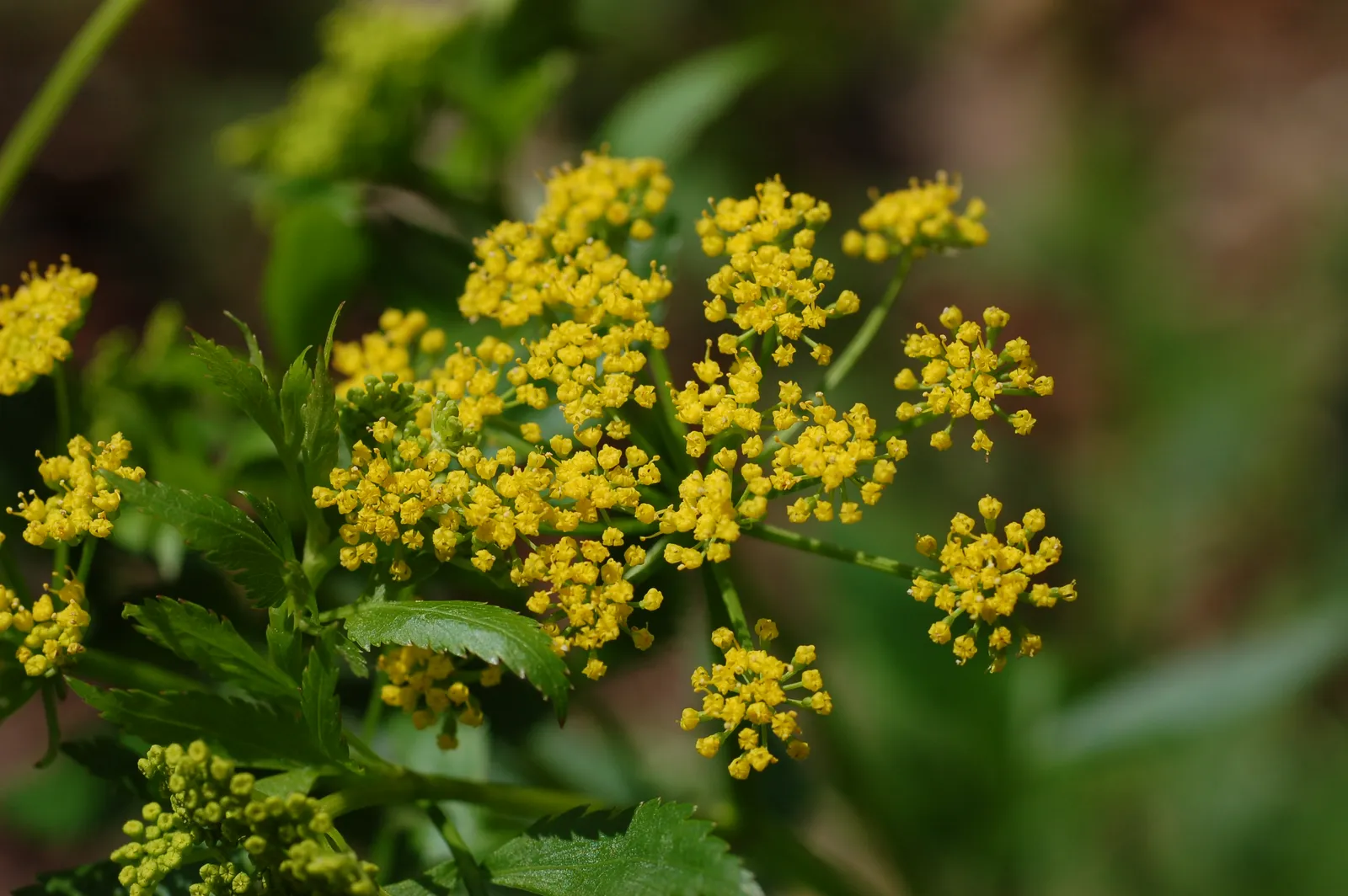
Zizia aurea, commonly known as golden alexanders, golden zizia, or meadow parsnip, is an enduring herbaceous perennial native to a broad expanse of eastern and central North America, extending from parts of Canada down through the New England states and along the Atlantic Coast. This resilient species is a cherished member of the Apiaceae family, a botanical group renowned for its characteristic umbellate flower clusters and including well-known edible and medicinal plants like carrots, parsley, and dill. Golden alexanders typically establishes itself as a robust, clumping plant, reaching heights of 1 to 3 feet (30 to 90 cm) with a spread of similar dimensions. Its foliage is distinctive, featuring attractive, compound leaves; the basal leaves are notably larger, triangular-ovate, and often deeply lobed or divided, presenting a somewhat fern-like texture, while the upper leaves are progressively smaller and more finely dissected.
The stems are smooth, erect, and frequently exhibit a subtle purplish hue. A highlight of the late spring to early summer landscape, Zizia aurea unfurls a profusion of small, brilliant yellow flowers. These are meticulously arranged in flat-topped compound umbels, a signature trait of the Apiaceae family, which can span 2 to 5 inches (5 to 12 cm) across. The genus name "Zizia" honors Johann Baptist Ziz, an 18th-century German botanist, while "aurea" is Latin for "golden," a direct reference to its striking floral display.
Beyond its aesthetic appeal, Zizia aurea plays a crucial ecological role as an early and vital nectar and pollen source, attracting a diverse array of beneficial insects including various species of bees, butterflies, moths, and other essential pollinators, thus supporting local biodiversity and ecosystem health. Following its vibrant bloom, the plant produces small, ribbed, oblong fruits that mature into a dark purplish-black color. This adaptable native thrives in moist to slightly dry, well-drained soils, tolerating both full sun and partial shade, making it a versatile and low-maintenance choice for naturalized gardens, wildflower meadows, and ecological restoration projects.
Trusted Scientific References
1. Authoritative external sources for Zizia aurea
1.1 Wikipedia — Zizia aurea
1.2 Kew POWO (Plants of the World Online)
1.3 PubMed — peer-reviewed research
1.4 NCBI Taxonomy Browser
1.5 GBIF — Global Biodiversity
1.1.Zizia Aurea — Key Features
- ✓ <strong>Native North American Perennial</strong> — Indigenous to eastern and central regions, supporting local ecosystems.
- ✓ <strong>Early Spring Bloomer</strong> — Provides vital nectar and pollen when other sources are scarce.
- ✓ <strong>Bright Yellow Umbels</strong> — Characteristic flat-topped flower clusters of the Apiaceae family.
- ✓ <strong>Premier Pollinator Attractor</strong> — Draws bees, butterflies, wasps, and other beneficial insects.
- ✓ <strong>Traditional Indigenous Medicine</strong> — Historically used as an analgesic for headaches and a febrifuge for fevers.
- ✓ <strong>Edible Young Leaves and Shoots</strong> — Can be consumed raw or cooked, offering nutritional value.
- ✓ <strong>Low Maintenance and Adaptable</strong> — Tolerates various soil types and light conditions once established.
- ✓ <strong>Drought</strong> — Tolerant Once Established — Requires minimal watering after its initial growth phase.
- ✓ <strong>Supports Biodiversity</strong> — Contributes to habitat restoration and local wildlife support.
- ✓ <strong>Distinctive Foliage</strong> — Features attractive, compound leaves with a fern-like appearance.
1.2.Zizia Aurea — Quick Summary
- ✓ Golden alexanders is a native North American perennial valued for its bright yellow, early spring flowers.
- ✓ It serves as a critical early-season food source for a wide range of pollinators.
- ✓ Traditionally, indigenous peoples used Zizia aurea for its analgesic and febrifuge properties.
- ✓ The young leaves and shoots are edible, offering nutritional benefits.
- ✓ This low-maintenance plant thrives in various conditions, making it excellent for native and permaculture gardens.
- ✓ Its ecological role and traditional medicinal uses highlight its multifaceted value.
2.Zizia Aurea — Scientific Identity
3.Zizia Aurea — Quick Facts
4.Zizia Aurea — Appearance & Identification
5.Zizia Aurea — Native Habitat
6.Zizia Aurea — Water Requirements
- ✓ Site Selection — Plant Zizia aurea in a location that receives full sun to partial shade for optimal growth and flowering.
- ✓ Soil Preparation — Ensure moist to slightly dry, well-drained soil, as golden alexanders thrives in a variety of soil textures including loamy and clay soils.
- ✓ Hardiness Zone — Best suited for USDA Hardiness Zones 3 through 8, making it adaptable to a wide range of temperate climates.
- ✓ Propagation — Can be propagated by seeds, which benefit from a period of cold stratification, or by dividing established clumps in spring or fall.
- ✓ Watering — Requires regular watering during establishment, but once mature, it becomes relatively drought-tolerant, needing less frequent irrigation.
- ✓ Spacing — Space plants about 1 to 2 feet (30-60 cm) apart to allow for mature spread and good air circulation, as it forms clumps.
- ✓ Maintenance — Golden alexanders is a low-maintenance plant; deadheading spent flowers can encourage a tidier appearance, though it's not strictly necessary.
- ✓ Ecological Planting — Ideal for permaculture gardens, native plant landscapes, rain gardens, and pollinator gardens to attract beneficial insects.
Reviewed by the Flora Medical Global Botanical Review Panel
Multi-disciplinary editorial group · Botany · Ethnobotany · Herbal-medicine literature
Who reviewed this: This page was checked by the Flora Medical Global Botanical Review Panel — an in-house editorial group of botany graduates, ethnobotany researchers, and horticulture practitioners who collectively maintain our 7,000+ plant encyclopedia. Meet the team.
Our 4-step verification process
1. Taxonomic verification
Scientific names and synonyms cross-checked against Kew POWO, World Flora Online, and The Plant List.
2. Phytochemical & medicinal cross-reference
Active compounds, traditional uses, and reported activities are cross-referenced with PubMed, USDA Dr. Duke's database, and peer-reviewed ethnobotanical literature.
3. Conservation & distribution check
Distribution, ecology, and conservation status confirmed against GBIF occurrence records and the IUCN Red List.
4. Editorial & safety review
Every entry passes an editorial pass for clarity, originality, and safety notices (toxicity, contraindications, dosage caveats) before publication.
Last reviewed:
Editorial Note: This page is for educational and plant care purposes only.
Written by: Flora Medical Global Editorial Team
Reviewed by: Flora Medical Global Botanical Review Panel
Last Updated: June 15, 2026







Zizia Aurea — Comments & Community Reviews
Rate this plant