
Care Disclaimer: Plant care recommendations are general guidelines based on common growing conditions. Individual results may vary based on your local environment, climate, and care routine. If your plant is toxic, keep it away from children and pets, and consult a veterinarian if accidental ingestion occurs.
1.Abutilon — Overview
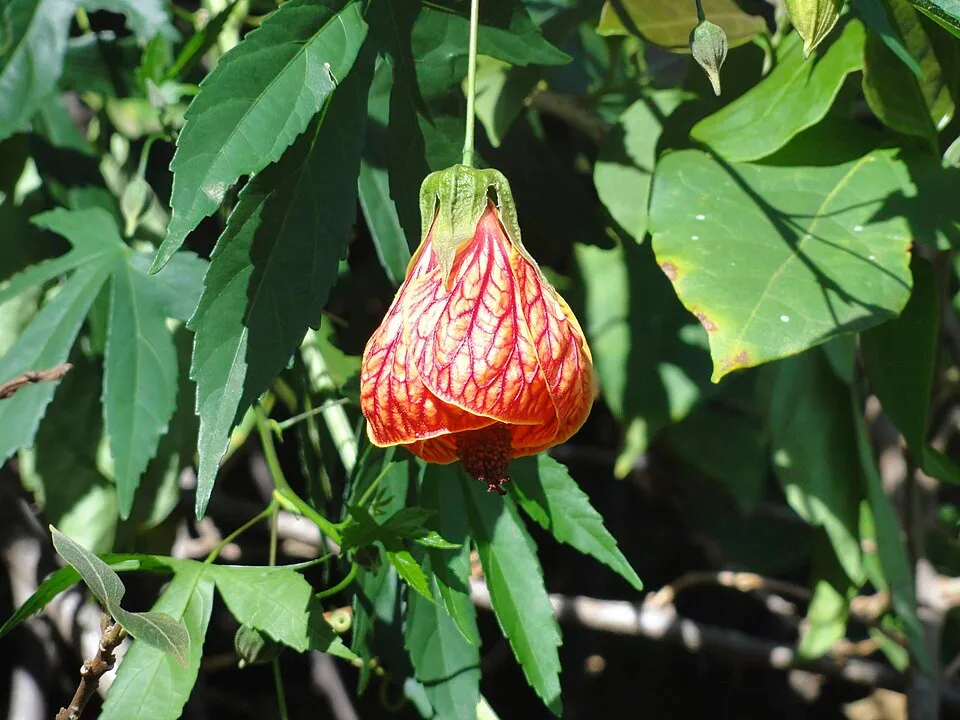
Abutilon pictum, widely recognized as Painted Indian Mallow or Flowering Maple, is a captivating evergreen shrub belonging to the Malvaceae family, a lineage closely related to the hibiscus. This striking plant is indigenous to the warm, frost-free regions of southern Brazil, Argentina, Paraguay, and Uruguay, where it flourishes in its natural subtropical habitat. The genus name 'Abutilon' originates from the Arabic 'aubutilun', denoting its mallow-like characteristics, while 'pictum' aptly translates to 'painted', referring to the visually appealing mottled or veined appearance of its foliage and flowers.
The leaves of Abutilon pictum are distinctly palmate, typically featuring three to five lobes with serrated edges, often resembling those of a maple tree, hence one of its common names. Their coloration varies from vibrant green to variegated patterns of yellow and cream, providing a dramatic contrast to the plant's abundant blossoms. These bell-shaped, pendulous flowers, which bloom almost continuously under favorable conditions, display a spectrum of colors from sunny yellow to deep orange and rich red, frequently highlighted by darker, intricate veining.
In optimal environments, the plant can attain heights of 3 to 5 meters, though many cultivated varieties are maintained at smaller sizes through diligent pruning. Since its introduction to Europe in the mid-19th century, Abutilon pictum has become a beloved ornamental, valued for its beauty and adaptability in diverse settings, from gardens and conservatories to indoor houseplants. It also plays an ecological role by attracting pollinators such as bees and hummingbirds, contributing to local biodiversity.
Trusted Scientific References
1. Authoritative external sources for Abutilon pictum
1.1 Wikipedia — Abutilon pictum
1.2 Kew POWO (Plants of the World Online)
1.3 PubMed — peer-reviewed research
1.4 NCBI Taxonomy Browser
1.5 GBIF — Global Biodiversity
1.6Abutilon should be interpreted through verified botanical identity, practical care, and responsible safety language. This recovery note adds the missing context needed for a complete profile: match light to the plant's habit, use well-drained soil, water according to season, and avoid unsupported medicinal or edible claims. For publishing, the plant can be presented as a source-backed indoor plant with clear care guidance, common problem diagnosis, and conservative safety wording.
1.1.Abutilon — Key Features
- ✓ <strong>Evergreen Ornamental Shrub</strong> — Provides continuous foliage and blooms, enhancing aesthetic appeal year-round.
- ✓ <strong>Malvaceae Family Member</strong> — Genetically related to hibiscus, sharing similar floral and growth characteristics.
- ✓ <strong>Distinctive Bell</strong> — shaped Flowers — Pendulous, often brightly colored with prominent, intricate red veins.
- ✓ <strong>Maple</strong> — like, Lobed Leaves — Characteristic palmate leaves give rise to its common name 'Flowering Maple'.
- ✓ <strong>Attracts Pollinators</strong> — Its nectar-rich blossoms are a favorite of bees and hummingbirds, supporting biodiversity.
- ✓ <strong>Rich in Mucilage Content</strong> — Contributes to its demulcent, soothing, and gentle laxative medicinal properties.
- ✓ <strong>Contains Antioxidant Flavonoids</strong> — Important for neutralizing free radicals and supporting cellular health.
- ✓ <strong>Adaptable Cultivation</strong> — Tolerates various growing conditions, making it suitable for gardens, containers, and indoor settings.
- ✓ <strong>Traditional Medicinal Uses</strong> — Employed in folk medicine for a range of minor ailments, from respiratory issues to skin conditions.
- ✓ <strong>Edible Flowers</strong> — The sweet-flavored flowers can be consumed raw or cooked, offering a unique culinary element.
1.2.Abutilon — Quick Summary
- ✓ Abutilon pictum, or Flowering Maple, is an attractive evergreen shrub from the Malvaceae family.
- ✓ Native to South America, it's cherished for its vibrant, bell-shaped, often red-veined flowers.
- ✓ The plant is rich in beneficial compounds including flavonoids, saponins, and soothing mucilage.
- ✓ Traditionally used for its anti-inflammatory, antimicrobial, antioxidant, and demulcent properties.
- ✓ Practical applications include teas for coughs and fevers, and topical pastes for wounds and skin irritations.
- ✓ Always prioritize safety by consulting healthcare professionals and adhering to proper usage guidelines.
2.Abutilon — Scientific Identity
3.Abutilon — Quick Facts
4.Abutilon — Appearance & Identification
5.Abutilon — Native Habitat
6.Abutilon — Water Requirements
- ✓ Climate — Thrives in warm, frost-free subtropical to warm-temperate climates, intolerant of freezing temperatures.
- ✓ Sunlight — Prefers full sun to light shade for optimal growth and abundant flower production.
- ✓ Soil — Requires well-drained, fertile garden soil with consistent moisture, avoiding waterlogging.
- ✓ Watering — Water every 1-2 weeks, ensuring the soil remains evenly moist, especially during dry periods.
- ✓ Fertilization — Apply a balanced, water-soluble fertilizer monthly during the active growing seasons of spring and summer.
- ✓ Pruning — Prune in late spring to encourage bushier growth, maintain desired shape, and stimulate continuous flowering.
- ✓ Propagation — Easily propagated from stem cuttings taken during spring or summer months for successful reproduction.
- ✓ Repotting — Repot every 2-3 years into a slightly larger pot with fresh soil to maintain plant vigor and prolific blooms.
Reviewed by the Flora Medical Global Botanical Review Panel
Multi-disciplinary editorial group · Botany · Ethnobotany · Herbal-medicine literature
Who reviewed this: This page was checked by the Flora Medical Global Botanical Review Panel — an in-house editorial group of botany graduates, ethnobotany researchers, and horticulture practitioners who collectively maintain our 7,000+ plant encyclopedia. Meet the team.
Our 4-step verification process
1. Taxonomic verification
Scientific names and synonyms cross-checked against Kew POWO, World Flora Online, and The Plant List.
2. Phytochemical & medicinal cross-reference
Active compounds, traditional uses, and reported activities are cross-referenced with PubMed, USDA Dr. Duke's database, and peer-reviewed ethnobotanical literature.
3. Conservation & distribution check
Distribution, ecology, and conservation status confirmed against GBIF occurrence records and the IUCN Red List.
4. Editorial & safety review
Every entry passes an editorial pass for clarity, originality, and safety notices (toxicity, contraindications, dosage caveats) before publication.
Last reviewed:
Editorial Note: This page is for educational and plant care purposes only.
Written by: Flora Medical Global Editorial Team
Reviewed by: Flora Medical Global Botanical Review Panel
Last Updated: June 16, 2026







Abutilon — Comments & Community Reviews
Rate this plant