
Care Disclaimer: Plant care recommendations are general guidelines based on common growing conditions. Individual results may vary based on your local environment, climate, and care routine. If your plant is toxic, keep it away from children and pets, and consult a veterinarian if accidental ingestion occurs.
1.Aeschynanthus (Lipstick Plant) — Overview
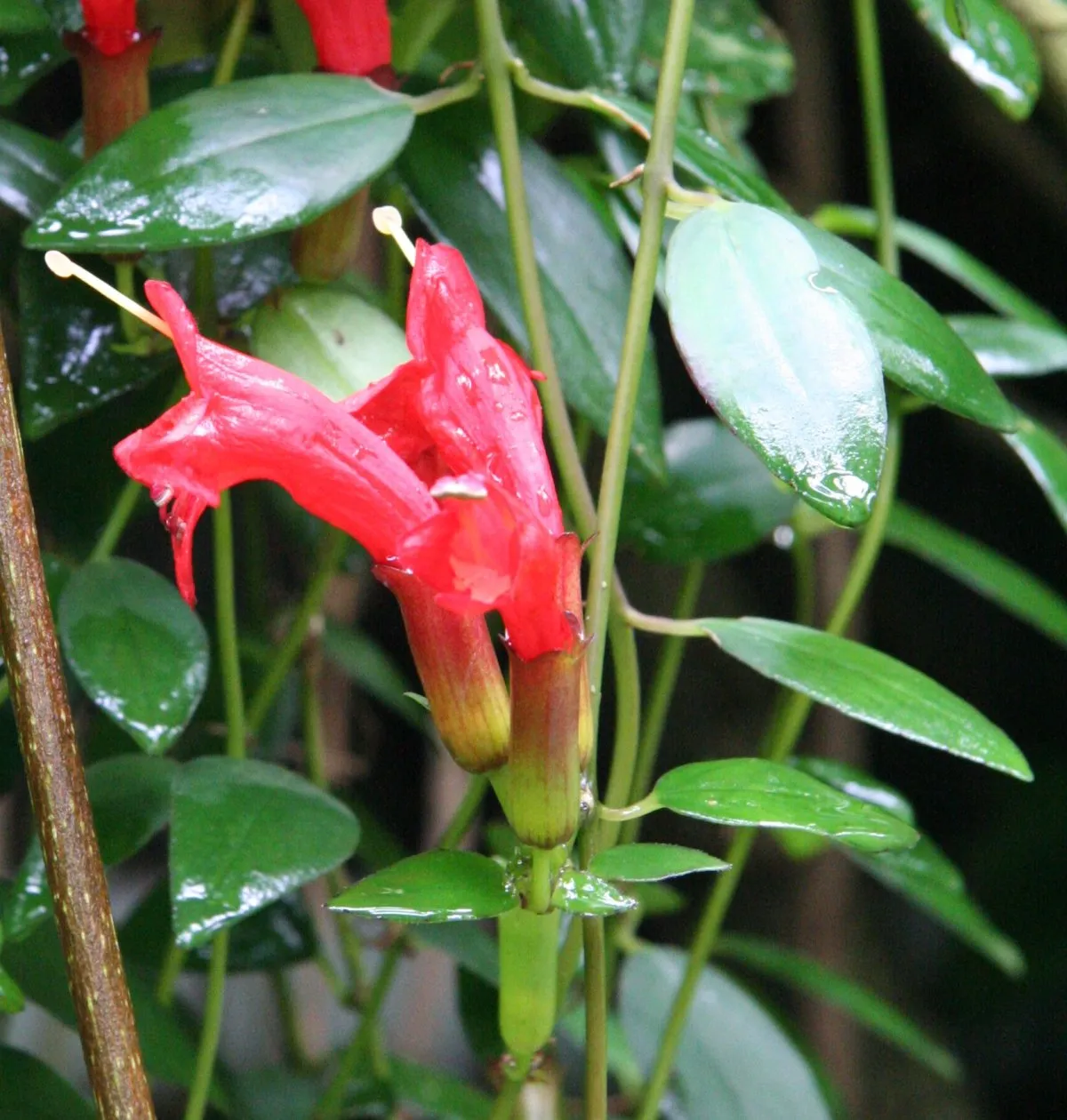
The Lipstick Plant, known scientifically as Aeschynanthus radicans, is an exquisite evergreen perennial belonging to the Gesneriaceae family. This captivating species is indigenous to the humid tropical rainforests of Southeast Asia, with its natural range spanning the Malay Peninsula, Sumatra, Borneo, and Thailand. It primarily exhibits an epiphytic or lithophytic growth habit, gracefully adorning trees or rock formations, a characteristic that makes it a popular choice for hanging baskets in cultivation.
The genus name 'Aeschynanthus' originates from Greek, combining 'aischyne' (shame) and 'anthos' (flower), possibly alluding to the vibrant red blooms emerging from dark calyces, a striking resemblance to a tube of lipstick. The species epithet 'radicans' is Latin for 'rooting,' reflecting its ability to root along its trailing stems.
Morphologically, Aeschynanthus radicans typically develops trailing stems that can extend up to 90 cm (3 feet) in length. Its foliage consists of deep green, somewhat succulent leaves, arranged oppositely along the stems. These leaves often feature a reddish tint on their undersides, contributing to the plant's ornamental appeal.
The most distinguishing feature is its showy, tubular flowers, which emerge in clusters. These bright red blossoms, often with a contrasting yellow throat, can appear throughout the year under optimal conditions. In its native environment, the Lipstick Plant thrives in conditions of high humidity and dappled light, necessitating consistent moisture and protection from direct, harsh sunlight to maintain its health and vigor.
Trusted Scientific References
1. Authoritative external sources for Aeschynanthus radicans
1.1 Wikipedia — Aeschynanthus radicans
1.2 Kew POWO (Plants of the World Online)
1.3 PubMed — peer-reviewed research
1.4 NCBI Taxonomy Browser
1.5 GBIF — Global Biodiversity
1.6Aeschynanthus (Lipstick Plant) should be interpreted through verified botanical identity, practical care, and responsible safety language. This recovery note adds the missing context needed for a complete profile: match light to the plant's habit, use well-drained soil, water according to season, and avoid unsupported medicinal or edible claims. For publishing, the plant can be presented as a source-backed indoor plant with clear care guidance, common problem diagnosis, and conservative safety wording.
1.1.Aeschynanthus (Lipstick Plant) — Key Features
- ✓ <strong>Striking Appearance</strong> — Features showy, bright red tubular flowers that emerge from dark calyces, resembling a lipstick tube.
- ✓ <strong>Epiphytic Growth Habit</strong> — Naturally grows on other plants or rocks, making it ideal for hanging displays.
- ✓ <strong>Lush Foliage</strong> — Displays deep green, succulent leaves, often with a reddish underside, enhancing its visual appeal.
- ✓ <strong>Tropical Origin</strong> — Native to the warm, humid rainforests of Southeast Asia, thriving in similar indoor conditions.
- ✓ <strong>Easy to Cultivate</strong> — Considered a relatively low-maintenance houseplant with proper care.
- ✓ <strong>Trailing Form</strong> — Long stems gracefully trail, making it perfect for elevated planters and baskets.
- ✓ <strong>Year</strong> — Round Blooms — Under ideal conditions, it can produce flowers throughout the year.
- ✓ <strong>Folk Medicine Mentions</strong> — Anecdotal traditional uses for minor ailments in its native regions, though not widely documented in major systems.
- ✓ <strong>Unique Etymology</strong> — Its Greek name 'Aeschynanthus' translates to 'shame flower,' adding to its intrigue.
- ✓ <strong>Propagation Ease</strong> — Readily propagated from stem cuttings, allowing for easy sharing and expansion.
1.2.Aeschynanthus (Lipstick Plant) — Quick Summary
- ✓ Aeschynanthus radicans, or Lipstick Plant, is a tropical epiphytic perennial from Southeast Asia.
- ✓ Renowned for its vibrant red, tubular flowers resembling lipstick and lush trailing foliage.
- ✓ Primarily valued as an ornamental houseplant due to its striking appearance and ease of care.
- ✓ Folk medicine traditions in native regions anecdotally used leaves for minor ailments.
- ✓ Requires bright indirect light, high humidity, and consistent moisture for optimal growth.
- ✓ Limited scientific research on its medicinal properties necessitates caution for internal use.
2.Aeschynanthus (Lipstick Plant) — Scientific Identity
3.Aeschynanthus (Lipstick Plant) — Quick Facts
4.Aeschynanthus (Lipstick Plant) — Appearance & Identification
5.Aeschynanthus (Lipstick Plant) — Native Habitat
6.Aeschynanthus (Lipstick Plant) — Water Requirements
- ✓ Light Conditions — Provide bright, indirect light; avoid harsh, direct sunlight which can scorch leaves and hinder Aeschynanthus radicans' growth.
- ✓ Temperature Requirements — Maintain warm conditions, ideally with soil temperatures between 18-21°C (65-70°F) during the growing season; protect from temperatures below 10°C (50°F) to prevent leaf drop.
- ✓ Humidity Management — Ensure high humidity with good air circulation to mimic its tropical habitat; stagnant moist air can encourage fungal diseases.
- ✓ Watering Schedule — Water frequently and consistently, allowing the topsoil to dry slightly between waterings, but ensure excellent drainage to prevent root rot.
- ✓ Fertilization Regime — Apply a dilute liquid fertilizer, such as one formulated for orchids, regularly during the active growing season to promote lush foliage and abundant blooms.
- ✓ Propagation Technique — Easily propagated from three-node soft stem cuttings; remove lower leaves, dip the cut end in rooting hormone, and pot in a well-draining mix like vermiculite and perlite.
- ✓ Potting Medium — Use a well-aerated, fast-draining potting mix, ideally formulated for epiphytic plants, to prevent waterlogging.
- ✓ Pruning for Shape — Light pruning can encourage bushier growth and maintain a desirable trailing form for ornamental purposes.
Reviewed by the Flora Medical Global Botanical Review Panel
Multi-disciplinary editorial group · Botany · Ethnobotany · Herbal-medicine literature
Who reviewed this: This page was checked by the Flora Medical Global Botanical Review Panel — an in-house editorial group of botany graduates, ethnobotany researchers, and horticulture practitioners who collectively maintain our 7,000+ plant encyclopedia. Meet the team.
Our 4-step verification process
1. Taxonomic verification
Scientific names and synonyms cross-checked against Kew POWO, World Flora Online, and The Plant List.
2. Phytochemical & medicinal cross-reference
Active compounds, traditional uses, and reported activities are cross-referenced with PubMed, USDA Dr. Duke's database, and peer-reviewed ethnobotanical literature.
3. Conservation & distribution check
Distribution, ecology, and conservation status confirmed against GBIF occurrence records and the IUCN Red List.
4. Editorial & safety review
Every entry passes an editorial pass for clarity, originality, and safety notices (toxicity, contraindications, dosage caveats) before publication.
Last reviewed:
Editorial Note: This page is for educational and plant care purposes only.
Written by: Flora Medical Global Editorial Team
Reviewed by: Flora Medical Global Botanical Review Panel
Last Updated: June 16, 2026







Aeschynanthus (Lipstick Plant) — Comments & Community Reviews
Rate this plant