
Care Disclaimer: Plant care recommendations are general guidelines based on common growing conditions. Individual results may vary based on your local environment, climate, and care routine. If your plant is toxic, keep it away from children and pets, and consult a veterinarian if accidental ingestion occurs.
1.Aglaonema Emerald Beauty — Overview
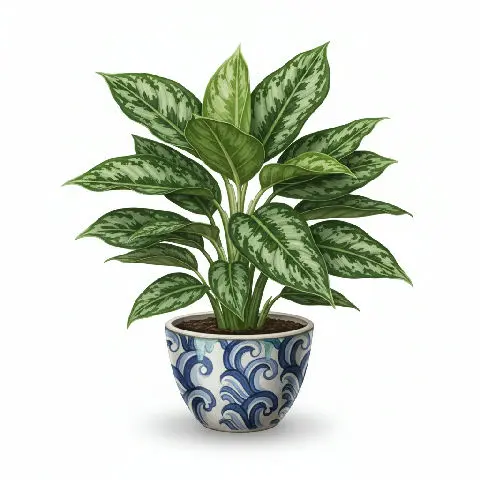
Aglaonema 'Emerald Beauty', a highly esteemed cultivar within the Aglaonema genus, is primarily celebrated for its exceptional ornamental appeal, commonly known as Chinese Evergreen. This captivating plant naturally thrives in the humid understories of tropical and subtropical rainforests, with its native range extending from northeastern India across Southeast Asia and into New Guinea. The genus Aglaonema was scientifically classified in 1829 by Heinrich Wilhelm Schott, and since then, numerous species and cultivars have emerged, with 'Emerald Beauty' representing a notable contemporary horticultural achievement. Morphologically, Aglaonema 'Emerald Beauty' exhibits a robust, bushy, and upright growth habit, typically reaching an indoor height of up to 1.5 feet.
Its most striking characteristic lies in its large, lance-shaped to oval leaves, which can measure between 4 to 8 inches in length and 2 to 3 inches in width. These leaves display a distinct and consistent variegation pattern: a deep emerald green base beautifully contrasted with silvery-green or creamy-white blotches and markings, frequently emphasizing the midrib and primary veins. Unlike some other Aglaonema cultivars that may feature red or pink tones, 'Emerald Beauty' maintains a predominantly verdant palette, making it a staple for integrating rich green textures into indoor environments. Botanically, Aglaonema belongs to the Araceae family, a diverse group that includes other popular houseplants like Philodendron and Monstera.
Characteristic of this family, Aglaonemas produce an inflorescence comprising a spadix, which is a spike of small flowers, partially enveloped by a spathe, a leaf-like bract. However, in cultivated indoor 'Emerald Beauty' plants, these flowers are often inconspicuous, and the plant is predominantly valued for its stunning foliage. The stem, which can develop a somewhat cane-like appearance with age, provides structural support for its attractive leaf arrangement.
Trusted Scientific References
1. Authoritative external sources for Aglaonema emerald beauty
1.1 Wikipedia — Aglaonema emerald beauty
1.2 Kew POWO (Plants of the World Online)
1.3 PubMed — peer-reviewed research
1.4 NCBI Taxonomy Browser
1.5 GBIF — Global Biodiversity
1.1.Aglaonema Emerald Beauty — Key Features
- ✓ <strong>Botanical Name</strong> — Aglaonema emerald beauty, a specific cultivar of the widely recognized Aglaonema genus.
- ✓ <strong>Common Name</strong> — Widely known as Chinese Evergreen, reflecting its Asian origin and evergreen characteristics.
- ✓ <strong>Family Affiliation</strong> — A proud member of the Araceae family, known for its distinctive spadix-spathe inflorescences.
- ✓ <strong>Distinctive Foliage</strong> — Characterized by large, lance-shaped leaves featuring a deep emerald green base with striking silvery-white variegation.
- ✓ <strong>Growth Habit</strong> — Exhibits a robust, bushy, and upright growth pattern, typically reaching up to 1.5 feet in indoor settings.
- ✓ <strong>Tropical Origin</strong> — Native to the lush tropical and subtropical rainforests across Southeast Asia and surrounding regions.
- ✓ <strong>Indoor Adaptability</strong> — Highly tolerant of diverse indoor environments, including conditions with lower light levels.
- ✓ <strong>Air Cleaning Properties</strong> — Recognized by some studies for its potential, albeit modest, to improve indoor air quality.
- ✓ <strong>Toxic Sap</strong> — Contains calcium oxalate crystals, which cause significant irritation if ingested or contacted with skin.
- ✓ <strong>Low Maintenance</strong> — Requires consistent moisture and indirect light, making it an easy-to-care-for houseplant.
1.2.Aglaonema Emerald Beauty — Quick Summary
- ✓ Ornamental Value — Highly prized for its striking variegated foliage, making it a popular indoor decorative plant.
- ✓ Toxic Nature — Contains irritating calcium oxalate crystals, rendering all plant parts poisonous if ingested.
- ✓ Low-Light Tolerant — Thrives well in indirect light, making it exceptionally suitable for various indoor conditions.
- ✓ Easy Care — Known for its resilience and adaptability, requiring minimal maintenance for sustained beauty.
- ✓ Air Purifier — Contributes modestly to improving indoor air quality by absorbing common environmental toxins.
- ✓ Pet & Child Warning — Must be diligently kept away from children and pets due to its irritant and toxic properties.
2.Aglaonema Emerald Beauty — Scientific Identity
3.Aglaonema Emerald Beauty — Quick Facts
4.Aglaonema Emerald Beauty — Appearance & Identification
5.Aglaonema Emerald Beauty — Native Habitat
6.Aglaonema Emerald Beauty — Water Requirements
- ✓ Light Requirements — Thrives best in diffuse sun or good indirect light; direct sunlight should be avoided as it can cause leaf scorch. It adapts well to low-light indoor conditions.
- ✓ Watering Schedule — Maintain consistently moist potting mix from spring through fall, allowing the top inch of soil to dry out between waterings. Reduce watering significantly during the winter months.
- ✓ Humidity & Temperature — Prefers high humidity but tolerates average indoor air. Ideal daytime temperatures range from 70-80°F (21-27°C); avoid cold drafts and temperatures below 60°F (15°C).
- ✓ Soil & Potting — Use a well-draining, peat-based potting mix that retains some moisture. Repot every 2-3 years or when the plant becomes root-bound to refresh the growing medium.
- ✓ Fertilization — Feed with a balanced liquid fertilizer diluted to half strength every 2-4 weeks during the active growing season (spring and summer); discontinue feeding in fall and winter.
- ✓ Pruning & Maintenance — Trim any leggy stems to encourage bushier growth and remove any inconspicuous flowers or fruits to redirect the plant's energy towards more vigorous foliage development.
- ✓ Pest Management — Regularly inspect for common houseplant pests such as aphids, mealybugs, spider mites, and scale; address infestations promptly using appropriate horticultural oils or insecticidal soaps.
Reviewed by the Flora Medical Global Botanical Review Panel
Multi-disciplinary editorial group · Botany · Ethnobotany · Herbal-medicine literature
Who reviewed this: This page was checked by the Flora Medical Global Botanical Review Panel — an in-house editorial group of botany graduates, ethnobotany researchers, and horticulture practitioners who collectively maintain our 7,000+ plant encyclopedia. Meet the team.
Our 4-step verification process
1. Taxonomic verification
Scientific names and synonyms cross-checked against Kew POWO, World Flora Online, and The Plant List.
2. Phytochemical & medicinal cross-reference
Active compounds, traditional uses, and reported activities are cross-referenced with PubMed, USDA Dr. Duke's database, and peer-reviewed ethnobotanical literature.
3. Conservation & distribution check
Distribution, ecology, and conservation status confirmed against GBIF occurrence records and the IUCN Red List.
4. Editorial & safety review
Every entry passes an editorial pass for clarity, originality, and safety notices (toxicity, contraindications, dosage caveats) before publication.
Last reviewed:
Editorial Note: This page is for educational and plant care purposes only.
Written by: Flora Medical Global Editorial Team
Reviewed by: Flora Medical Global Botanical Review Panel
Last Updated: June 16, 2026







Aglaonema Emerald Beauty — Comments & Community Reviews
Rate this plant