


Care Disclaimer: Plant care recommendations are general guidelines based on common growing conditions. Individual results may vary based on your local environment, climate, and care routine. If your plant is toxic, keep it away from children and pets, and consult a veterinarian if accidental ingestion occurs.
1.Albuca Spiralis — Overview
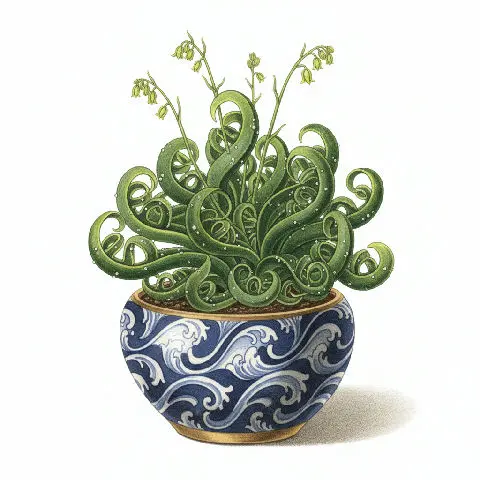
Albuca spiralis, affectionately known as the 'Frizzle Sizzle' plant or Corkscrew Albuca, is a truly captivating perennial succulent belonging to the Asparagaceae family, specifically within the subfamily Scilloideae. This distinctive geophyte is indigenous to the arid and semi-arid landscapes of the Western and Northern Cape Provinces of South Africa, a region renowned for its unique botanical diversity. Its scientific epithet, 'spiralis', is a direct homage to its most striking feature: the exceptionally coiled, corkscrew-like foliage that elegantly unfurls from a subterranean bulb. This unique morphology not only provides significant ornamental value but also serves as a remarkable adaptation to its native drought-prone environment. Botanically, Albuca spiralis emerges from a relatively small, ovoid bulb, typically measuring up to 2.5 cm in diameter, which can grow solitarily or in small clusters. This bulb functions as a crucial reservoir for water and stored nutrients, enabling the plant to endure prolonged dry spells by entering a dormant phase during the hot summer months.
The leaves, the plant's most celebrated characteristic, are slender, bright green, and can reach lengths of up to 11-20 cm. They are initially channeled at the base but become nearly cylindrical towards the tip, often adorned with a subtle fringe of tiny glandular hairs, though this can vary. The degree of spiraling is highly variable, influenced significantly by environmental factors such as intense sunlight and cooler temperatures, which tend to enhance the coiling effect. Plants cultivated in lower light conditions often exhibit a less pronounced spiral. During its active growing season in winter and early spring, Albuca spiralis produces an inflorescence on a tall, slender scape, which can extend up to 60 cm in height. This scape bears a raceme of pendant, nodding flowers, typically greenish-yellow with pale yellow or cream margins.
Each flower features three widely spreading outer tepals and three inner tepals that closely clasp the reproductive organs. These flowers are often sweetly scented, emitting a delicate vanilla-like fragrance, adding another layer to the plant's charm. Following successful pollination, primarily by solitary bees, the flowers give way to rounded capsules containing flat, glossy black seeds, which are dispersed upon maturity. Taxonomically, the genus Albuca encompasses approximately 125 species, predominantly found in Africa and extending into Arabia, ...[CURRENT TEXT EXISTS: 3563 chars]
1.1.Albuca Spiralis — Key Features
- ✓ <strong>Coiled Foliage</strong> — Albuca spiralis is uniquely characterized by its tightly coiled, corkscrew-like, bright green leaves.
- ✓ <strong>Subterranean Bulb</strong> — It grows from a bulb that stores water and nutrients, allowing it to survive drought periods.
- ✓ <strong>Summer Dormancy</strong> — The plant enters a dormant phase during hot summer months, often losing its leaves.
- ✓ <strong>Winter Grower</strong> — Its active growth period occurs during the cooler, wetter months of autumn through spring.
- ✓ <strong>Nodding Flowers</strong> — Produces clusters of pendant, greenish-yellow flowers with a delicate vanilla scent.
- ✓ <strong>Arid Adaptations</strong> — Its bulbous nature and succulent leaves are adaptations for survival in dry, desert-like environments.
- ✓ <strong>South African Native</strong> — Endemic to the Western and Northern Cape Provinces of South Africa.
- ✓ <strong>Asparagaceae Family</strong> — Belongs to the large Asparagus family, reflecting its botanical lineage.
- ✓ <strong>Ornamental Appeal</strong> — Highly valued by succulent collectors and enthusiasts for its striking visual uniqueness.
- ✓ <strong>Light</strong> — Dependent Spirals — The degree of leaf spiraling is enhanced by strong, direct sunlight and cooler temperatures.
- ✓ <strong>Easy Cultivation (with care)</strong> — Relatively straightforward to grow for succulent lovers, provided specific needs are met.
- ✓ <strong>Distinctive Scent</strong> — The flowers emit a pleasant, subtle vanilla-like fragrance.
- ✓ <strong>Drought Tolerant</strong> — Highly tolerant of dry conditions due to its water-storing bulb.
- ✓ <strong>Dwarf Species</strong> — Typically a small plant, making it suitable for compact spaces and containers.
- ✓ <strong>Seed Propagation</strong> — Can be propagated from small, flat, black seeds produced in rounded capsules.
1.2.Albuca Spiralis — Quick Summary
- ✓ Primary Use — Ornamental succulent, prized for its unique spiraling foliage.
- ✓ Key Feature — Distinctive corkscrew-like leaves and subterranean bulb.
- ✓ Native Habitat — Arid and semi-arid regions of South Africa.
- ✓ Medicinal Status — Limited specific documented traditional medicinal uses for the species itself.
- ✓ Genus Ethnobotany — Broader Albuca genus has some ethnobotanical applications as food or mild remedies.
- ✓ Cultivation — Requires bright light, well-draining soil, and careful watering, especially during dormancy.
- ✓ Safety Precaution — Avoid internal consumption due to lack of scientific safety data.
- ✓ Botanical Family — Member of the Asparagaceae family, subfamily Scilloideae.
2.Albuca Spiralis — Scientific Identity
3.Albuca Spiralis — Quick Facts
4.Albuca Spiralis — Appearance & Identification
5.Albuca Spiralis — Native Habitat
6.Albuca Spiralis — Water Requirements
- ✓ Soil Requirements — Albuca spiralis thrives in well-draining, gritty succulent potting mix. A blend of pumice, perlite, coarse sand, and a small amount of organic compost is ideal to prevent waterlogging.
- ✓ Watering — Water thoroughly only when the soil is completely dry during its active growing season (autumn to spring). Reduce watering significantly during summer dormancy to prevent bulb rot.
- ✓ Light Requirements — Provide ample bright, direct sunlight for at least 6 hours daily. Strong light encourages the characteristic spiraling of the leaves and robust flowering. Insufficient light leads to stretched, less coiled foliage.
- ✓ Temperature — Prefers cool to moderate temperatures, ideally between 10°C and 25°C (50°F-77°F). Protect from frost, as it is not cold hardy.
- ✓ Humidity — Tolerates average indoor humidity. Good air circulation is more important to prevent fungal issues.
- ✓ Fertilization — Fertilize sparingly with a diluted, balanced liquid fertilizer (e.g., 10-10-10) once or twice during the active growing season. Avoid fertilizing during dormancy.
- ✓ Potting — Use pots with excellent drainage holes. Terracotta pots are often preferred as they allow the soil to breathe and dry out more quickly.
- ✓ Dormancy Care — During its summer dormancy, the leaves may yellow and die back. Stop watering almost entirely and keep the bulb dry in a cool, shaded location until new growth appears in autumn.
- ✓ Propagation — Primarily propagated by offsets (bulbils) that form around the mother bulb or from seeds. Seeds require specific conditions for germination, often a cool, moist period.
- ✓ Pests and Diseases — Generally robust, but watch for common succulent pests like mealybugs and spider mites. Overwatering is the main cause of issues, leading to root and bulb rot.
Reviewed by the Flora Medical Global Botanical Review Panel
Multi-disciplinary editorial group · Botany · Ethnobotany · Herbal-medicine literature
Who reviewed this: This page was checked by the Flora Medical Global Botanical Review Panel — an in-house editorial group of botany graduates, ethnobotany researchers, and horticulture practitioners who collectively maintain our 7,000+ plant encyclopedia. Meet the team.
Our 4-step verification process
1. Taxonomic verification
Scientific names and synonyms cross-checked against Kew POWO, World Flora Online, and The Plant List.
2. Phytochemical & medicinal cross-reference
Active compounds, traditional uses, and reported activities are cross-referenced with PubMed, USDA Dr. Duke's database, and peer-reviewed ethnobotanical literature.
3. Conservation & distribution check
Distribution, ecology, and conservation status confirmed against GBIF occurrence records and the IUCN Red List.
4. Editorial & safety review
Every entry passes an editorial pass for clarity, originality, and safety notices (toxicity, contraindications, dosage caveats) before publication.
Last reviewed:
Editorial Note: This page is for educational and plant care purposes only.
Written by: Flora Medical Global Editorial Team
Reviewed by: Flora Medical Global Botanical Review Panel
Last Updated: June 16, 2026







Albuca Spiralis — Comments & Community Reviews
Rate this plant