
Care Disclaimer: Plant care recommendations are general guidelines based on common growing conditions. Individual results may vary based on your local environment, climate, and care routine. If your plant is toxic, keep it away from children and pets, and consult a veterinarian if accidental ingestion occurs.
1.Anthurium Clarinervium — Overview
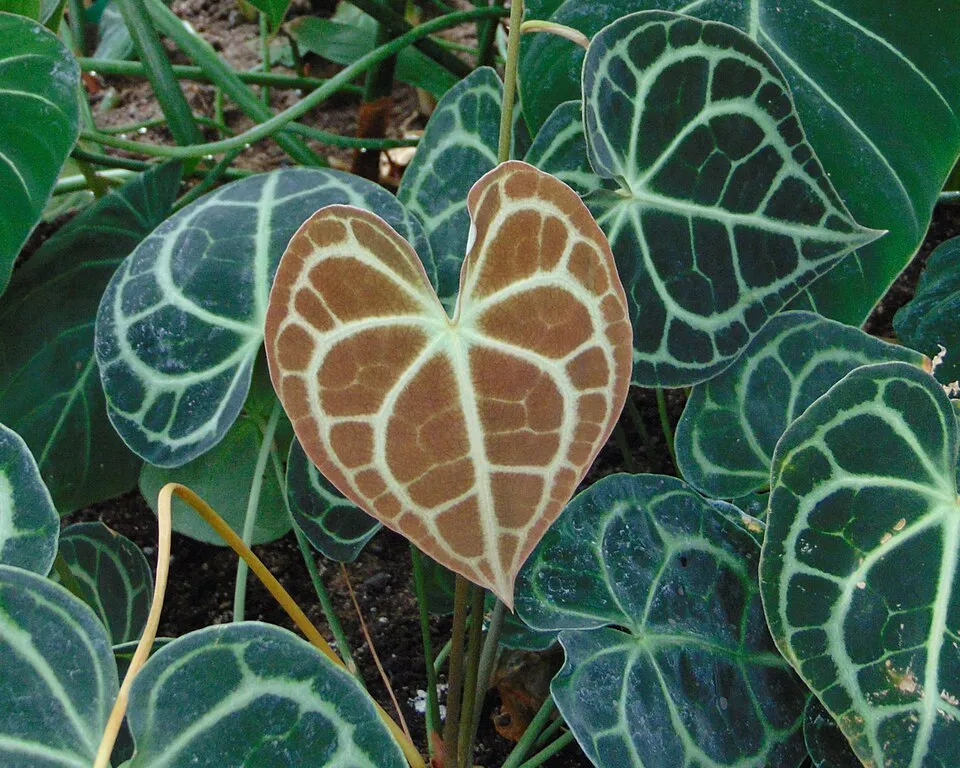
Anthurium clarinervium, commonly known as the 'Velvet Cardboard Anthurium' or 'Heart-leaf Anthurium', is a striking perennial herbaceous species belonging to the diverse Araceae family. Native to the humid, tropical rainforests of Chiapas, Mexico, this epiphytic or hemiepiphytic plant thrives in the shaded understory, often rooting on trees or rock crevices. Its distribution is localized to this specific region, highlighting its ecological niche. Morphologically, Anthurium clarinervium is primarily celebrated for its distinctive foliage rather than its relatively inconspicuous inflorescence.
The plant produces large, deeply cordate (heart-shaped) leaves that can measure up to 30 centimeters in length and width under optimal cultivation. The adaxial surface of these leaves exhibits a luxurious, deep dark green hue with a velvety texture, dramatically contrasted by thick, prominent, silvery-white to pale green veins that create a highly intricate, almost quilted or corrugated pattern. This venation is not merely ornamental but plays a crucial physiological role in efficient nutrient and water transport across the expansive leaf lamina. The abaxial surface typically presents a paler, matte green.
Unlike many of its Anthurium relatives cultivated for their vibrant spathes, A. clarinervium's spathe is typically a subtle green or brownish-green, enclosing a small, cream-colored spadix. Its primary significance is ecological within its native habitat and ornamental in cultivation, with specific traditional human medicinal uses remaining largely undocumented.
Trusted Scientific References
1. Authoritative external sources for Anthurium clarinervium
1.1 Wikipedia — Anthurium clarinervium
1.2 Kew POWO (Plants of the World Online)
1.3 PubMed — peer-reviewed research
1.4 NCBI Taxonomy Browser
1.5 GBIF — Global Biodiversity
1.6Anthurium Clarinervium should be interpreted through verified botanical identity, practical care, and responsible safety language. This recovery note adds the missing context needed for a complete profile: match light to the plant's habit, use well-drained soil, water according to season, and avoid unsupported medicinal or edible claims. For publishing, the plant can be presented as a source-backed indoor plant with clear care guidance, common problem diagnosis, and conservative safety wording.
1.1.Anthurium Clarinervium — Key Features
- ✓ <strong>Striking Foliage</strong> — Large, heart-shaped leaves with a distinctive velvety texture.
- ✓ <strong>Prominent Venation</strong> — Intricate network of silvery-white or pale green veins creating a corrugated pattern.
- ✓ <strong>Deep Green Coloration</strong> — Rich, dark green adaxial leaf surface.
- ✓ <strong>Epiphytic Nature</strong> — Grows on other plants or surfaces in its native habitat.
- ✓ <strong>Tropical Origin</strong> — Native to the humid rainforests of Chiapas, Mexico.
- ✓ <strong>Moderate Growth Rate</strong> — Develops slowly into a mature plant.
- ✓ <strong>Inconspicuous Flowers</strong> — Spathe and spadix are not the primary ornamental feature.
- ✓ <strong>High Humidity Requirement</strong> — Thrives in environments with consistent high moisture in the air.
- ✓ <strong>Toxicity</strong> — Contains calcium oxalate crystals, rendering it toxic if ingested.
- ✓ <strong>Ornamental Houseplant</strong> — Widely cultivated for aesthetic appeal in indoor settings.
1.2.Anthurium Clarinervium — Quick Summary
- ✓ Ornamental Plant — Prized for its large, velvety, heart-shaped leaves with prominent silver venation.
- ✓ Native to Mexico — Thrives in humid, tropical rainforest understories as an epiphyte.
- ✓ Contains Calcium Oxalate — All parts are toxic if ingested, causing irritation and swelling.
- ✓ High Humidity & Indirect Light — Essential care requirements for optimal growth.
- ✓ No Documented Medicinal Use — Primarily valued for its aesthetic appeal, not therapeutic properties.
- ✓ Pet and Child Safety — Keep out of reach due to toxicity.
2.Anthurium Clarinervium — Scientific Identity
3.Anthurium Clarinervium — Quick Facts
4.Anthurium Clarinervium — Appearance & Identification
5.Anthurium Clarinervium — Native Habitat
6.Anthurium Clarinervium — Water Requirements
- ✓ Light — Provide bright, indirect light; avoid direct sunlight which can scorch the velvet leaves of Anthurium clarinervium.
- ✓ Soil — Use a well-draining, porous, and airy potting mix, similar to an orchid mix, consisting of bark, perlite, and a small amount of peat or coco coir.
- ✓ Watering — Keep the soil consistently moist but not waterlogged; water when the top inch of soil feels dry to the touch, ensuring proper drainage.
- ✓ Temperature — Maintain warm temperatures between 70-90°F (21-32°C) during growing seasons, never below 60°F (15°C) to prevent cold damage.
- ✓ Humidity — Requires high humidity, ideally 60-80%; consider using a humidifier, pebble tray, or placing it in a naturally humid environment like a bathroom.
- ✓ Fertilization — Fertilize sparingly with a balanced liquid houseplant fertilizer diluted to half strength every 2-3 months during spring and summer.
- ✓ Pruning — Prune only to remove old, yellowing, or damaged leaves at their base using clean, sharp shears to maintain plant health and aesthetics.
- ✓ Repotting — Repot every 2-3 years or when root-bound, choosing a pot only 1-2 inches larger in diameter to prevent overwatering issues.
Reviewed by the Flora Medical Global Botanical Review Panel
Multi-disciplinary editorial group · Botany · Ethnobotany · Herbal-medicine literature
Who reviewed this: This page was checked by the Flora Medical Global Botanical Review Panel — an in-house editorial group of botany graduates, ethnobotany researchers, and horticulture practitioners who collectively maintain our 7,000+ plant encyclopedia. Meet the team.
Our 4-step verification process
1. Taxonomic verification
Scientific names and synonyms cross-checked against Kew POWO, World Flora Online, and The Plant List.
2. Phytochemical & medicinal cross-reference
Active compounds, traditional uses, and reported activities are cross-referenced with PubMed, USDA Dr. Duke's database, and peer-reviewed ethnobotanical literature.
3. Conservation & distribution check
Distribution, ecology, and conservation status confirmed against GBIF occurrence records and the IUCN Red List.
4. Editorial & safety review
Every entry passes an editorial pass for clarity, originality, and safety notices (toxicity, contraindications, dosage caveats) before publication.
Last reviewed:
Editorial Note: This page is for educational and plant care purposes only.
Written by: Flora Medical Global Editorial Team
Reviewed by: Flora Medical Global Botanical Review Panel
Last Updated: June 16, 2026







Anthurium Clarinervium — Comments & Community Reviews
Rate this plant