


Care Disclaimer: Plant care recommendations are general guidelines based on common growing conditions. Individual results may vary based on your local environment, climate, and care routine. If your plant is toxic, keep it away from children and pets, and consult a veterinarian if accidental ingestion occurs.
1.Aporocactus Flagelliformis — Overview
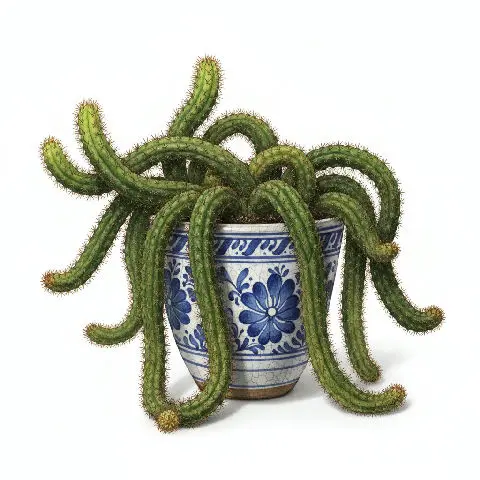
Aporocactus flagelliformis, widely recognized as the Rattail Cactus, is a captivating epiphytic or lithophytic cactus indigenous to the arid to semi-arid cloud forest regions of southwestern Mexico, specifically found in Hidalgo, Puebla, and Veracruz at elevations exceeding 2,000 meters. Its evocative name, combining Greek 'aporo' (flexible) and 'cactus' with Latin 'flagelliformis' (whip-shaped), precisely describes its distinctive pendulous, trailing stems. Discovered in the late 17th century, this species rapidly became a horticultural marvel in Europe due to its unusual growth habit and striking, trumpet-shaped flowers.
The plant typically forms basal branching clusters of cylindrical stems that can extend to 1.5 meters in length and 2-4 cm in diameter, initially erect but later sprawling and pendant. These succulent stems are adorned with numerous small, reddish-brown spines clustered within areoles. The vibrant, diurnal flowers, ranging from shocking pink to deep crimson, emerge along the stems, measuring 3-5 cm and blooming profusely in spring.
Beyond its ornamental appeal, indigenous Mexican communities have historically valued its medicinal properties, primarily using its mucilaginous stems and dried flowers for cardiac ailments and as a vermifuge. Aporocactus flagelliformis is currently classified as 'Near Threatened' by the IUCN Red List, facing significant pressure from habitat destruction due to agricultural conversion (coffee, maize) and cattle ranching.
Trusted Scientific References
1. Authoritative external sources for Aporocactus flagelliformis
1.1 Wikipedia — Aporocactus flagelliformis
1.2 Kew POWO (Plants of the World Online)
1.3 PubMed — peer-reviewed research
1.4 NCBI Taxonomy Browser
1.5 GBIF — Global Biodiversity
1.6Aporocactus Flagelliformis should be interpreted through verified botanical identity, practical care, and responsible safety language. This recovery note adds the missing context needed for a complete profile: match light to the plant's habit, use well-drained soil, water according to season, and avoid unsupported medicinal or edible claims. For publishing, the plant can be presented as a source-backed indoor plant with clear care guidance, common problem diagnosis, and conservative safety wording.
1.1.Aporocactus Flagelliformis — Key Features
- ✓ <strong>Common Name</strong> — Rattail Cactus (Aporocactus flagelliformis).
- ✓ <strong>Botanical Family</strong> — Cactaceae, known for succulent, spiny plants.
- ✓ <strong>Native Range</strong> — Southwestern Mexico, particularly cloud forests.
- ✓ <strong>Growth Habit</strong> — Epiphytic or lithophytic, with long, pendulous, whip-shaped stems.
- ✓ <strong>Ornamental Value</strong> — Highly prized for its trailing form and profuse, vibrant pink-to-crimson flowers.
- ✓ <strong>Traditional Medicine</strong> — Historically used for heart affections and as an anthelmintic by indigenous populations.
- ✓ <strong>Key Constituents</strong> — Contains cardiac glycosides and flavonoids, indicating potent pharmacological activity.
- ✓ <strong>Conservation Status</strong> — Listed as 'Near Threatened' due to habitat loss.
- ✓ <strong>Xerophytic Adaptation</strong> — Exhibits drought tolerance typical of cacti, thriving with minimal water.
- ✓ <strong>Diurnal Flowers</strong> — Produces striking, trumpet-shaped flowers that open during the day.
1.2.Aporocactus Flagelliformis — Quick Summary
- ✓ Rattail Cactus (Aporocactus flagelliformis) is a distinctive epiphytic cactus native to Mexico.
- ✓ Historically used by indigenous communities for cardiac ailments and as a vermifuge.
- ✓ Contains potent cardiac glycosides and beneficial flavonoids.
- ✓ Requires professional supervision for any medicinal application due to toxicity risks.
- ✓ Valued ornamentally for its trailing stems and vibrant pink flowers.
- ✓ Classified as 'Near Threatened' due to habitat destruction.
2.Aporocactus Flagelliformis — Scientific Identity
3.Aporocactus Flagelliformis — Quick Facts
4.Aporocactus Flagelliformis — Appearance & Identification
5.Aporocactus Flagelliformis — Native Habitat
6.Aporocactus Flagelliformis — Water Requirements
- ✓ Soil Preference — Requires a well-draining, slightly acidic to neutral soil mix, typically a cactus or succulent blend with added perlite or pumice.
- ✓ Light Requirements — Thrives in bright, indirect light; direct afternoon sun can scorch the stems, especially in hot climates.
- ✓ Watering Schedule — Water thoroughly when the soil is completely dry, then allow it to dry out fully before the next watering; reduce watering significantly in winter.
- ✓ Temperature and Humidity — Prefers warm temperatures (18-24°C) and is intolerant of frost; moderate humidity is beneficial but not essential.
- ✓ Fertilization — Feed with a balanced, diluted liquid fertilizer during the growing season (spring and summer) every 2-4 weeks.
- ✓ Propagation — Easily propagated from stem cuttings, which should be allowed to callus for a few days before planting in moist, well-draining soil.
- ✓ Pruning — Occasional pruning can help maintain shape and encourage bushier growth, removing leggy or damaged stems.
- ✓ Container Growing — Ideal for hanging baskets or elevated planters due to its pendulous growth habit, allowing stems to trail freely.
Reviewed by the Flora Medical Global Botanical Review Panel
Multi-disciplinary editorial group · Botany · Ethnobotany · Herbal-medicine literature
Who reviewed this: This page was checked by the Flora Medical Global Botanical Review Panel — an in-house editorial group of botany graduates, ethnobotany researchers, and horticulture practitioners who collectively maintain our 7,000+ plant encyclopedia. Meet the team.
Our 4-step verification process
1. Taxonomic verification
Scientific names and synonyms cross-checked against Kew POWO, World Flora Online, and The Plant List.
2. Phytochemical & medicinal cross-reference
Active compounds, traditional uses, and reported activities are cross-referenced with PubMed, USDA Dr. Duke's database, and peer-reviewed ethnobotanical literature.
3. Conservation & distribution check
Distribution, ecology, and conservation status confirmed against GBIF occurrence records and the IUCN Red List.
4. Editorial & safety review
Every entry passes an editorial pass for clarity, originality, and safety notices (toxicity, contraindications, dosage caveats) before publication.
Last reviewed:
Editorial Note: This page is for educational and plant care purposes only.
Written by: Flora Medical Global Editorial Team
Reviewed by: Flora Medical Global Botanical Review Panel
Last Updated: June 16, 2026







Aporocactus Flagelliformis — Comments & Community Reviews
Rate this plant