
Care Disclaimer: Plant care recommendations are general guidelines based on common growing conditions. Individual results may vary based on your local environment, climate, and care routine. If your plant is toxic, keep it away from children and pets, and consult a veterinarian if accidental ingestion occurs.
1.Black Gold Snake Plant — Overview
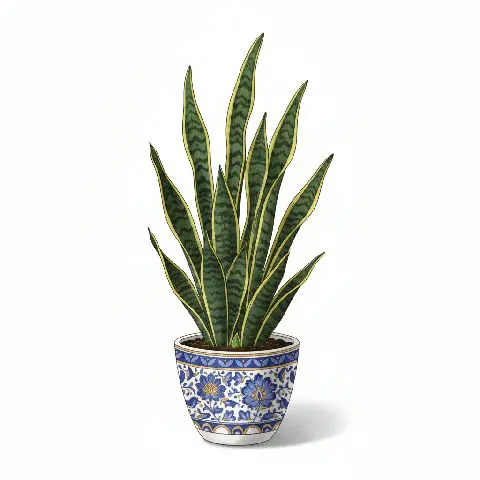
The Black Gold Snake Plant, scientifically known as Dracaena trifasciata black, is a highly esteemed cultivar belonging to the Asparagaceae family. Native to the arid, rocky regions of West Africa, this resilient perennial thrives in conditions ranging from full sun to partial shade, demonstrating remarkable drought tolerance. Morphologically, it is characterized by its striking upright, sword-like leaves that can reach heights of up to three feet.
The foliage presents a deep, almost black-green center, dramatically contrasted by vibrant golden-yellow margins, giving it its 'Black Gold' appellation. These stiff, succulent leaves emerge from a robust rhizomatous root system, allowing for easy propagation and resilience. While primarily cultivated as an ornamental houseplant due to its aesthetic appeal and low maintenance requirements, its ecological significance lies in its proven capacity for indoor air purification.
This plant's adaptability to diverse indoor environments, coupled with its unique visual appeal, makes it a popular choice for enhancing both the beauty and air quality of domestic and professional spaces. Its taxonomic history includes a reclassification from the genus Sansevieria to Dracaena, reflecting modern phylogenetic understanding.
Trusted Scientific References
1. Authoritative external sources for Dracaena trifasciata black
1.1 Wikipedia — Dracaena trifasciata black
1.2 Kew POWO (Plants of the World Online)
1.3 PubMed — peer-reviewed research
1.4 NCBI Taxonomy Browser
1.5 GBIF — Global Biodiversity
1.6Black Gold Snake Plant should be interpreted through verified botanical identity, practical care, and responsible safety language. This recovery note adds the missing context needed for a complete profile: match light to the plant's habit, use well-drained soil, water according to season, and avoid unsupported medicinal or edible claims. For publishing, the plant can be presented as a source-backed indoor plant with clear care guidance, common problem diagnosis, and conservative safety wording.
1.1.Black Gold Snake Plant — Key Features
- ✓ <strong>Superior indoor air</strong> — Superior indoor air purification capabilities, targeting VOCs.
- ✓ <strong>Striking dark green leaves with prominent golden</strong> — yellow margins.
- ✓ <strong>Exceptionally low maintenance</strong> — Exceptionally low maintenance and resilient, ideal for beginners.
- ✓ <strong>Tolerates a wide</strong> — Tolerates a wide range of light conditions, from low to bright indirect.
- ✓ <strong>Efficient removal of</strong> — Efficient removal of toxins like formaldehyde, benzene, and xylene.
- ✓ <strong>Native to tropical</strong> — Native to tropical West Africa, adaptable to indoor climates.
- ✓ <strong>Classified within the</strong> — Classified within the Asparagaceae family (formerly Sansevieria).
- ✓ <strong>Non</strong> — toxic through atmospheric interaction, but toxic if ingested.
- ✓ <strong>Drought</strong> — tolerant due to succulent-like leaves and CAM photosynthesis.
- ✓ <strong>Contributes to improved</strong> — Contributes to improved indoor environmental quality and well-being.
1.2.Black Gold Snake Plant — Quick Summary
- ✓ Exceptional indoor air purifier, removing common VOCs.
- ✓ Striking ornamental foliage with low maintenance.
- ✓ Toxic if ingested by humans or pets due to saponins.
- ✓ Primarily beneficial for environmental health, not internal medicine.
- ✓ Highly drought-tolerant and adaptable to various light conditions.
- ✓ Reclassified from Sansevieria to Dracaena.
2.Black Gold Snake Plant — Scientific Identity
3.Black Gold Snake Plant — Quick Facts
4.Black Gold Snake Plant — Appearance & Identification
5.Black Gold Snake Plant — Native Habitat
6.Black Gold Snake Plant — Water Requirements
- ✓ Light Requirements — Thrives in bright, indirect light but is remarkably tolerant of low-light conditions, making it versatile for various indoor placements.
- ✓ Watering Schedule — Allow the soil to dry out completely between waterings to prevent root rot, as Dracaena trifasciata black is highly drought-tolerant.
- ✓ Soil Composition — Requires a well-draining potting mix, ideally one formulated for succulents or cacti, to ensure adequate aeration and prevent waterlogging.
- ✓ Temperature Preferences — Prefers average room temperatures between 18-35°C (65-95°F) and should be protected from cold drafts or temperatures below 10°C (50°F).
- ✓ Humidity Levels — Tolerates average household humidity and does not require special humidity considerations, adapting well to typical indoor environments.
- ✓ Propagation Techniques — Easily propagated through rhizome division or by rooting leaf cuttings in water or well-draining soil during the warmer growing season.
- ✓ Fertilization Regime — Fertilize sparingly, typically once or twice during the spring and summer growing months, using a balanced liquid fertilizer diluted to half strength.
- ✓ Pest and Disease Management — Generally pest-resistant, but occasionally susceptible to mealybugs or spider mites; ensure good air circulation and avoid overwatering to prevent fungal issues.
Reviewed by the Flora Medical Global Botanical Review Panel
Multi-disciplinary editorial group · Botany · Ethnobotany · Herbal-medicine literature
Who reviewed this: This page was checked by the Flora Medical Global Botanical Review Panel — an in-house editorial group of botany graduates, ethnobotany researchers, and horticulture practitioners who collectively maintain our 7,000+ plant encyclopedia. Meet the team.
Our 4-step verification process
1. Taxonomic verification
Scientific names and synonyms cross-checked against Kew POWO, World Flora Online, and The Plant List.
2. Phytochemical & medicinal cross-reference
Active compounds, traditional uses, and reported activities are cross-referenced with PubMed, USDA Dr. Duke's database, and peer-reviewed ethnobotanical literature.
3. Conservation & distribution check
Distribution, ecology, and conservation status confirmed against GBIF occurrence records and the IUCN Red List.
4. Editorial & safety review
Every entry passes an editorial pass for clarity, originality, and safety notices (toxicity, contraindications, dosage caveats) before publication.
Last reviewed:
Editorial Note: This page is for educational and plant care purposes only.
Written by: Flora Medical Global Editorial Team
Reviewed by: Flora Medical Global Botanical Review Panel
Last Updated: June 16, 2026







Black Gold Snake Plant — Comments & Community Reviews
Rate this plant