


Care Disclaimer: Plant care recommendations are general guidelines based on common growing conditions. Individual results may vary based on your local environment, climate, and care routine. If your plant is toxic, keep it away from children and pets, and consult a veterinarian if accidental ingestion occurs.
1.Brazilian Rain Tree Bonsai — Overview
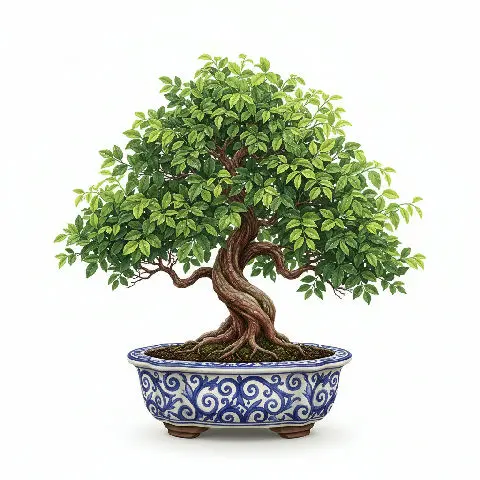
The Brazilian Rain Tree, scientifically known as Pithecellobium tortum, is an exquisite leguminous tree indigenous to the warm, coastal regions of southeastern Brazil. Its distinctive common name, 'Rain Tree,' stems from its fascinating nyctinastic behavior, where its delicate bipinnate leaves fold inward at dusk or during periods of environmental stress, resembling a plant in slumber. This unique attribute, combined with its naturally small leaflets, intricate branch ramification, characteristic tortuous or twisted trunk development, and appealing fissured bark, makes Pithecellobium tortum an exceptionally prized species in the ancient art of bonsai.
These morphological traits allow even young specimens to convey an impression of considerable age and wisdom. Taxonomically, it belongs to the Fabaceae family, a diverse group of flowering plants, and has sometimes been misidentified horticulturally before its reclassification. While specific documented ethnomedicinal uses for Pithecellobium tortum within traditional systems like Ayurveda, TCM, or Unani are notably scarce, its broader Fabaceae relatives are often employed in various traditional remedies for their anti-inflammatory or antimicrobial properties.
Modern pharmacological interest in the wider Pithecellobium genus is emerging, primarily focusing on the potential antioxidant and cytotoxic activities of its triterpenoid saponins and flavonoids. Culturally, while not historically significant in ancient medical texts, its contemporary popularity in horticulture underscores its aesthetic value and the dynamic element its leaf movement adds to any collection.
Trusted Scientific References
1. Authoritative external sources for Pithecellobium tortum
1.1 Wikipedia — Pithecellobium tortum
1.2 Kew POWO (Plants of the World Online)
1.3 PubMed — peer-reviewed research
1.4 NCBI Taxonomy Browser
1.5 GBIF — Global Biodiversity
1.6Brazilian Rain Tree Bonsai should be interpreted through verified botanical identity, practical care, and responsible safety language. This recovery note adds the missing context needed for a complete profile: match light to the plant's habit, use well-drained soil, water according to season, and avoid unsupported medicinal or edible claims. For publishing, the plant can be presented as a source-backed indoor plant with clear care guidance, common problem diagnosis, and conservative safety wording.
1.1.Brazilian Rain Tree Bonsai — Key Features
- ✓ <strong>Nyctinastic Leaf Movement</strong> — Leaves fold inward at night or during drought.
- ✓ <strong>Tortuous Trunk Development</strong> — Naturally develops an appealing twisted trunk, ideal for bonsai.
- ✓ <strong>Fine Ramification</strong> — Produces dense, delicate branching structure.
- ✓ <strong>Fissured Bark</strong> — Develops attractive, aged-looking bark even on young trees.
- ✓ <strong>Fragrant, Puffy Flowers</strong> — Bears small, white to pinkish, sweet-scented flowers.
- ✓ <strong>Rapid Growth</strong> — Grows relatively quickly under ideal conditions, aiding bonsai development.
- ✓ <strong>Leguminous Species</strong> — Belongs to the Fabaceae family, often forming nitrogen-fixing root nodules.
- ✓ <strong>Tropical Origin</strong> — Native to warm, humid coastal regions of southeastern Brazil.
- ✓ <strong>High Humidity Requirement</strong> — Thrives in environments with consistent high humidity.
- ✓ <strong>Frost Intolerant</strong> — Must be protected from cold temperatures below 7°C (45°F).
1.2.Brazilian Rain Tree Bonsai — Quick Summary
- ✓ Brazilian Rain Tree (Pithecellobium tortum) is a prized tropical bonsai species from Brazil.
- ✓ Exhibits unique nyctinastic leaf movement, folding at night or under stress.
- ✓ Valued for its twisted trunk, fine ramification, and fragrant, puffy flowers.
- ✓ Requires consistent moisture, high humidity, and protection from frost.
- ✓ Limited documented medicinal uses; research on genus compounds suggests antioxidant potential.
- ✓ Primarily appreciated for its horticultural beauty and contribution to well-being.
2.Brazilian Rain Tree Bonsai — Scientific Identity
3.Brazilian Rain Tree Bonsai — Quick Facts
4.Brazilian Rain Tree Bonsai — Appearance & Identification
5.Brazilian Rain Tree Bonsai — Native Habitat
6.Brazilian Rain Tree Bonsai — Water Requirements
- ✓ Placement — Prefers a sunny outdoor spot during warmer growing seasons, but must be brought indoors when temperatures drop below 7°C (45°F), requiring a south-facing window or grow lights.
- ✓ Watering — Keep the rootball consistently moist but never waterlogged; avoid complete drying out. Indoor specimens benefit from increased humidity via misting or a pebble tray.
- ✓ Fertilizing — Apply a balanced liquid fertilizer weekly during the active growing season and reduce to monthly during cooler, less active periods.
- ✓ Pruning — When pruning, leave a small stub to prevent die-back, as the Brazilian Rain Tree can be sensitive to aggressive cuts. Regular trimming of shoots is essential for shape.
- ✓ Wiring and Shaping — Wiring is possible, but for delicate branches, the use of guy wires or clip-and-grow techniques is often preferred to avoid damage.
- ✓ Repotting — Repot every two to three years, performing moderate root pruning. A well-draining soil mix is critical to prevent root rot and ensure aeration.
- ✓ Propagation — Can be propagated effectively from seeds, stem cuttings, or through air-layering, allowing for new plant generation.
- ✓ Pest Management — While generally resistant, monitor for nematodes (root nodules), aphids, spider mites, and whiteflies, especially on indoor plants, and treat as necessary.
Reviewed by the Flora Medical Global Botanical Review Panel
Multi-disciplinary editorial group · Botany · Ethnobotany · Herbal-medicine literature
Who reviewed this: This page was checked by the Flora Medical Global Botanical Review Panel — an in-house editorial group of botany graduates, ethnobotany researchers, and horticulture practitioners who collectively maintain our 7,000+ plant encyclopedia. Meet the team.
Our 4-step verification process
1. Taxonomic verification
Scientific names and synonyms cross-checked against Kew POWO, World Flora Online, and The Plant List.
2. Phytochemical & medicinal cross-reference
Active compounds, traditional uses, and reported activities are cross-referenced with PubMed, USDA Dr. Duke's database, and peer-reviewed ethnobotanical literature.
3. Conservation & distribution check
Distribution, ecology, and conservation status confirmed against GBIF occurrence records and the IUCN Red List.
4. Editorial & safety review
Every entry passes an editorial pass for clarity, originality, and safety notices (toxicity, contraindications, dosage caveats) before publication.
Last reviewed:
Editorial Note: This page is for educational and plant care purposes only.
Written by: Flora Medical Global Editorial Team
Reviewed by: Flora Medical Global Botanical Review Panel
Last Updated: June 16, 2026







Brazilian Rain Tree Bonsai — Comments & Community Reviews
Rate this plant