


Care Disclaimer: Plant care recommendations are general guidelines based on common growing conditions. Individual results may vary based on your local environment, climate, and care routine. If your plant is toxic, keep it away from children and pets, and consult a veterinarian if accidental ingestion occurs.
1.Breynia Disticha — Overview
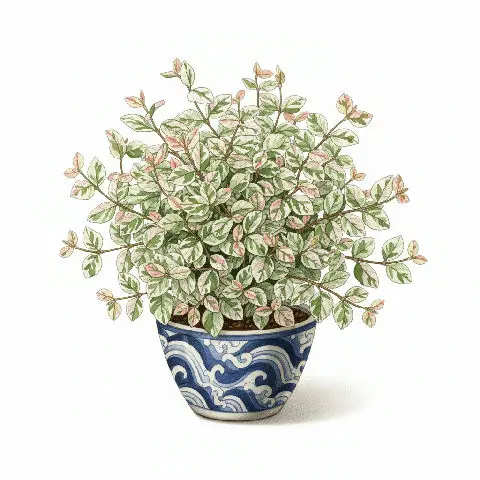
Breynia disticha, commonly known as Snowbush, Hawaiian Snowbush, or Sweetpea Bush, is a striking evergreen shrub belonging to the family Phyllanthaceae. Native to the southwestern Pacific islands, specifically New Caledonia and Vanuatu, this species has gained global recognition primarily for its exceptional ornamental value.
Its journey into cultivation began in the 19th century, driven by its aesthetic appeal rather than any documented ancient medicinal uses. The botanical epithet 'disticha' aptly describes its distinctive two-ranked, or distichous, arrangement of leaves along its slender, often reddish stems, contributing to its delicate, fern-like appearance.
Morphologically, Breynia disticha typically grows as a small to medium-sized shrub, reaching heights of 1 to 3 meters in its natural habitat, though often maintained at smaller sizes in cultivated settings. Its most captivating feature is its foliage, comprising small, oval to ovate or nearly round leaves that are alternately arranged. The variegation patterns are diverse and vivid, with cultivars displaying green leaves heavily splashed, speckled, or edged with white, cream, pink, or even red.
The 'Roseopicta' cultivar is particularly noted for its intense pink and red hues, which become more pronounced in bright light, creating a 'snow-dusted' effect that gives rise to its common name, Snowbush. The flowers of Breynia disticha are inconspicuous; they are small, greenish-yellow, lack prominent petals, and emerge from the leaf axils. The plant is monoecious, bearing both male and female flowers on the same individual.
These give way to small, fleshy, capsular fruits. Taxonomically, there is ongoing discussion regarding its classification, with some proposals suggesting its merger into the broader genus Phyllanthus, reflecting close phylogenetic relationships within the Phyllanthaceae family.
Trusted Scientific References
1. Authoritative external sources for Breynia disticha
1.1 Wikipedia — Breynia disticha
1.2 Kew POWO (Plants of the World Online)
1.3 PubMed — peer-reviewed research
1.4 NCBI Taxonomy Browser
1.5 GBIF — Global Biodiversity
1.1.Breynia Disticha — Key Features
- ✓ <strong>Striking Variegated Foliage</strong> — Displays vibrant patterns of green, white, cream, pink, and red on its leaves.
- ✓ <strong>Two</strong> — Ranked Leaf Arrangement — The specific epithet 'disticha' refers to its distinctive distichous leaf arrangement.
- ✓ <strong>Evergreen Shrub</strong> — Maintains its foliage year-round, offering continuous ornamental appeal.
- ✓ <strong>Inconspicuous Flowers</strong> — Produces small, greenish-yellow, non-showy flowers in leaf axils.
- ✓ <strong>Small Fleshy Fruits</strong> — Develops into small, capsular fruits after flowering.
- ✓ <strong>Native to SW Pacific</strong> — Indigenous to New Caledonia and Vanuatu.
- ✓ <strong>High Ornamental Value</strong> — Widely cultivated globally for its decorative aesthetic in horticulture.
- ✓ <strong>Easy Propagation</strong> — Can be propagated effectively from seeds, stem cuttings, and root suckers.
- ✓ <strong>Potential for Invasiveness</strong> — Known to spread aggressively via suckers, requiring careful placement.
- ✓ <strong>Phyllanthaceae Family Member</strong> — Part of a botanically diverse family with ongoing taxonomic review.
1.2.Breynia Disticha — Quick Summary
- ✓ Breynia disticha, or Snowbush, is a striking variegated ornamental shrub.
- ✓ Native to the southwestern Pacific, it belongs to the Phyllanthaceae family.
- ✓ Renowned for its vibrant green, white, pink, and red foliage, particularly the 'Roseopicta' cultivar.
- ✓ Primarily cultivated for its aesthetic appeal in gardens, hedges, and as an indoor plant.
- ✓ Lacks documented traditional medicinal uses in major systems like Ayurveda or TCM.
- ✓ Can exhibit invasive tendencies in tropical climates due to prolific suckering.
2.Breynia Disticha — Scientific Identity
3.Breynia Disticha — Quick Facts
4.Breynia Disticha — Appearance & Identification
5.Breynia Disticha — Native Habitat
6.Breynia Disticha — Water Requirements
- ✓ Light Requirements — Breynia disticha thrives best in partial shade, though variegated forms often display more intense coloration when exposed to full sun.
- ✓ Soil Preferences — It prefers a consistently moist, fertile, and well-draining soil to support healthy growth and vibrant foliage.
- ✓ Watering — Regular watering is essential to keep the soil moist, especially in warmer climates, as it does not tolerate prolonged drought.
- ✓ Pruning and Maintenance — The plant responds well to clipping and can be easily maintained in a compact form, making it an excellent choice for hedges or shapely ornamental specimens.
- ✓ Propagation — It can be readily propagated by seeds, stem cuttings, or by separating the numerous root suckers it produces.
- ✓ Container Growing — Breynia disticha is well-suited for container cultivation, particularly in cooler climates where it can be brought indoors during winter months.
- ✓ Invasive Potential — Be aware that the plant can sucker profusely and has escaped cultivation to become naturalized in some tropical areas, such as Hawaii; therefore, placement should be considered carefully.
Reviewed by the Flora Medical Global Botanical Review Panel
Multi-disciplinary editorial group · Botany · Ethnobotany · Herbal-medicine literature
Who reviewed this: This page was checked by the Flora Medical Global Botanical Review Panel — an in-house editorial group of botany graduates, ethnobotany researchers, and horticulture practitioners who collectively maintain our 7,000+ plant encyclopedia. Meet the team.
Our 4-step verification process
1. Taxonomic verification
Scientific names and synonyms cross-checked against Kew POWO, World Flora Online, and The Plant List.
2. Phytochemical & medicinal cross-reference
Active compounds, traditional uses, and reported activities are cross-referenced with PubMed, USDA Dr. Duke's database, and peer-reviewed ethnobotanical literature.
3. Conservation & distribution check
Distribution, ecology, and conservation status confirmed against GBIF occurrence records and the IUCN Red List.
4. Editorial & safety review
Every entry passes an editorial pass for clarity, originality, and safety notices (toxicity, contraindications, dosage caveats) before publication.
Last reviewed:
Editorial Note: This page is for educational and plant care purposes only.
Written by: Flora Medical Global Editorial Team
Reviewed by: Flora Medical Global Botanical Review Panel
Last Updated: June 16, 2026







Breynia Disticha — Comments & Community Reviews
Rate this plant