


Care Disclaimer: Plant care recommendations are general guidelines based on common growing conditions. Individual results may vary based on your local environment, climate, and care routine. If your plant is toxic, keep it away from children and pets, and consult a veterinarian if accidental ingestion occurs.
1.Bromeliaceae Scarlet Star — Overview
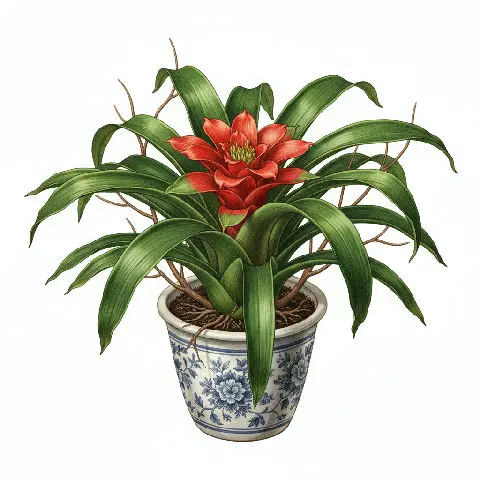
Guzmania sanguinea, commonly known as Scarlet Star, is a captivating epiphytic bromeliad native to the humid tropical rainforests of Central and South America, particularly flourishing in regions of Ecuador and Colombia. Its name is a tribute to the Spanish botanist Anastasio Guzman, while 'sanguinea' is Latin for 'blood-red,' aptly describing its most dramatic feature—the brilliant scarlet bracts that emerge during its flowering cycle.
Discovered and formally described in the 19th century, this species holds significant botanical interest due to its specialized adaptations for an arboreal lifestyle.
Unlike many terrestrial plants, Guzmania sanguinea thrives by attaching itself to trees, absorbing essential nutrients and moisture primarily through specialized scales (trichomes) on its leaves and from the central 'tank' or 'urn' formed by its tightly overlapping leaf bases. This unique survival strategy allows it to flourish in the shaded understory of dense rainforests, often at moderate elevations where competition for light and ground-based resources is intense. The plant forms a striking rosette of glossy, strap-like leaves, typically dark green, which can extend up to 30-40 cm in length.
The central cup collects rainwater and decaying organic matter, providing a vital nutrient reservoir. While the true flowers are small and often inconspicuous, usually white or yellow, they emerge from the center of the brilliant red inner bracts. These intensely colored bracts are the plant's primary ornamental draw, often maintaining their vibrant hue for several months, signaling to potential pollinators and delighting human observers alike.
Trusted Scientific References
1. Authoritative external sources for Guzmania sanguinea
1.1 Wikipedia — Guzmania sanguinea
1.2 Kew POWO (Plants of the World Online)
1.3 PubMed — peer-reviewed research
1.4 NCBI Taxonomy Browser
1.5 GBIF — Global Biodiversity
1.6Bromeliaceae Scarlet Star should be interpreted through verified botanical identity, practical care, and responsible safety language. This recovery note adds the missing context needed for a complete profile: match light to the plant's habit, use well-drained soil, water according to season, and avoid unsupported medicinal or edible claims. For publishing, the plant can be presented as a source-backed indoor plant with clear care guidance, common problem diagnosis, and conservative safety wording.
1.1.Bromeliaceae Scarlet Star — Key Features
- ✓ <strong>Botanical Name</strong> — *Guzmania sanguinea*
- ✓ <strong>Common Name</strong> — Scarlet Star
- ✓ <strong>Family</strong> — Bromeliaceae
- ✓ <strong>Native Range</strong> — Tropical rainforests of Central and South America
- ✓ <strong>Growth Habit</strong> — Epiphytic, forming a dense rosette of strap-like leaves
- ✓ <strong>Striking Bracts</strong> — Features brilliant scarlet inner bracts that maintain their intense coloration for several months, overshadowing the small true flowers.
- ✓ <strong>Central Water Reservoir</strong> — Collects rainwater and nutrients in its leaf 'urn' or 'tank', a key adaptation for its epiphytic lifestyle.
- ✓ <strong>Pet</strong> — Friendly — Non-toxic to cats, dogs, and other household pets, ensuring safety in family environments.
- ✓ <strong>Air Purifier</strong> — Helps improve indoor air quality by absorbing certain volatile organic compounds and releasing oxygen.
- ✓ <strong>Low Light Tolerance</strong> — Thrives in bright, indirect light conditions, making it suitable for many indoor settings away from harsh direct sun.
1.2.Bromeliaceae Scarlet Star — Quick Summary
- ✓ Striking Tropical Epiphyte — *Guzmania sanguinea*, or Scarlet Star, is an epiphytic bromeliad cherished for its vibrant, long-lasting scarlet bracts that emerge from a rosette of green leaves.
- ✓ Low Maintenance Indoor Plant — Known for its ease of care and adaptability to indoor conditions, making it an excellent choice for beginners and busy individuals seeking lush greenery.
- ✓ Air-Purifying & Non-Toxic — Contributes to cleaner indoor air by filtering certain toxins and is completely safe for homes with children and pets.
- ✓ Unique Watering Method — Absorbs water primarily through its central 'tank' or 'urn' formed by overlapping leaf bases, which should be kept filled with fresh water.
- ✓ Propagated by Pups — The mother plant flowers once and then slowly declines, but produces offsets or 'pups' that can be separated and replanted to continue the life cycle.
2.Bromeliaceae Scarlet Star — Scientific Identity
3.Bromeliaceae Scarlet Star — Quick Facts
4.Bromeliaceae Scarlet Star — Appearance & Identification
5.Bromeliaceae Scarlet Star — Native Habitat
6.Bromeliaceae Scarlet Star — Water Requirements
- ✓ Light — Provide bright, indirect sunlight; direct sun can scorch leaves, making north or east-facing windows ideal for indoor placement or a shade net outdoors.
- ✓ Watering — Fill the central 'cup' or 'tank' with filtered water weekly, changing it regularly (every 1-2 days) to prevent stagnation, while keeping the potting mix only slightly moist to avoid root rot.
- ✓ Humidity & Temperature — Maintain high humidity (around 60-80%) using a humidity tray or misting the plant regularly, and keep temperatures between 18°C and 30°C, avoiding cold drafts below 12°C.
- ✓ Potting Medium — Use a well-draining, airy mix specifically formulated for orchids or bromeliads, such as a blend of orchid bark, coco peat, peat moss, perlite, and charcoal.
- ✓ Fertilization — During the active growing season (spring to summer), apply a diluted liquid balanced fertilizer (e.g., 10-10-10) every 4-6 weeks directly into the central cup or as a foliar spray, skipping winter fertilization.
- ✓ Pruning & Grooming — Remove faded flower bracts and any dried or dying leaves by hand or with sterile scissors. After the mother plant's bloom fades and it begins to decline, separate 'pups' (offsets) when they reach 1/3 to 1/2 the size of the mother plant to encourage new growth.
- ✓ Propagation — Propagate readily by carefully twisting and pulling pups away from the base of the mother plant once they are 6-8 inches tall, then replanting them in a small pot with a suitable bromeliad mix.
Reviewed by the Flora Medical Global Botanical Review Panel
Multi-disciplinary editorial group · Botany · Ethnobotany · Herbal-medicine literature
Who reviewed this: This page was checked by the Flora Medical Global Botanical Review Panel — an in-house editorial group of botany graduates, ethnobotany researchers, and horticulture practitioners who collectively maintain our 7,000+ plant encyclopedia. Meet the team.
Our 4-step verification process
1. Taxonomic verification
Scientific names and synonyms cross-checked against Kew POWO, World Flora Online, and The Plant List.
2. Phytochemical & medicinal cross-reference
Active compounds, traditional uses, and reported activities are cross-referenced with PubMed, USDA Dr. Duke's database, and peer-reviewed ethnobotanical literature.
3. Conservation & distribution check
Distribution, ecology, and conservation status confirmed against GBIF occurrence records and the IUCN Red List.
4. Editorial & safety review
Every entry passes an editorial pass for clarity, originality, and safety notices (toxicity, contraindications, dosage caveats) before publication.
Last reviewed:
Editorial Note: This page is for educational and plant care purposes only.
Written by: Flora Medical Global Editorial Team
Reviewed by: Flora Medical Global Botanical Review Panel
Last Updated: June 16, 2026







Bromeliaceae Scarlet Star — Comments & Community Reviews
Rate this plant