
Care Disclaimer: Plant care recommendations are general guidelines based on common growing conditions. Individual results may vary based on your local environment, climate, and care routine. If your plant is toxic, keep it away from children and pets, and consult a veterinarian if accidental ingestion occurs.
1.Bromeliad Neoregelia — Overview
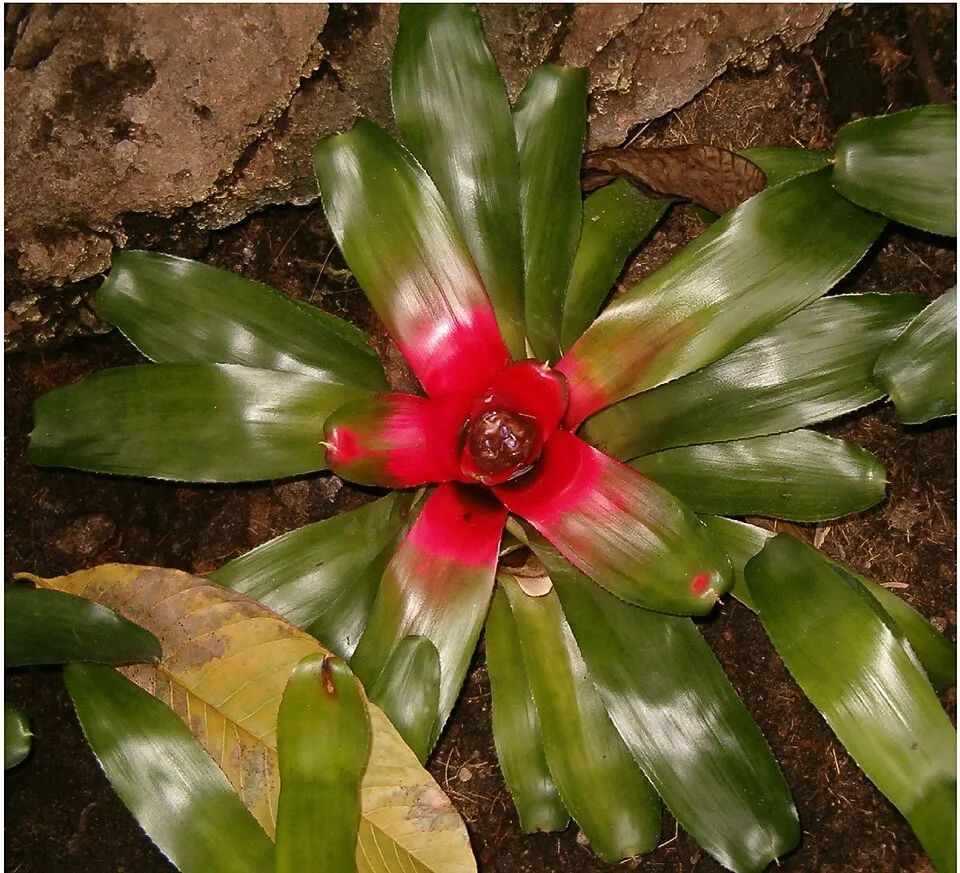
Neoregelia carolinae, widely recognized as the Blushing Bromeliad or blushing bromeliad, is a captivating evergreen perennial species belonging to the diverse Bromeliaceae family. Native to the lush tropical rainforests of southeastern Brazil, specifically found across regions like Espírito Santo, Minas Gerais, and Rio de Janeiro, this plant thrives as an epiphyte, anchoring itself to trees, though it can occasionally establish as a lithophyte on rocks or even terrestrially. Its distinct morphology features a central rosette of broad, strap-like leaves that form a 'tank' or 'cup,' an ingenious adaptation for collecting rainwater and organic debris, providing essential nutrients and moisture.
The most striking characteristic, from which it derives its common name, is the dramatic color transformation of its innermost leaves or bracts, which 'blush' a vivid red or pink hue as the plant prepares to flower. This vibrant display serves not the flowers themselves, which are often small and inconspicuous, but rather as an elaborate mechanism to attract pollinators in its native ecosystem. Taxonomically, Neoregelia carolinae exemplifies the genus's adaptation to humid, shaded understory environments.
While primarily celebrated for its ornamental value in horticulture, its ecological role in supporting micro-habitats within its water-filled rosettes is significant. Research into N. carolinae has largely concentrated on its unique horticultural traits, propagation, and ecological interactions, with direct pharmacological studies being less extensive compared to other bromeliad genera.
Trusted Scientific References
1. Authoritative external sources for Neoregelia carolinae
1.1 Wikipedia — Neoregelia carolinae
1.2 Kew POWO (Plants of the World Online)
1.3 PubMed — peer-reviewed research
1.4 NCBI Taxonomy Browser
1.5 GBIF — Global Biodiversity
1.6Bromeliad Neoregelia should be interpreted through verified botanical identity, practical care, and responsible safety language. This recovery note adds the missing context needed for a complete profile: match light to the plant's habit, use well-drained soil, water according to season, and avoid unsupported medicinal or edible claims. For publishing, the plant can be presented as a source-backed indoor plant with clear care guidance, common problem diagnosis, and conservative safety wording.
1.1.Bromeliad Neoregelia — Key Features
- ✓ <strong>Native to the</strong> — Native to the tropical rainforests of southeastern Brazil.
- ✓ <strong>Exhibits a distinctive</strong> — Exhibits a distinctive 'blushing' phenomenon where inner leaves turn vibrant red or pink.
- ✓ <strong>Grows primarily as</strong> — Grows primarily as an epiphyte, attaching to trees, but can also be lithophytic or terrestrial.
- ✓ <strong>Features a characteristic</strong> — Features a characteristic rosetted leaf structure forming a central 'tank' for water collection.
- ✓ <strong>Primarily valued for</strong> — Primarily valued for its striking ornamental foliage rather than its inconspicuous flowers.
- ✓ <strong>Generally considered a low</strong> — maintenance houseplant suitable for indirect light conditions.
- ✓ <strong>Non</strong> — toxic to both children and common household pets.
- ✓ <strong>Propagates readily through</strong> — Propagates readily through the production of 'pups' or offshoots after flowering.
- ✓ <strong>Requires high humidity</strong> — Requires high humidity and consistent moisture in its central cup for optimal growth.
- ✓ <strong>Belongs to the</strong> — Belongs to the large and diverse Bromeliaceae family, known for unique adaptations.
1.2.Bromeliad Neoregelia — Quick Summary
- ✓ Neoregelia carolinae, the Blushing Bromeliad, is a vibrant ornamental plant native to Brazilian rainforests.
- ✓ It is renowned for its striking 'blushing' inner leaves that change color during its blooming phase.
- ✓ While primarily aesthetic, related bromeliads contain compounds like bromelain and flavonoids with potential anti-inflammatory and digestive benefits.
- ✓ Cultivation requires bright, indirect light, high humidity, and specific watering practices for its central 'cup'.
- ✓ Generally considered non-toxic for pets and children, but internal medicinal use lacks sufficient research and requires caution.
- ✓ Propagated easily from 'pups' or offshoots, ensuring its continued beauty in collections.
2.Bromeliad Neoregelia — Scientific Identity
3.Bromeliad Neoregelia — Quick Facts
4.Bromeliad Neoregelia — Appearance & Identification
5.Bromeliad Neoregelia — Native Habitat
6.Bromeliad Neoregelia — Water Requirements
- ✓ Light — Provide bright, indirect light for 2-6 hours daily; excessive direct sun can cause leaf scorch and fade colors, while too little light can diminish the vibrant 'blushing'.
- ✓ Soil — Use a loose, airy, and well-draining soilless mix, such as an orchid potting medium composed of bark, sphagnum moss, and perlite, as Neoregelia carolinae is an epiphyte.
- ✓ Watering — Keep the central 'cup' or rosette about one-quarter to one-third full of rainwater or distilled water, changing it regularly to prevent stagnation; allow the potting medium to dry out completely between waterings.
- ✓ Temperature and Humidity — Maintain temperatures between 50°F and 90°F (10°C-32°C) and high humidity (65-80%), which can be achieved through daily misting or using a pebble tray.
- ✓ Fertilizer — Fertilize sparingly, once or twice a year in spring or summer, using a half-strength all-purpose orchid food applied to the potting medium, avoiding the central cup to prevent leaf burn.
- ✓ Propagation — Propagate using 'pups' (offshoots) that form at the base of the mother plant after flowering; remove pups when they are one-third to one-half the size of the parent and have developed their own roots.
- ✓ Repotting — Repot when the plant becomes root-bound, typically in spring or summer, choosing a pot only 1-2 inches larger and ensuring excellent drainage with a suitable bromeliad-specific or orchid mix.
Reviewed by the Flora Medical Global Botanical Review Panel
Multi-disciplinary editorial group · Botany · Ethnobotany · Herbal-medicine literature
Who reviewed this: This page was checked by the Flora Medical Global Botanical Review Panel — an in-house editorial group of botany graduates, ethnobotany researchers, and horticulture practitioners who collectively maintain our 7,000+ plant encyclopedia. Meet the team.
Our 4-step verification process
1. Taxonomic verification
Scientific names and synonyms cross-checked against Kew POWO, World Flora Online, and The Plant List.
2. Phytochemical & medicinal cross-reference
Active compounds, traditional uses, and reported activities are cross-referenced with PubMed, USDA Dr. Duke's database, and peer-reviewed ethnobotanical literature.
3. Conservation & distribution check
Distribution, ecology, and conservation status confirmed against GBIF occurrence records and the IUCN Red List.
4. Editorial & safety review
Every entry passes an editorial pass for clarity, originality, and safety notices (toxicity, contraindications, dosage caveats) before publication.
Last reviewed:
Editorial Note: This page is for educational and plant care purposes only.
Written by: Flora Medical Global Editorial Team
Reviewed by: Flora Medical Global Botanical Review Panel
Last Updated: June 16, 2026







Bromeliad Neoregelia — Comments & Community Reviews
Rate this plant