
Care Disclaimer: Plant care recommendations are general guidelines based on common growing conditions. Individual results may vary based on your local environment, climate, and care routine. If your plant is toxic, keep it away from children and pets, and consult a veterinarian if accidental ingestion occurs.
1.Button Fern — Overview
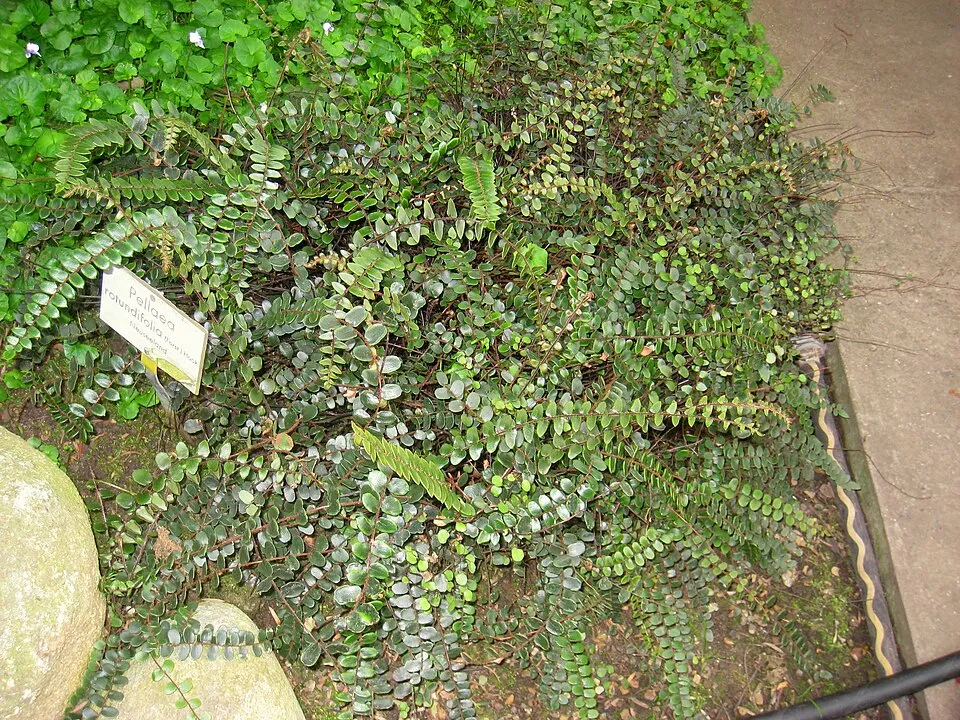
Pellaea rotundifolia, commonly known as the button fern or round-leaf fern, is an endearing and relatively compact fern species, now taxonomically recognized by some as Hemionitis rotundifolia. It is indigenous to the shaded, humid forested regions of New Zealand and Australia, often thriving as a lithophyte or epiphyte, gracefully clinging to rocks and tree trunks under the protective canopy of larger vegetation. Belonging to the family Pteridaceae, this elegant evergreen fern is easily distinguished by its unique, arching fronds, which are intricately composed of numerous small, round, dark green leaflets that distinctly resemble buttons.
Its growth habit is primarily rhizomatous, with creeping, wiry rhizomes that efficiently produce new fronds, allowing it to spread gently. While historically indigenous Māori communities in New Zealand have observed and appreciated Pellaea rotundifolia, formal documentation of its specific internal medicinal uses within their Rongoā Māori system is less extensively recorded compared to other native plants, with observations suggesting a greater appreciation for its resilience and aesthetic appeal. Modern scientific interest in ferns, including Pellaea rotundifolia, often focuses on their diverse phytochemical profiles.
Although specific detailed pharmacological studies exclusively on Pellaea rotundifolia are still emerging, ferns generally are known to harbor a range of secondary metabolites, including flavonoids, triterpenoids, and phenolic compounds, which collectively contribute to their potential antioxidant, anti-inflammatory, and antimicrobial properties. As an indoor plant, the button fern has gained immense popularity due to its attractive appearance, compact size, and relatively low maintenance requirements, making it an ideal choice for interior decoration.
Trusted Scientific References
1. Authoritative external sources for Pellaea rotundifolia
1.1 Wikipedia — Pellaea rotundifolia
1.2 Kew POWO (Plants of the World Online)
1.3 PubMed — peer-reviewed research
1.4 NCBI Taxonomy Browser
1.5 GBIF — Global Biodiversity
1.1.Button Fern — Key Features
- ✓ <strong>Botanical Name</strong> — Pellaea rotundifolia (syn. Hemionitis rotundifolia)
- ✓ <strong>Common Name</strong> — Button Fern, Round-leaf Fern, Round-leafed Fern, Cliff Brake
- ✓ <strong>Family</strong> — Pteridaceae
- ✓ <strong>Native Range</strong> — New Zealand, Australia
- ✓ <strong>Growth Habit</strong> — Rhizomatous, evergreen, typically lithophytic or epiphytic
- ✓ <strong>Leaf Morphology</strong> — Pinnate fronds with small, round, dark green, button-like leaflets
- ✓ <strong>Light Preference</strong> — Medium to bright indirect light; tolerant of lower light conditions
- ✓ <strong>Humidity Preference</strong> — Moderate humidity (40-50%) is ideal for healthy growth
- ✓ <strong>Primary Use</strong> — Highly popular as an ornamental houseplant for indoor decoration
- ✓ <strong>Known Compounds</strong> — Contains general fern phytochemicals such as flavonoids, triterpenoids, and phenolic acids
1.2.Button Fern — Quick Summary
- ✓ Button Fern (Pellaea rotundifolia) is a charming, compact fern native to New Zealand and Australia.
- ✓ Characterized by distinctive round, dark green leaflets resembling buttons on arching fronds.
- ✓ Primarily valued as an ornamental houseplant due to its aesthetic appeal and relatively low maintenance requirements.
- ✓ Phytochemical analysis suggests the presence of antioxidants, anti-inflammatories, and antimicrobial compounds, common to many fern species.
- ✓ Specific traditional medicinal uses for internal consumption of Pellaea rotundifolia are not extensively documented.
- ✓ Requires indirect light, consistently moist but well-drained soil, and moderate humidity for optimal growth.
2.Button Fern — Scientific Identity
3.Button Fern — Quick Facts
4.Button Fern — Appearance & Identification
5.Button Fern — Native Habitat
6.Button Fern — Water Requirements
- ✓ Light Requirements — Place Pellaea rotundifolia in medium to bright indirect light; it can tolerate lower light but direct sunlight will scorch its delicate fronds.
- ✓ Soil Preference — Plant in a light, well-drained potting mix rich in organic matter, such as a standard houseplant mix amended with peat moss or coconut coir, perlite, and vermiculite.
- ✓ Watering Schedule — Keep the soil consistently moist but not waterlogged; water when the top inch of soil begins to dry out, ensuring adequate drainage to prevent root rot.
- ✓ Temperature and Humidity — Maintain temperatures between 18-27°C (65-80°F) and moderate humidity levels of 40-50%, avoiding cold drafts.
- ✓ Fertilization — Feed with a balanced liquid houseplant fertilizer diluted to half strength approximately every two months during the active growing season from late winter to fall.
- ✓ Potting and Repotting — Use a somewhat shallow pot, such as an azalea pot, and repot every two to three years or when roots emerge from drainage holes, increasing pot size by only one increment.
- ✓ Propagation — Easily propagate by dividing the rhizomes of a mature plant during repotting in the spring, ensuring each division has both foliage and rhizomes.
Reviewed by the Flora Medical Global Botanical Review Panel
Multi-disciplinary editorial group · Botany · Ethnobotany · Herbal-medicine literature
Who reviewed this: This page was checked by the Flora Medical Global Botanical Review Panel — an in-house editorial group of botany graduates, ethnobotany researchers, and horticulture practitioners who collectively maintain our 7,000+ plant encyclopedia. Meet the team.
Our 4-step verification process
1. Taxonomic verification
Scientific names and synonyms cross-checked against Kew POWO, World Flora Online, and The Plant List.
2. Phytochemical & medicinal cross-reference
Active compounds, traditional uses, and reported activities are cross-referenced with PubMed, USDA Dr. Duke's database, and peer-reviewed ethnobotanical literature.
3. Conservation & distribution check
Distribution, ecology, and conservation status confirmed against GBIF occurrence records and the IUCN Red List.
4. Editorial & safety review
Every entry passes an editorial pass for clarity, originality, and safety notices (toxicity, contraindications, dosage caveats) before publication.
Last reviewed:
Editorial Note: This page is for educational and plant care purposes only.
Written by: Flora Medical Global Editorial Team
Reviewed by: Flora Medical Global Botanical Review Panel
Last Updated: June 16, 2026







Button Fern — Comments & Community Reviews
Rate this plant