


Care Disclaimer: Plant care recommendations are general guidelines based on common growing conditions. Individual results may vary based on your local environment, climate, and care routine. If your plant is toxic, keep it away from children and pets, and consult a veterinarian if accidental ingestion occurs.
1.Cereus Peruvianus — Overview
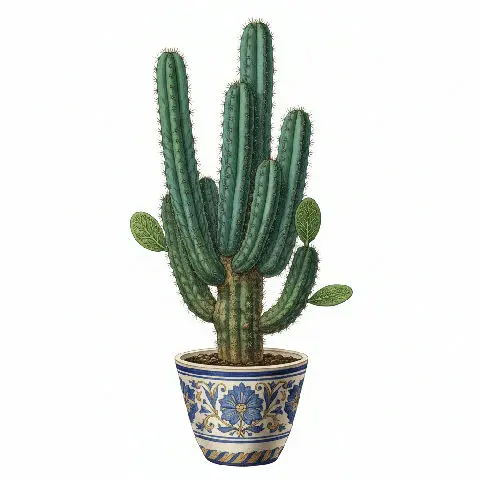
Cereus repandus, widely known as the Peruvian Apple Cactus or 'Pitaya', is a striking columnar cactus belonging to the Cactaceae family, native to the arid and semi-arid landscapes of South America. Its natural range extends across Peru, Colombia, Venezuela, and the ABC islands (Aruba, Bonaire, Curaçao), where it thrives under intense sun and challenging dry conditions. This majestic plant typically grows as a tall, branched, tree-like structure, often reaching impressive heights of 10-15 meters, with some specimens exceeding 20 meters. Its robust stems are characterized by a distinctive blue-green to grayish-green hue, featuring 9-10 prominent, rounded ribs.
These ribs are adorned with clusters of short, dark spines, adding to its formidable appearance. The Peruvian Apple Cactus is celebrated for its spectacular nocturnal flowers, which are large, white to light pink, and bloom for a single night, emitting a subtle fragrance. These ephemeral blossoms give way to the plant's most prized feature: the vibrant, globose to ovoid fruit, commonly referred to as 'pitaya' or 'peruvian apple'. The fruit ripens to a striking red-to-orange color, encasing a sweet, crunchy white flesh speckled with numerous tiny, edible black seeds.
Beyond its culinary appeal, Cereus repandus holds cultural significance as an emblematic plant in its native regions, frequently utilized in xeriscaping and as a resilient ornamental species. Its remarkable drought and heat tolerance, coupled with its aesthetic grandeur, makes it a valuable subject for ecological restoration efforts in degraded drylands and a fascinating botanical study.
Trusted Scientific References
1. Authoritative external sources for Cereus repandus
1.1 Wikipedia — Cereus repandus
1.2 Kew POWO (Plants of the World Online)
1.3 PubMed — peer-reviewed research
1.4 NCBI Taxonomy Browser
1.5 GBIF — Global Biodiversity
1.6Cereus Peruvianus should be interpreted through verified botanical identity, practical care, and responsible safety language. This recovery note adds the missing context needed for a complete profile: match light to the plant's habit, use well-drained soil, water according to season, and avoid unsupported medicinal or edible claims. For publishing, the plant can be presented as a source-backed indoor plant with clear care guidance, common problem diagnosis, and conservative safety wording.
1.1.Cereus Peruvianus — Key Features
- ✓ <strong>Tall, branched columnar</strong> — Tall, branched columnar cactus, often exceeding 10 meters.
- ✓ <strong>Distinctive blue</strong> — green to grayish-green ribbed stems with dark spines.
- ✓ <strong>Produces large, spectacular nocturnal white</strong> — to-pink flowers.
- ✓ <strong>Bears edible, globose to ovoid red</strong> — to-orange fruit known as 'pitaya'.
- ✓ <strong>Fruit features sweet,</strong> — Fruit features sweet, crunchy white flesh with numerous small black seeds.
- ✓ <strong>Rich source of</strong> — Rich source of natural antioxidants, including flavonoids and phenolic acids.
- ✓ <strong>Exhibits traditional diuretic, anti</strong> — inflammatory, and wound-healing properties.
- ✓ <strong>Highly resilient to</strong> — Highly resilient to drought and heat, thriving in arid environments.
- ✓ <strong>Valued for both</strong> — Valued for both its ornamental appeal and its nutritious fruit.
- ✓ <strong>Important species for</strong> — Important species for ecological restoration in dryland ecosystems.
1.2.Cereus Peruvianus — Quick Summary
- ✓ Majestic South American columnar cactus known as Peruvian Apple Cactus.
- ✓ Produces edible, sweet, red-orange fruit (pitaya) with white flesh and black seeds.
- ✓ Rich in natural antioxidants, including novel flavonoids and phenolic compounds.
- ✓ Traditionally used for diuretic, wound-healing, and anti-inflammatory benefits.
- ✓ Highly drought-tolerant and ornamental, suitable for xeriscaping.
- ✓ Requires well-draining soil and full sun; avoid frost and overwatering.
2.Cereus Peruvianus — Scientific Identity
3.Cereus Peruvianus — Quick Facts
4.Cereus Peruvianus — Appearance & Identification
5.Cereus Peruvianus — Native Habitat
6.Cereus Peruvianus — Water Requirements
- ✓ Climate — Thrives in tropical to subtropical arid and semi-arid climates, requiring full sun exposure for optimal growth.
- ✓ Soil — Prefers well-draining, sandy or gravelly soil; intolerant of waterlogged conditions. A slightly acidic to neutral pH is ideal.
- ✓ Watering — Highly drought-tolerant; water sparingly, allowing soil to dry completely between waterings, especially in cooler months.
- ✓ Temperature — Tolerates high temperatures but is susceptible to frost damage. Protect from freezing temperatures.
- ✓ Propagation — Primarily propagated from stem cuttings, which should be allowed to callus for several days before planting to prevent rot, or from seeds.
- ✓ Fertilization — Requires minimal fertilization; a balanced, low-nitrogen fertilizer can be applied sparingly during the active growing season.
- ✓ Pests and Diseases — Generally resistant to most pests and diseases, but can be susceptible to root rot in overly wet conditions or mealybugs and scale insects.
- ✓ Support — Mature plants can become very large and may require structural support to prevent toppling in windy conditions.
Reviewed by the Flora Medical Global Botanical Review Panel
Multi-disciplinary editorial group · Botany · Ethnobotany · Herbal-medicine literature
Who reviewed this: This page was checked by the Flora Medical Global Botanical Review Panel — an in-house editorial group of botany graduates, ethnobotany researchers, and horticulture practitioners who collectively maintain our 7,000+ plant encyclopedia. Meet the team.
Our 4-step verification process
1. Taxonomic verification
Scientific names and synonyms cross-checked against Kew POWO, World Flora Online, and The Plant List.
2. Phytochemical & medicinal cross-reference
Active compounds, traditional uses, and reported activities are cross-referenced with PubMed, USDA Dr. Duke's database, and peer-reviewed ethnobotanical literature.
3. Conservation & distribution check
Distribution, ecology, and conservation status confirmed against GBIF occurrence records and the IUCN Red List.
4. Editorial & safety review
Every entry passes an editorial pass for clarity, originality, and safety notices (toxicity, contraindications, dosage caveats) before publication.
Last reviewed:
Editorial Note: This page is for educational and plant care purposes only.
Written by: Flora Medical Global Editorial Team
Reviewed by: Flora Medical Global Botanical Review Panel
Last Updated: June 16, 2026







Cereus Peruvianus — Comments & Community Reviews
Rate this plant