
Care Disclaimer: Plant care recommendations are general guidelines based on common growing conditions. Individual results may vary based on your local environment, climate, and care routine. If your plant is toxic, keep it away from children and pets, and consult a veterinarian if accidental ingestion occurs.
1.Columnea Goldfish — Overview
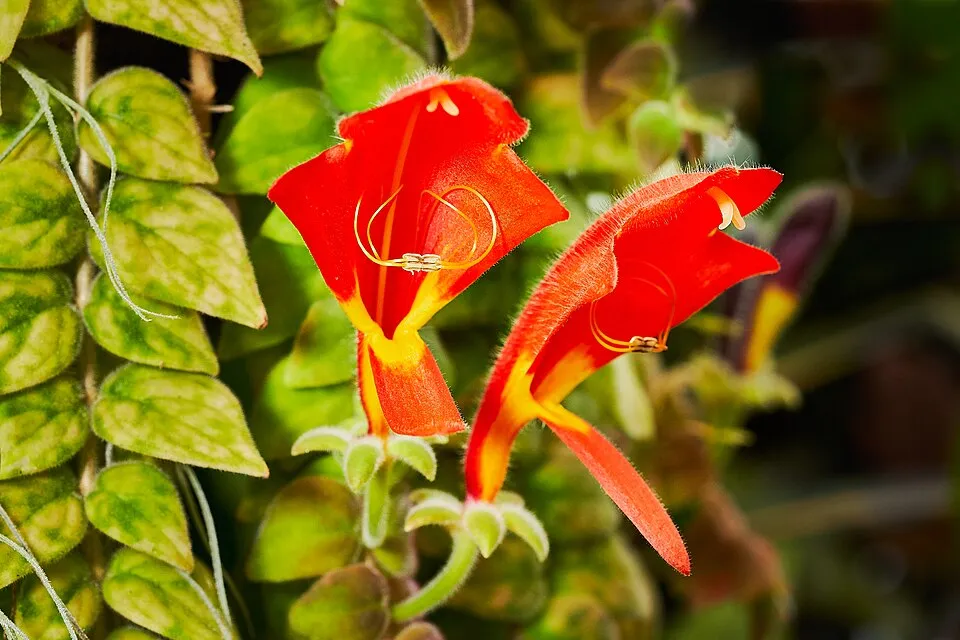
Columnea gloriosa, affectionately known as the Goldfish Plant, is a striking epiphytic perennial native to the humid tropical rainforests of Central and South America, particularly found thriving in the understory canopy. This captivating member of the Gesneriaceae family is renowned for its unique, pouch-shaped, vibrant orange-red flowers that bear a remarkable resemblance to miniature goldfish, giving the plant its popular moniker. Historically, while European botanists first formally documented Columnea species in the 18th century, indigenous communities in its native range undoubtedly possessed extensive traditional knowledge and appreciation for these plants long before. Morphologically, Columnea gloriosa is characterized by its long, slender, trailing stems, which can extend up to 0.9 to 1.2 meters (3 to 4 feet) when cultivated indoors, making it an excellent choice for hanging baskets.
These cascading stems are adorned with small, ovate, dark green leaves that are somewhat succulent, often presenting a reddish or purplish tint on their undersides, especially when exposed to brighter light conditions. The foliage provides an attractive backdrop to the profuse blooms, which typically emerge in late winter and spring, though sporadic flowering can occur throughout the year under ideal environmental conditions. In its natural habitat, C. gloriosa exhibits its epiphytic nature by attaching itself to trees, drawing essential moisture and nutrients from the ambient air and decaying organic matter accumulated in bark crevices, rather than rooting in soil.
This evolutionary adaptation necessitates a well-drained, airy growing medium when cultivated, mimicking its natural arboreal perch. The distinct botanical features of C. gloriosa include its prominent, scarlet to orange corolla, uniquely shaped like a fish's body with a constricted opening and a small 'mouth' at the apex, distinguishing it within its genus.
Trusted Scientific References
1. Authoritative external sources for Columnea gloriosa
1.1 Wikipedia — Columnea gloriosa
1.2 Kew POWO (Plants of the World Online)
1.3 PubMed — peer-reviewed research
1.4 NCBI Taxonomy Browser
1.5 GBIF — Global Biodiversity
1.1.Columnea Goldfish — Key Features
- ✓ <strong>Unique Goldfish</strong> — Shaped Flowers — Iconic orange-red blooms resembling miniature goldfish, giving the plant its common name.
- ✓ <strong>Epiphytic Growth Habit</strong> — Naturally grows on trees, deriving nutrients from air and organic matter, requiring specialized well-draining media in cultivation.
- ✓ <strong>Trailing/Cascading Stems</strong> — Long, slender stems make it an excellent choice for hanging baskets or elevated displays, reaching up to 1.2 meters.
- ✓ <strong>Evergreen Foliage</strong> — Small, ovate, dark green leaves, often with a reddish underside, providing year-round visual appeal.
- ✓ <strong>Tropical Origin</strong> — Native to the humid rainforests of Central and South America, requiring specific environmental conditions for optimal growth.
- ✓ <strong>Gesneriaceae Family Member</strong> — Part of a diverse botanical family known for its ornamental and sometimes ethnobotanical species.
- ✓ <strong>Potential Phytochemical Richness</strong> — Likely contains flavonoids, phenolic acids, and anthocyanins, suggesting antioxidant and anti-inflammatory potential.
- ✓ <strong>Ornamental Value</strong> — Primarily cultivated for its striking aesthetic appeal and ease of indoor care under proper conditions.
- ✓ <strong>Low Maintenance (with proper care)</strong> — Relatively easy to grow indoors once its specific light, humidity, and watering needs are met.
- ✓ <strong>Adaptable to Indoors</strong> — Thrives as a houseplant, bringing a touch of tropical vibrancy to interior spaces.
1.2.Columnea Goldfish — Quick Summary
- ✓ Columnea gloriosa, the Goldfish Plant, is a vibrant epiphytic perennial from Central/South American rainforests.
- ✓ Known for its distinctive orange-red, fish-shaped flowers and trailing habit, ideal for hanging baskets.
- ✓ While not extensively documented in traditional medicine, related species suggest potential anti-inflammatory and wound-healing properties.
- ✓ Thrives in bright, indirect light, high humidity, warm temperatures, and well-draining epiphytic soil mixes.
- ✓ Phytochemicals likely include flavonoids, phenolic acids, and anthocyanins, contributing to antioxidant activity.
- ✓ Primarily used ornamentally; any medicinal application should be external and approached with caution due to limited research.
2.Columnea Goldfish — Scientific Identity
3.Columnea Goldfish — Quick Facts
4.Columnea Goldfish — Appearance & Identification
5.Columnea Goldfish — Native Habitat
6.Columnea Goldfish — Water Requirements
- ✓ Bright, Indirect Light — Place in an east-facing window or a spot with filtered light; protect from harsh afternoon sun to prevent leaf scorch.
- ✓ Consistent Moisture — Keep soil consistently moist but never waterlogged; allow the top inch of soil to dry out between waterings, reducing frequency slightly in winter.
- ✓ High Humidity — Maintain humidity levels between 60-80% using a pebble tray, humidifier, or by grouping plants; misting can supplement but is not a primary solution.
- ✓ Warm Temperatures — Ideal range is 18-24°C (65-75°F) during the day, with a slight drop at night; avoid temperatures below 10°C (50°F) and cold drafts.
- ✓ Well-Draining Epiphytic Mix — Use a potting medium of equal parts peat moss, perlite, and orchid bark (pH 6.0-6.5) to mimic its natural arboreal habitat and ensure excellent drainage.
- ✓ Regular Fertilization — Feed with a balanced, water-soluble fertilizer (e.g., 10-10-10) diluted to half strength every 2-3 weeks during active growth (spring-fall), reducing or stopping in winter.
- ✓ Pruning for Shape — Pinch back leggy stems to encourage bushier growth and more abundant flowering, promoting a fuller, more attractive plant habit.
- ✓ Repotting — Repot every 2-3 years in fresh potting mix to refresh nutrients and prevent compaction, ensuring the plant doesn't become root-bound.
Reviewed by the Flora Medical Global Botanical Review Panel
Multi-disciplinary editorial group · Botany · Ethnobotany · Herbal-medicine literature
Who reviewed this: This page was checked by the Flora Medical Global Botanical Review Panel — an in-house editorial group of botany graduates, ethnobotany researchers, and horticulture practitioners who collectively maintain our 7,000+ plant encyclopedia. Meet the team.
Our 4-step verification process
1. Taxonomic verification
Scientific names and synonyms cross-checked against Kew POWO, World Flora Online, and The Plant List.
2. Phytochemical & medicinal cross-reference
Active compounds, traditional uses, and reported activities are cross-referenced with PubMed, USDA Dr. Duke's database, and peer-reviewed ethnobotanical literature.
3. Conservation & distribution check
Distribution, ecology, and conservation status confirmed against GBIF occurrence records and the IUCN Red List.
4. Editorial & safety review
Every entry passes an editorial pass for clarity, originality, and safety notices (toxicity, contraindications, dosage caveats) before publication.
Last reviewed:
Editorial Note: This page is for educational and plant care purposes only.
Written by: Flora Medical Global Editorial Team
Reviewed by: Flora Medical Global Botanical Review Panel
Last Updated: June 16, 2026







Columnea Goldfish — Comments & Community Reviews
Rate this plant