
Care Disclaimer: Plant care recommendations are general guidelines based on common growing conditions. Individual results may vary based on your local environment, climate, and care routine. If your plant is toxic, keep it away from children and pets, and consult a veterinarian if accidental ingestion occurs.
1.Cotyledon Tomentosa — Overview
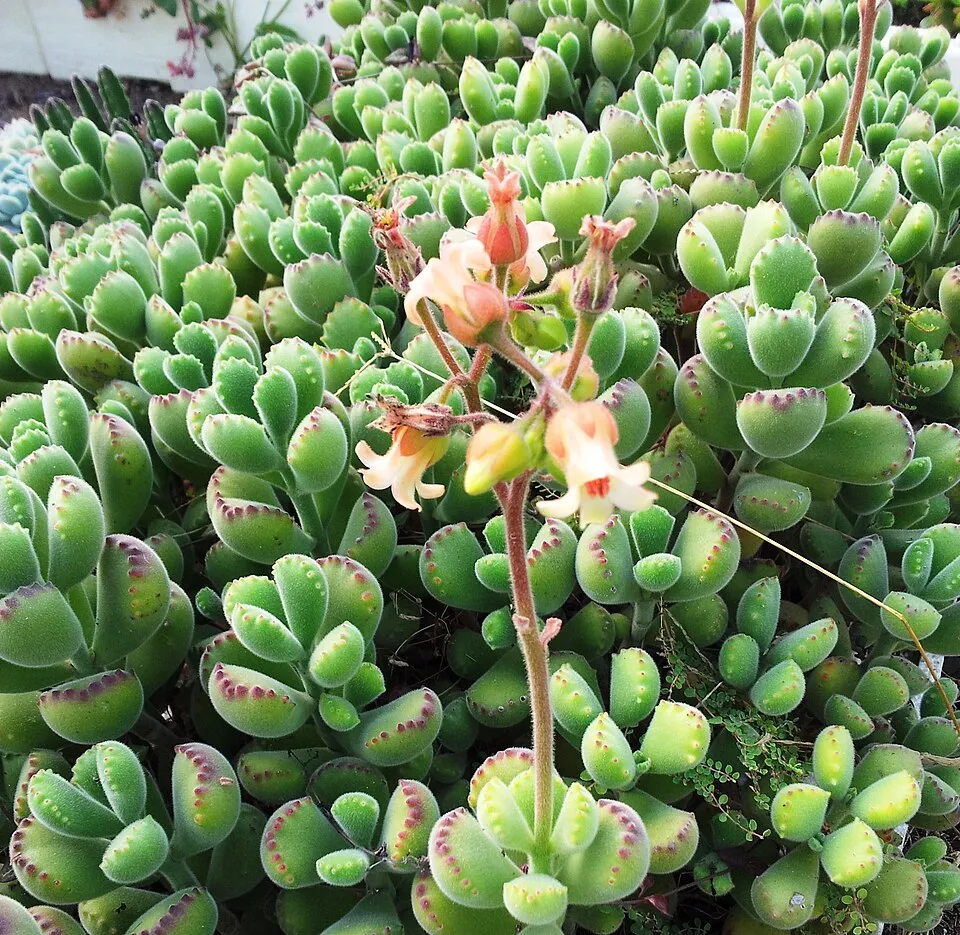
Cotyledon tomentosa, widely recognized as 'Bear's Paw' or 'Bear Paw Succulent' due to its distinctively shaped, fuzzy leaves, is a captivating and highly sought-after succulent native to the arid regions of Southern Africa, specifically the Eastern Cape and KwaZulu-Natal provinces of South Africa, particularly thriving in the Little Karoo. This charming plant belongs to the Crassulaceae family, a large group celebrated for its drought-tolerant and aesthetically pleasing members. Its history as a cultivated ornamental plant dates back to its discovery and introduction to horticulture, valued primarily for its unique appearance. Botanically, Cotyledon tomentosa is a small, freely branched, succulent evergreen shrub typically reaching up to 70 cm in height. Its most striking features are its thick, fleshy, ovate to oblanceolate leaves, usually 2-3 cm long, covered in a fine, white, downy fuzz (tomentose, giving rise to its species name) which provides a velvety texture.
Each leaf typically terminates in 3-10 distinct reddish-brown 'teeth' or lobes, strikingly resembling a bear's paw. The stems are relatively thick and succulent, branching freely, starting green and gradually hardening to a woody texture with age. When mature, it produces bell-shaped, pendent flowers, usually orange-red to yellow, borne on a tall inflorescence that can extend up to 30 cm above the foliage. These vibrant flowers typically bloom in spring or early summer (July to September in its native range), adding another layer of visual interest. Ecologically, Cotyledon tomentosa thrives in rocky outcrops and well-drained sandy or gritty soils in its native habitat, often growing under the partial shade of larger shrubs or in crevices, which offers protection from the harshest sun.
Its succulent nature enables it to store water efficiently, making it extremely drought-tolerant—a crucial adaptation for survival in its arid environment. Two subspecies are recognized: subsp. tomentosa, the autonymous subspecies, and subsp. ladismithiensis, which features longer, more cylindrical leaves that generally lack the prominent 'teeth' and has brown peeling bark.
Trusted Scientific References
1. Authoritative external sources for Cotyledon tomentosa
1.1 Wikipedia — Cotyledon tomentosa
1.2 Kew POWO (Plants of the World Online)
1.3 PubMed — peer-reviewed research
1.4 NCBI Taxonomy Browser
1.5 GBIF — Global Biodiversity
1.1.Cotyledon Tomentosa — Key Features
- ✓ <strong>Unique 'Bear's Paw'</strong> — Unique 'Bear's Paw' leaf shape with prominent reddish teeth.
- ✓ <strong>Velvety, tomentose foliage,</strong> — Velvety, tomentose foliage, giving a soft, fuzzy texture.
- ✓ <strong>Highly drought</strong> — tolerant succulent, adapted to arid conditions.
- ✓ <strong>Native to the Eastern Cape and KwaZulu</strong> — Natal provinces of South Africa.
- ✓ <strong>Produces attractive bell</strong> — shaped, pendent orange-red to yellow flowers.
- ✓ <strong>Primarily grown for</strong> — Primarily grown for ornamental display and horticultural appeal.
- ✓ <strong>Relatively low maintenance</strong> — Relatively low maintenance plant, suitable for beginners.
- ✓ <strong>Listed as Vulnerable</strong> — Listed as Vulnerable on the SANBI Red List in its native habitat.
- ✓ <strong>Member of the diverse and succulent</strong> — rich Crassulaceae family.
- ✓ <strong>Two recognized subspecies</strong> — *tomentosa* and *ladismithiensis*.
1.2.Cotyledon Tomentosa — Quick Summary
- ✓ 'Bear's Paw' succulent, native to Southern Africa.
- ✓ Distinctive fuzzy, paw-shaped leaves with reddish 'teeth'.
- ✓ Primarily ornamental; no documented traditional medicinal uses.
- ✓ Part of the Crassulaceae family, known for CAM photosynthesis and drought tolerance.
- ✓ Potential toxicity within the *Cotyledon* genus; ingestion must be strictly avoided.
- ✓ Easy to cultivate as a houseplant or in xeriscapes, requiring minimal water.
2.Cotyledon Tomentosa — Scientific Identity
3.Cotyledon Tomentosa — Quick Facts
4.Cotyledon Tomentosa — Appearance & Identification
5.Cotyledon Tomentosa — Native Habitat
6.Cotyledon Tomentosa — Water Requirements
- ✓ Soil — Requires extremely well-draining soil; ideally a specialized succulent or gritty cactus mix to prevent root rot, which is fatal for this plant.
- ✓ Light — Prefers bright, indirect light or partial shade; direct, harsh afternoon sun can scorch its distinctive fuzzy leaves, leading to discoloration.
- ✓ Watering — Water thoroughly only when the soil is completely dry, then allow it to dry out entirely before the next watering cycle. Reduce watering significantly in winter or during dormant periods.
- ✓ Temperature — Thrives in warm temperatures, typically between 18-24°C (65-75°F); protect diligently from frost, as it is not cold-hardy.
- ✓ Propagation — Easily propagated from stem cuttings or individual healthy leaves; allow the cut ends to callus for several days before planting in dry soil to prevent rot.
- ✓ Fertilization — Fertilize sparingly during the active growing season (spring and summer) with a diluted, balanced succulent-specific liquid fertilizer.
- ✓ Air Circulation — Good air circulation is beneficial to prevent fungal issues, especially in humid environments.
- ✓ Pests — Generally robust but can be susceptible to common succulent pests like mealybugs or spider mites, particularly if stressed or in poor conditions.
Reviewed by the Flora Medical Global Botanical Review Panel
Multi-disciplinary editorial group · Botany · Ethnobotany · Herbal-medicine literature
Who reviewed this: This page was checked by the Flora Medical Global Botanical Review Panel — an in-house editorial group of botany graduates, ethnobotany researchers, and horticulture practitioners who collectively maintain our 7,000+ plant encyclopedia. Meet the team.
Our 4-step verification process
1. Taxonomic verification
Scientific names and synonyms cross-checked against Kew POWO, World Flora Online, and The Plant List.
2. Phytochemical & medicinal cross-reference
Active compounds, traditional uses, and reported activities are cross-referenced with PubMed, USDA Dr. Duke's database, and peer-reviewed ethnobotanical literature.
3. Conservation & distribution check
Distribution, ecology, and conservation status confirmed against GBIF occurrence records and the IUCN Red List.
4. Editorial & safety review
Every entry passes an editorial pass for clarity, originality, and safety notices (toxicity, contraindications, dosage caveats) before publication.
Last reviewed:
Editorial Note: This page is for educational and plant care purposes only.
Written by: Flora Medical Global Editorial Team
Reviewed by: Flora Medical Global Botanical Review Panel
Last Updated: June 16, 2026







Cotyledon Tomentosa — Comments & Community Reviews
Rate this plant