
Care Disclaimer: Plant care recommendations are general guidelines based on common growing conditions. Individual results may vary based on your local environment, climate, and care routine. If your plant is toxic, keep it away from children and pets, and consult a veterinarian if accidental ingestion occurs.
1.Cymbidium Orchid — Overview
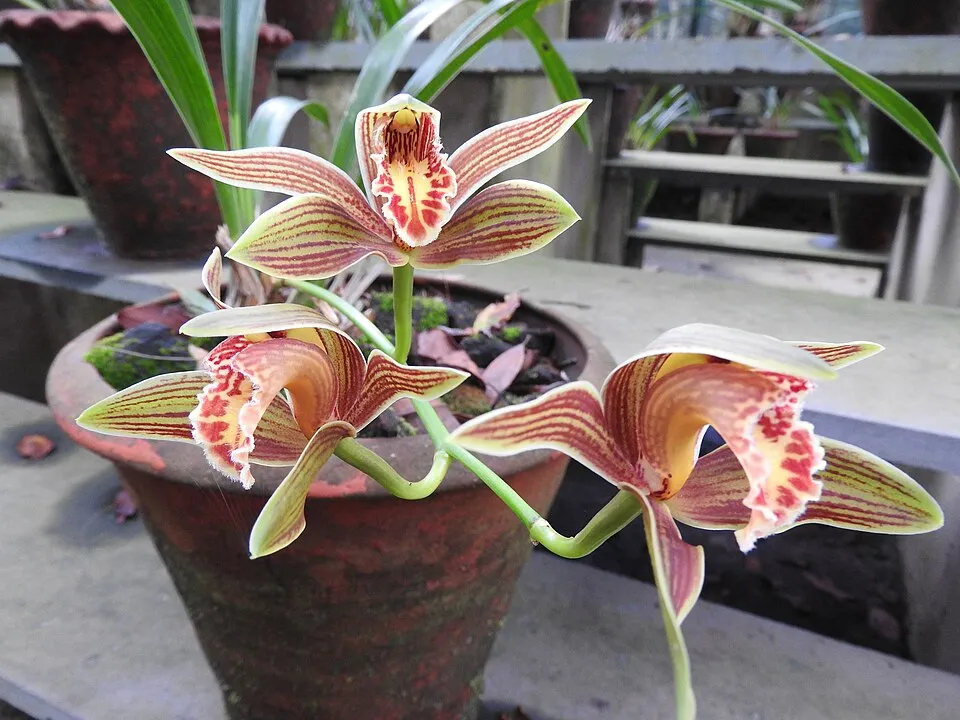
Cymbidium orchids, encompassing the vast genus Cymbidium and its numerous cultivated hybrids, are celebrated globally for their striking, long-lasting blossoms and relatively straightforward cultivation. The term "Cymbidium hybrid" specifically refers to the multitude of selectively bred varieties, often stemming from species native to the Himalayan regions and Southeast Asia, such as Cymbidium insigne and Cymbidium tracyanum. These hybrids are prized for their enhanced vigor, larger flower sizes, and an extraordinary spectrum of colors, including pure whites, vibrant yellows, deep burgundies, and intricate spotted patterns.
Historically, Cymbidiums hold deep cultural significance, particularly in China, where they were revered over 2,500 years ago. Confucius himself lauded their exquisite fragrance and elegant form, associating them with nobility, friendship, and scholarly pursuits. Their introduction to the Western horticultural world dates back to the late 18th century.
Botanically, Cymbidiums are predominantly sympodial epiphytic or terrestrial orchids. They are characterized by prominent pseudobulbs, which serve as vital storage organs for water and nutrients. From these clustered, ovoid to conical pseudobulbs, which can vary significantly in size, emerge graceful, arching flower spikes and strap-like, leathery leaves.
The deep green foliage, typically arranged in a fan-like manner, can reach lengths of up to 90 cm. Flowering generally occurs from late autumn through spring, influenced by the specific hybrid and prevailing environmental conditions. Each robust flower spike can bear a considerable number of blooms, often ranging from 5 to 30, with individual flowers maintaining their beauty for several weeks to a few months.
While their primary appeal remains ornamental, traditional knowledge systems, particularly in their indigenous habitats, have historically recognized the medicinal value of various wild Cymbidium species.
Trusted Scientific References
1. Authoritative external sources for Cymbidium hybrid
1.1 Wikipedia — Cymbidium hybrid
1.2 Kew POWO (Plants of the World Online)
1.3 PubMed — peer-reviewed research
1.4 NCBI Taxonomy Browser
1.5 GBIF — Global Biodiversity
1.1.Cymbidium Orchid — Key Features
- ✓ <strong>Ornamental Excellence</strong> — Highly valued for their large, colorful, and long-lasting flowers.
- ✓ <strong>Rich Phytochemistry</strong> — Contains diverse secondary metabolites including phenanthrenes and dibenzyls.
- ✓ <strong>Antioxidant Power</strong> — Extracts exhibit significant free radical scavenging capabilities.
- ✓ <strong>Anti</strong> — Aging Potential — Demonstrated inhibition of elastase and collagenase enzymes, crucial for skin integrity.
- ✓ <strong>Skin Brightening Effects</strong> — Anti-tyrosinase activity suggests efficacy against hyperpigmentation.
- ✓ <strong>Traditional Reverence</strong> — Historically significant in Eastern cultures, notably China, as symbols of nobility.
- ✓ <strong>Sustainable Sourcing</strong> — Research focuses on utilizing cultivation by-products, promoting sustainability.
- ✓ <strong>Versatile Growth Habits</strong> — Includes both epiphytic and terrestrial forms, adaptable to various environments.
- ✓ <strong>Long Bloom Duration</strong> — Individual flowers can last for several weeks to months, providing extended beauty.
- ✓ <strong>Cultural Symbolism</strong> — Represents friendship, elegance, and virtue in many Asian traditions.
1.2.Cymbidium Orchid — Quick Summary
- ✓ Cymbidium orchids are popular ornamentals with emerging dermo-cosmetic potential.
- ✓ Research indicates antioxidant, anti-tyrosinase, anti-elastase, and anti-collagenase activities.
- ✓ Key compounds include phenanthrenes, dibenzyls, and phenolic acid derivatives.
- ✓ Traditional uses exist for wild Cymbidium species in systems like TCM.
- ✓ Primarily explored for anti-aging, skin brightening, and protective skin care applications.
- ✓ Safety for internal use is largely unstudied; topical application requires caution and patch testing.
2.Cymbidium Orchid — Scientific Identity
3.Cymbidium Orchid — Quick Facts
4.Cymbidium Orchid — Appearance & Identification
5.Cymbidium Orchid — Native Habitat
6.Cymbidium Orchid — Water Requirements
- ✓ Light — Provide bright, indirect light; avoid direct scorching sun, especially during peak hours. East or west-facing windows are ideal.
- ✓ Watering — Water thoroughly when the potting medium approaches dryness. Allow some drying between waterings to prevent root rot, which is common in orchids.
- ✓ Potting Medium — Use a well-draining, coarse orchid mix, typically composed of bark, perlite, and charcoal, to ensure adequate aeration for the roots.
- ✓ Temperature — Maintain daytime temperatures between 18-24°C (65-75°F) and nighttime temperatures slightly cooler, around 10-16°C (50-60°F), to encourage flowering.
- ✓ Humidity — Aim for moderate to high humidity, ideally between 40-60%. Misting or using a humidity tray can be beneficial, especially in dry indoor environments.
- ✓ Fertilization — Feed regularly during the growing season with a balanced orchid-specific fertilizer, typically at half strength, reducing frequency during dormancy.
- ✓ Repotting — Repot every 1-2 years or when the plant outgrows its pot, typically after flowering, using fresh potting medium to prevent breakdown and compaction.
- ✓ Air Circulation — Ensure good air movement around the plants to prevent fungal diseases and promote healthy growth.
Reviewed by the Flora Medical Global Botanical Review Panel
Multi-disciplinary editorial group · Botany · Ethnobotany · Herbal-medicine literature
Who reviewed this: This page was checked by the Flora Medical Global Botanical Review Panel — an in-house editorial group of botany graduates, ethnobotany researchers, and horticulture practitioners who collectively maintain our 7,000+ plant encyclopedia. Meet the team.
Our 4-step verification process
1. Taxonomic verification
Scientific names and synonyms cross-checked against Kew POWO, World Flora Online, and The Plant List.
2. Phytochemical & medicinal cross-reference
Active compounds, traditional uses, and reported activities are cross-referenced with PubMed, USDA Dr. Duke's database, and peer-reviewed ethnobotanical literature.
3. Conservation & distribution check
Distribution, ecology, and conservation status confirmed against GBIF occurrence records and the IUCN Red List.
4. Editorial & safety review
Every entry passes an editorial pass for clarity, originality, and safety notices (toxicity, contraindications, dosage caveats) before publication.
Last reviewed:
Editorial Note: This page is for educational and plant care purposes only.
Written by: Flora Medical Global Editorial Team
Reviewed by: Flora Medical Global Botanical Review Panel
Last Updated: June 16, 2026







Cymbidium Orchid — Comments & Community Reviews
Rate this plant