
Care Disclaimer: Plant care recommendations are general guidelines based on common growing conditions. Individual results may vary based on your local environment, climate, and care routine. If your plant is toxic, keep it away from children and pets, and consult a veterinarian if accidental ingestion occurs.
1.Echeveria Perle von Nurnberg — Overview
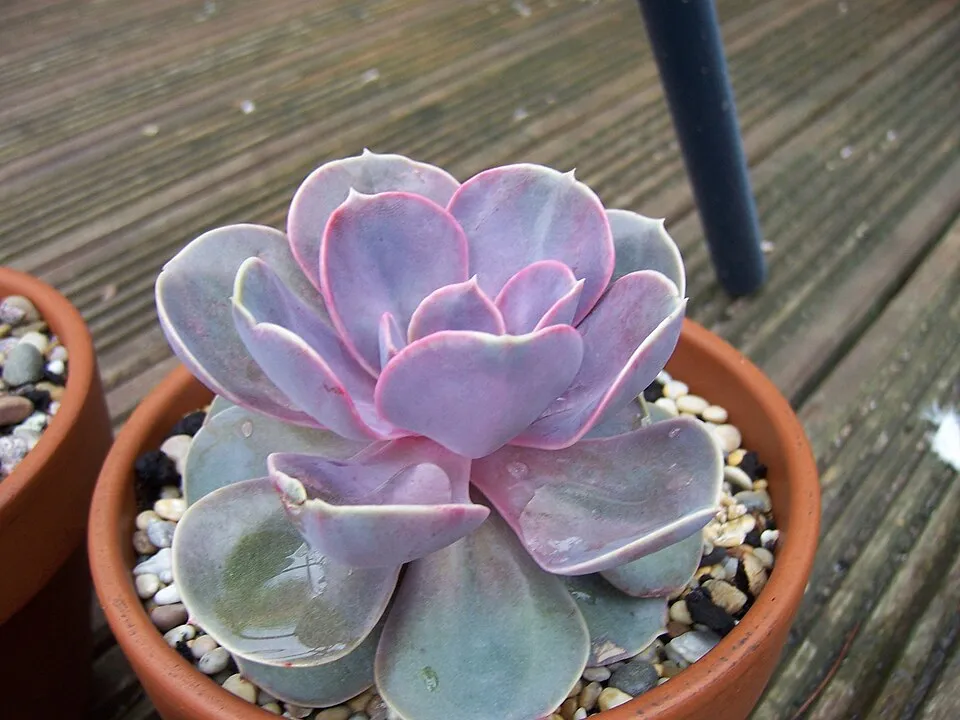
Echeveria 'Perle von Nürnberg', a distinguished hybrid succulent within the Crassulaceae family, presents a striking rosette formation that can impressively reach a diameter of up to 20 cm (8 inches). This cultivar is celebrated for its fleshy, spoon-shaped leaves, which typically measure between 8 to 12 cm (3 to 5 inches) in length. The foliage exhibits a captivating blue-grey base color, often developing exquisite pink, red, or purple margins and overall hues when exposed to ample bright light, a phenomenon attributed to anthocyanin production.
Each rounded lance-shaped leaf is covered with a delicate powdery bloom, known as farina, which serves as a natural sunscreen and water repellent, enhancing the plant's resilience. In late spring to summer, Echeveria 'Perle von Nürnberg' produces slender, reddish flower stalks that can extend up to 30 cm (12 inches) above the rosette. These stalks bear clusters of charming bell-shaped, tubular flowers, displaying a soft coral-pink exterior with vibrant yellow interiors, attracting various pollinators.
The plant's robust, fleshy stems, approximately 1 cm in diameter, are also protected by a waxy cuticle. This ornamental hybrid was created by German nurseryman Alfred Gräser through a cross between Echeveria gibbiflora 'Metallica' and a form of Echeveria elegans (Echeveria potosina). While not native to a specific wild habitat due to its hybrid origin, it thrives in conditions mimicking dry, rocky environments, making it exceptionally well-suited for indoor cultivation, container gardens, and xeriscaping in suitable climates.
Trusted Scientific References
1. Authoritative external sources for Echeveria perle von nurnberg
1.1 Wikipedia — Echeveria perle von nurnberg
1.2 Kew POWO (Plants of the World Online)
1.3 PubMed — peer-reviewed research
1.4 NCBI Taxonomy Browser
1.5 GBIF — Global Biodiversity
1.6Echeveria Perle von Nurnberg should be interpreted through verified botanical identity, practical care, and responsible safety language. This recovery note adds the missing context needed for a complete profile: match light to the plant's habit, use well-drained soil, water according to season, and avoid unsupported medicinal or edible claims. For publishing, the plant can be presented as a source-backed indoor plant with clear care guidance, common problem diagnosis, and conservative safety wording.
1.1.Echeveria Perle von Nurnberg — Key Features
- ✓ <strong>Hybrid Origin</strong> — A cultivated hybrid by Alfred Gräser, not a wild species.
- ✓ <strong>Rosette Growth</strong> — Forms compact, symmetrical rosettes up to 20 cm in diameter.
- ✓ <strong>Color Transformation</strong> — Leaves display a vibrant blue-grey that blushes pink, red, or purple with sun exposure.
- ✓ <strong>Fleshy Leaves</strong> — Thick, spoon-shaped leaves with a powdery farina coating.
- ✓ <strong>Bell</strong> — shaped Flowers — Produces coral-pink flowers with yellow interiors on tall reddish stalks.
- ✓ <strong>Drought Tolerant</strong> — Highly adapted to dry conditions due to succulent nature and CAM photosynthesis.
- ✓ <strong>Low Maintenance</strong> — Relatively easy to care for, making it popular for beginners.
- ✓ <strong>Ornamental Value</strong> — Primarily cultivated for its aesthetic appeal in gardens and indoors.
- ✓ <strong>Topical Uses (Genus)</strong> — Related Echeveria species are traditionally used for skin soothing and hydration.
1.2.Echeveria Perle von Nurnberg — Quick Summary
- ✓ Ornamental succulent with striking rosettes.
- ✓ Leaves change color from blue-grey to pink/purple in bright light.
- ✓ Traditional uses for Echeveria genus include skin hydration and soothing.
- ✓ Contains polysaccharides, flavonoids, and anthocyanins.
- ✓ Requires bright light, well-draining soil, and infrequent watering.
- ✓ Primarily for topical application; ingestion is not recommended.
2.Echeveria Perle von Nurnberg — Scientific Identity
3.Echeveria Perle von Nurnberg — Quick Facts
4.Echeveria Perle von Nurnberg — Appearance & Identification
5.Echeveria Perle von Nurnberg — Native Habitat
6.Echeveria Perle von Nurnberg — Water Requirements
- ✓ Light — Requires full sun to partial sun; bright, indirect light indoors, with some direct morning sun for best color development.
- ✓ Watering — Water thoroughly only when the soil is completely dry; allow excess water to drain completely to prevent root rot.
- ✓ Soil — Use a well-draining succulent or cactus potting mix, ideally with added perlite or pumice for enhanced aeration.
- ✓ Temperature — Thrives in average room temperatures (18-24°C / 65-75°F); protect from frost, as it is hardy only in USDA zones 9b-11b.
- ✓ Fertilizing — Feed sparingly with a diluted succulent fertilizer during the growing season (spring and summer), typically once a month.
- ✓ Repotting — Repot every 2-3 years or when root-bound, preferably during the warmer months, ensuring the soil is dry before transfer.
- ✓ Propagation — Easily propagated from leaf cuttings or stem cuttings; allow cuttings to callus for a few days before planting in dry soil.
- ✓ Pests & Diseases — Watch for mealybugs and root rot; ensure good air circulation and avoid overwatering to prevent fungal issues.
Reviewed by the Flora Medical Global Botanical Review Panel
Multi-disciplinary editorial group · Botany · Ethnobotany · Herbal-medicine literature
Who reviewed this: This page was checked by the Flora Medical Global Botanical Review Panel — an in-house editorial group of botany graduates, ethnobotany researchers, and horticulture practitioners who collectively maintain our 7,000+ plant encyclopedia. Meet the team.
Our 4-step verification process
1. Taxonomic verification
Scientific names and synonyms cross-checked against Kew POWO, World Flora Online, and The Plant List.
2. Phytochemical & medicinal cross-reference
Active compounds, traditional uses, and reported activities are cross-referenced with PubMed, USDA Dr. Duke's database, and peer-reviewed ethnobotanical literature.
3. Conservation & distribution check
Distribution, ecology, and conservation status confirmed against GBIF occurrence records and the IUCN Red List.
4. Editorial & safety review
Every entry passes an editorial pass for clarity, originality, and safety notices (toxicity, contraindications, dosage caveats) before publication.
Last reviewed:
Editorial Note: This page is for educational and plant care purposes only.
Written by: Flora Medical Global Editorial Team
Reviewed by: Flora Medical Global Botanical Review Panel
Last Updated: June 16, 2026







Echeveria Perle von Nurnberg — Comments & Community Reviews
Rate this plant