
Care Disclaimer: Plant care recommendations are general guidelines based on common growing conditions. Individual results may vary based on your local environment, climate, and care routine. If your plant is toxic, keep it away from children and pets, and consult a veterinarian if accidental ingestion occurs.
1.False Shamrock — Overview
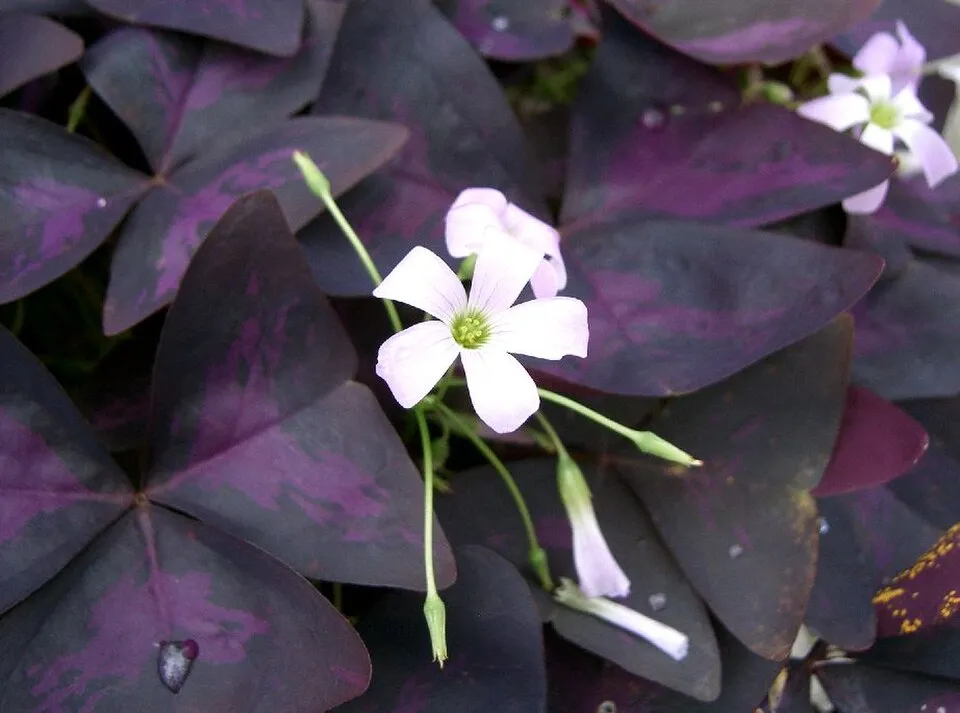
Oxalis triangularis, commonly known as False Shamrock, Purple Shamrock, or Love Plant, is a captivating perennial flowering plant native to the verdant regions of Brazil and other parts of South America, belonging to the botanical family Oxalidaceae. This species is predominantly cultivated as an ornamental houseplant, cherished for its striking, deep purple, triangular-shaped foliage. The leaves are trifoliate, resembling a cluster of butterflies or a clover, which gives rise to its common name, distinguishing it from the true shamrock, Trifolium repens.
A remarkable characteristic of False Shamrock is its nyctinastic movement, where the leaves dramatically fold downwards at night or when subjected to environmental stress, reopening with daylight. Delicate, pale pink to white trumpet-shaped flowers emerge in clusters above the foliage, typically blooming from late spring through summer, adding to its aesthetic appeal. Historically, while the broader Oxalis genus has seen various ethnomedical applications, O.
triangularis itself is primarily recognized for its ornamental value and relatively easy care, which contributed to its spread from South American conservatories to a beloved indoor plant worldwide starting in the 19th century. Its unique architectural form and response to light make it a fascinating addition to any interior space, symbolizing good luck and remembrance in contemporary culture.
Trusted Scientific References
1. Authoritative external sources for Oxalis triangularis
1.1 Wikipedia — Oxalis triangularis
1.2 Kew POWO (Plants of the World Online)
1.3 PubMed — peer-reviewed research
1.4 NCBI Taxonomy Browser
1.5 GBIF — Global Biodiversity
1.6False Shamrock should be interpreted through verified botanical identity, practical care, and responsible safety language. This recovery note adds the missing context needed for a complete profile: match light to the plant's habit, use well-drained soil, water according to season, and avoid unsupported medicinal or edible claims. For publishing, the plant can be presented as a source-backed indoor plant with clear care guidance, common problem diagnosis, and conservative safety wording.
1.1.False Shamrock — Key Features
- ✓ <strong>Striking deep purple,</strong> — Striking deep purple, triangular trifoliate leaves.
- ✓ <strong>Exhibits nyctinasty, with</strong> — Exhibits nyctinasty, with leaves folding down at night or under stress.
- ✓ <strong>Delicate pale pink to white trumpet</strong> — shaped flowers blooming in clusters.
- ✓ <strong>Easy</strong> — to-care-for ornamental houseplant, popular worldwide.
- ✓ <strong>Native to Brazil,</strong> — Native to Brazil, belonging to the Oxalidaceae family.
- ✓ <strong>Often mistaken for</strong> — Often mistaken for a true shamrock, though botanically distinct.
- ✓ <strong>Undergoes a natural</strong> — Undergoes a natural dormancy period, often in summer.
- ✓ <strong>Rich in anthocyanins</strong> — Rich in anthocyanins and flavonoids, contributing to its color and antioxidant potential.
- ✓ <strong>Contains significant levels</strong> — Contains significant levels of oxalic acid, requiring caution regarding ingestion.
- ✓ <strong>Symbolizes good luck</strong> — Symbolizes good luck and remembrance, making it a thoughtful gift.
1.2.False Shamrock — Quick Summary
- ✓ Distinctive deep purple, triangular foliage known for nyctinastic movement.
- ✓ Primarily cultivated as an ornamental houseplant.
- ✓ Contains oxalic acid, anthocyanins, and flavonoids.
- ✓ Limited traditional medicinal use for O. triangularis itself; some genus-level potential for antioxidants.
- ✓ High oxalic acid content makes it toxic if ingested in large amounts.
- ✓ Requires bright, indirect light and well-draining soil, with a natural dormancy period.
2.False Shamrock — Scientific Identity
3.False Shamrock — Quick Facts
4.False Shamrock — Appearance & Identification
5.False Shamrock — Native Habitat
6.False Shamrock — Water Requirements
- ✓ Light — Prefers bright, indirect light; protect from harsh afternoon sun to prevent leaf burn.
- ✓ Water — Water thoroughly, allowing the topsoil to dry out between waterings; reduce frequency during dormancy.
- ✓ Soil — Use a fast-draining, soil-based potting mixture amended with perlite and peat to ensure good aeration and drainage.
- ✓ Temperature — Thrives in cool household temperatures, ideally between 60-70°F (15-21°C), with slightly cooler nights.
- ✓ Humidity — Maintain humidity above 50% during active growth; use a pebble tray or humidifier.
- ✓ Repotting — Repot annually in the fall as growth resumes, moving to a pot one size larger if root-bound, and refresh the soil.
- ✓ Nutrition — Feed lightly with a 1/4 strength balanced organic fertilizer monthly during its active growing season.
- ✓ Dormancy Care — If the plant enters dormancy (leaves fade and die back), taper watering and store in a dark, cool place for 1-3 months until new growth emerges.
Reviewed by the Flora Medical Global Botanical Review Panel
Multi-disciplinary editorial group · Botany · Ethnobotany · Herbal-medicine literature
Who reviewed this: This page was checked by the Flora Medical Global Botanical Review Panel — an in-house editorial group of botany graduates, ethnobotany researchers, and horticulture practitioners who collectively maintain our 7,000+ plant encyclopedia. Meet the team.
Our 4-step verification process
1. Taxonomic verification
Scientific names and synonyms cross-checked against Kew POWO, World Flora Online, and The Plant List.
2. Phytochemical & medicinal cross-reference
Active compounds, traditional uses, and reported activities are cross-referenced with PubMed, USDA Dr. Duke's database, and peer-reviewed ethnobotanical literature.
3. Conservation & distribution check
Distribution, ecology, and conservation status confirmed against GBIF occurrence records and the IUCN Red List.
4. Editorial & safety review
Every entry passes an editorial pass for clarity, originality, and safety notices (toxicity, contraindications, dosage caveats) before publication.
Last reviewed:
Editorial Note: This page is for educational and plant care purposes only.
Written by: Flora Medical Global Editorial Team
Reviewed by: Flora Medical Global Botanical Review Panel
Last Updated: June 16, 2026







False Shamrock — Comments & Community Reviews
Rate this plant