

Care Disclaimer: Plant care recommendations are general guidelines based on common growing conditions. Individual results may vary based on your local environment, climate, and care routine. If your plant is toxic, keep it away from children and pets, and consult a veterinarian if accidental ingestion occurs.
1.Fiddle Leaf Fig Bambino — Overview
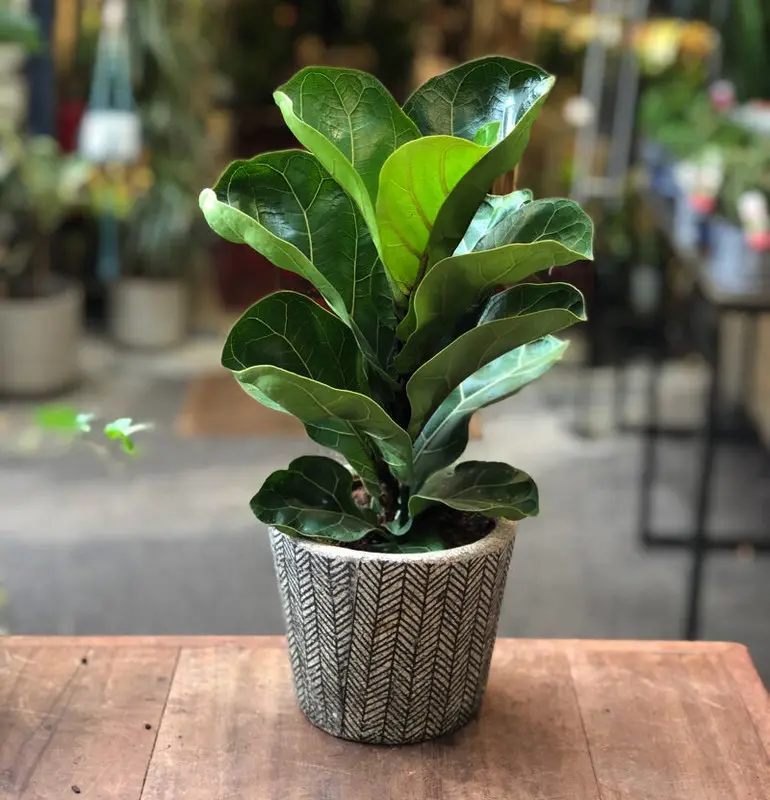
Ficus lyrata Bambino, widely recognized as the Fiddle Leaf Fig Bambino, is an appealing, compact cultivar derived from the larger Ficus lyrata species. This evergreen broadleaf tree, native to the tropical rainforests of West Africa, has been selectively bred to thrive as an indoor ornamental, typically reaching a manageable height of 0.6 to 1 meter (2 to 3 feet) in domestic settings. Its defining characteristic is its striking foliage: large, glossy, and leathery leaves that distinctly resemble a violin or lyre, which can extend up to 20 cm (8 inches) long and 15 cm (6 inches) wide.
These rich, dark green leaves often feature subtle, lighter veins and emerge from sturdy, upright stems. The smooth, greyish-brown bark contributes to its sleek, architectural presence. While the parent species, Ficus lyrata, can grow into a substantial tree exceeding 15 meters (50 feet) in its native habitat and produce small, inconspicuous figs, the 'Bambino' cultivar rarely flowers or fruits indoors.
It flourishes in bright, indirect light, appreciating consistent warmth and moderate to high humidity, making it a popular choice for enhancing interior landscapes due to its adaptable nature and dramatic aesthetic appeal.
Trusted Scientific References
1. Authoritative external sources for Ficus lyrata Bambino
1.1 Wikipedia — Ficus lyrata Bambino
1.2 Kew POWO (Plants of the World Online)
1.3 PubMed — peer-reviewed research
1.4 NCBI Taxonomy Browser
1.5 GBIF — Global Biodiversity
1.6Fiddle Leaf Fig Bambino should be interpreted through verified botanical identity, practical care, and responsible safety language. This recovery note adds the missing context needed for a complete profile: match light to the plant's habit, use well-drained soil, water according to season, and avoid unsupported medicinal or edible claims. For publishing, the plant can be presented as a source-backed indoor plant with clear care guidance, common problem diagnosis, and conservative safety wording.
1.1.Fiddle Leaf Fig Bambino — Key Features
- ✓ <strong>Compact Size</strong> — Reaches 2-3 feet tall, perfect for smaller indoor spaces.
- ✓ <strong>Lyre</strong> — Shaped Leaves — Distinctive, large, glossy, dark green foliage.
- ✓ <strong>Air Purifying</strong> — Helps remove indoor toxins like formaldehyde.
- ✓ <strong>Ornamental Value</strong> — Highly sought after for its dramatic aesthetic appeal.
- ✓ <strong>Easy Care</strong> — Relatively low maintenance with proper light and watering.
- ✓ <strong>Tropical Origin</strong> — Native to West African rainforests, thrives in warm humidity.
- ✓ <strong>Non</strong> — Flowering Indoors — Typically does not produce flowers or fruits as a houseplant.
- ✓ <strong>Mildly Toxic</strong> — Sap is an irritant and plant is toxic if ingested by humans or pets.
- ✓ <strong>Broadleaf Evergreen</strong> — Maintains lush foliage year-round.
- ✓ <strong>Adaptable Houseplant</strong> — Tolerates common indoor conditions with care.
1.2.Fiddle Leaf Fig Bambino — Quick Summary
- ✓ Compact Fiddle Leaf Fig cultivar, ideal for indoor spaces.
- ✓ Recognised for air-purifying qualities and aesthetic value.
- ✓ Requires bright, indirect light and consistent watering.
- ✓ Milky sap contains irritants and is toxic if ingested.
- ✓ Enhances well-being and reduces stress in home environments.
- ✓ Low maintenance as a houseplant but sensitive to overwatering.
2.Fiddle Leaf Fig Bambino — Scientific Identity
3.Fiddle Leaf Fig Bambino — Quick Facts
4.Fiddle Leaf Fig Bambino — Appearance & Identification
5.Fiddle Leaf Fig Bambino — Native Habitat
6.Fiddle Leaf Fig Bambino — Water Requirements
- ✓ Light — Provide bright, indirect light; direct afternoon sun can scorch the leaves of Fiddle Leaf Fig Bambino.
- ✓ Watering — Water thoroughly when the top 2-3 inches of soil are dry, ensuring adequate drainage to prevent root rot.
- ✓ Humidity — Maintain medium to high humidity, especially in dry indoor environments; misting or a pebble tray can help.
- ✓ Soil — Use a well-draining, loamy potting mix that retains some moisture but prevents waterlogging.
- ✓ Temperature — Keep temperatures between 18-24°C (65-75°F); avoid sudden temperature fluctuations or cold drafts.
- ✓ Fertilization — Feed with a balanced liquid fertilizer every 2-4 weeks during the growing season (spring and summer), reducing in fall and winter.
- ✓ Pruning — Prune to maintain desired shape and size, removing any yellowing or damaged leaves; use clean, sharp shears.
- ✓ Repotting — Repot Ficus lyrata Bambino every 1-2 years into a slightly larger pot with fresh soil, typically in spring.
Reviewed by the Flora Medical Global Botanical Review Panel
Multi-disciplinary editorial group · Botany · Ethnobotany · Herbal-medicine literature
Who reviewed this: This page was checked by the Flora Medical Global Botanical Review Panel — an in-house editorial group of botany graduates, ethnobotany researchers, and horticulture practitioners who collectively maintain our 7,000+ plant encyclopedia. Meet the team.
Our 4-step verification process
1. Taxonomic verification
Scientific names and synonyms cross-checked against Kew POWO, World Flora Online, and The Plant List.
2. Phytochemical & medicinal cross-reference
Active compounds, traditional uses, and reported activities are cross-referenced with PubMed, USDA Dr. Duke's database, and peer-reviewed ethnobotanical literature.
3. Conservation & distribution check
Distribution, ecology, and conservation status confirmed against GBIF occurrence records and the IUCN Red List.
4. Editorial & safety review
Every entry passes an editorial pass for clarity, originality, and safety notices (toxicity, contraindications, dosage caveats) before publication.
Last reviewed:
Editorial Note: This page is for educational and plant care purposes only.
Written by: Flora Medical Global Editorial Team
Reviewed by: Flora Medical Global Botanical Review Panel
Last Updated: June 16, 2026







Fiddle Leaf Fig Bambino — Comments & Community Reviews
Rate this plant