
Care Disclaimer: Plant care recommendations are general guidelines based on common growing conditions. Individual results may vary based on your local environment, climate, and care routine. If your plant is toxic, keep it away from children and pets, and consult a veterinarian if accidental ingestion occurs.
1.Hoya Australis — Overview
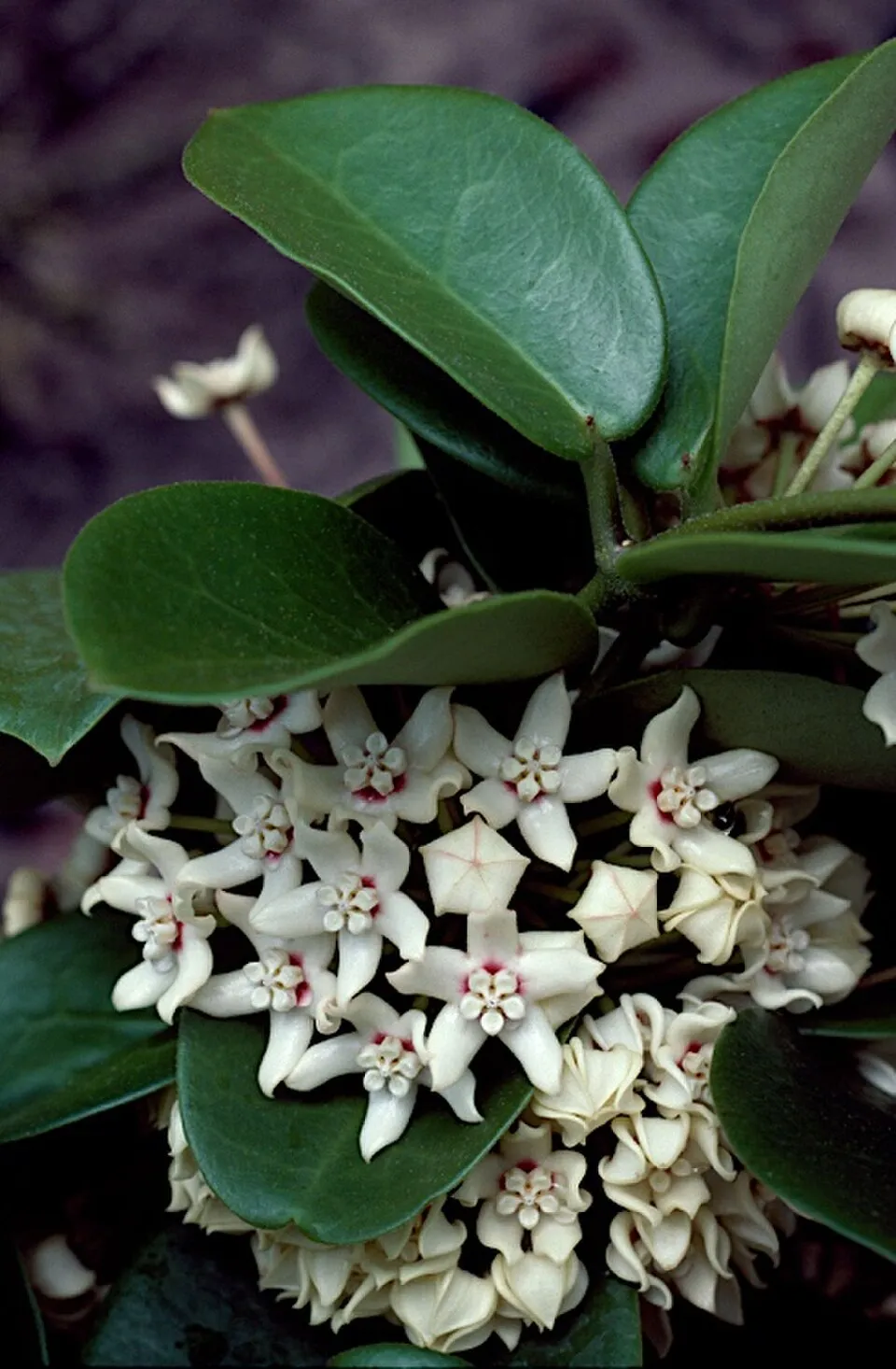
Hoya australis, commonly known as the Australian wax plant or waxvine, is a captivating perennial vine native to the tropical and subtropical regions of Australia, particularly thriving in the understory of rainforests and open woodlands. This species exhibits a robust climbing or trailing growth habit, capable of ascending to heights of 4 to 8 meters (13 to 26 feet) in its natural environment, though often more compact in cultivation. Its distinguishing features include thick, succulent, ovate leaves, typically ranging from 5 to 10 centimeters (2 to 4 inches) in length, characterized by a glossy, deep green surface that sometimes displays lighter green or yellowish variegation along the margins.
The plant's inflorescence is particularly striking, presenting as dense, spherical clusters, each comprising up to 30 individual star-shaped flowers. These delicate blossoms, usually white to creamy white with contrasting reddish or pink centers, measure approximately 1-2 centimeters (0.4-0.8 inches) across and are renowned for emitting a potent, sweet, honey-like fragrance, which intensifies during the evening hours. Hoya australis belongs to the diverse Apocynaceae family, a group well-known for its ornamental and sometimes medicinally significant species.
It prefers conditions mimicking its native habitat—bright, indirect light, high humidity, and consistently well-draining soil, making it a popular choice for both indoor cultivation and botanical gardens.
Trusted Scientific References
1. Authoritative external sources for Hoya australis
1.1 Wikipedia — Hoya australis
1.2 Kew POWO (Plants of the World Online)
1.3 PubMed — peer-reviewed research
1.4 NCBI Taxonomy Browser
1.5 GBIF — Global Biodiversity
1.6Hoya Australis should be interpreted through verified botanical identity, practical care, and responsible safety language. This recovery note adds the missing context needed for a complete profile: match light to the plant's habit, use well-drained soil, water according to season, and avoid unsupported medicinal or edible claims. For publishing, the plant can be presented as a source-backed indoor plant with clear care guidance, common problem diagnosis, and conservative safety wording.
1.1.Hoya Australis — Key Features
- ✓ <strong>Native Australian perennial</strong> — Native Australian perennial vine with a climbing or trailing growth habit.
- ✓ <strong>Features thick, glossy</strong> — Features thick, glossy green, succulent, ovate leaves.
- ✓ <strong>Produces spherical clusters</strong> — Produces spherical clusters of highly fragrant, white to cream, star-shaped flowers.
- ✓ <strong>Flowers emit a sweet, honey</strong> — like scent, particularly strong in the evening.
- ✓ <strong>Traditionally used topically</strong> — Traditionally used topically by indigenous Australians for minor skin irritations, cuts, and burns.
- ✓ <strong>Belongs to the</strong> — Belongs to the Apocynaceae family, known for diverse plant characteristics.
- ✓ <strong>Adaptable as an</strong> — Adaptable as an ornamental houseplant, preferring bright, indirect light and well-draining soil.
- ✓ <strong>Exhibits potential antiseptic, wound</strong> — healing, and anti-inflammatory properties based on traditional use.
- ✓ <strong>Relatively low</strong> — maintenance plant, suitable for various indoor environments.
- ✓ <strong>Propagates easily from</strong> — Propagates easily from stem cuttings, making it popular among plant enthusiasts.
1.2.Hoya Australis — Quick Summary
- ✓ Hoya australis is a fragrant, succulent vine native to Australia, cherished for its ornamental beauty.
- ✓ Traditionally, its sap has been used topically by indigenous communities for minor skin ailments.
- ✓ It is valued for perceived wound-healing, antiseptic, and anti-inflammatory properties for external use.
- ✓ Cultivation is popular for its easy care and sweet-smelling, star-shaped flowers.
- ✓ Internal consumption is not recommended, and caution is advised for topical application due to potential irritation.
- ✓ Research into its specific phytochemicals and pharmacological actions is ongoing.
2.Hoya Australis — Scientific Identity
3.Hoya Australis — Quick Facts
4.Hoya Australis — Appearance & Identification
5.Hoya Australis — Native Habitat
6.Hoya Australis — Water Requirements
- ✓ Light — Provide bright, indirect sunlight; direct sun can scorch leaves, while insufficient light may hinder blooming.
- ✓ Soil — Use a well-draining potting mix, ideally a blend of two parts potting mix with one part perlite and one part orchid bark.
- ✓ Watering — Water thoroughly when the topsoil has completely dried out; succulent leaves tolerate some dryness but avoid prolonged wilting.
- ✓ Temperature & Humidity — Thrives in temperatures between 15-35°C (60-95°F) and prefers humidity levels of 50-60%, though it adapts to lower indoor humidity.
- ✓ Fertilization — Feed monthly during spring and summer with a balanced liquid houseplant fertilizer diluted to half strength; switch to a higher phosphorus formula during blooming.
- ✓ Pruning — Prune after flowering to manage growth and shape, but crucially, leave the peduncles (flower stems) intact as flowers will re-emerge from them.
- ✓ Propagation — Easily propagated from stem cuttings in spring or summer, rooting well in moist potting mix or perlite under high humidity conditions.
- ✓ Support — As a climbing vine, Hoya australis benefits from a trellis or other support structure to encourage upward growth and display its foliage.
Reviewed by the Flora Medical Global Botanical Review Panel
Multi-disciplinary editorial group · Botany · Ethnobotany · Herbal-medicine literature
Who reviewed this: This page was checked by the Flora Medical Global Botanical Review Panel — an in-house editorial group of botany graduates, ethnobotany researchers, and horticulture practitioners who collectively maintain our 7,000+ plant encyclopedia. Meet the team.
Our 4-step verification process
1. Taxonomic verification
Scientific names and synonyms cross-checked against Kew POWO, World Flora Online, and The Plant List.
2. Phytochemical & medicinal cross-reference
Active compounds, traditional uses, and reported activities are cross-referenced with PubMed, USDA Dr. Duke's database, and peer-reviewed ethnobotanical literature.
3. Conservation & distribution check
Distribution, ecology, and conservation status confirmed against GBIF occurrence records and the IUCN Red List.
4. Editorial & safety review
Every entry passes an editorial pass for clarity, originality, and safety notices (toxicity, contraindications, dosage caveats) before publication.
Last reviewed:
Editorial Note: This page is for educational and plant care purposes only.
Written by: Flora Medical Global Editorial Team
Reviewed by: Flora Medical Global Botanical Review Panel
Last Updated: June 16, 2026







Hoya Australis — Comments & Community Reviews
Rate this plant