

Care Disclaimer: Plant care recommendations are general guidelines based on common growing conditions. Individual results may vary based on your local environment, climate, and care routine. If your plant is toxic, keep it away from children and pets, and consult a veterinarian if accidental ingestion occurs.
1.Maranta Lemon Lime — Overview
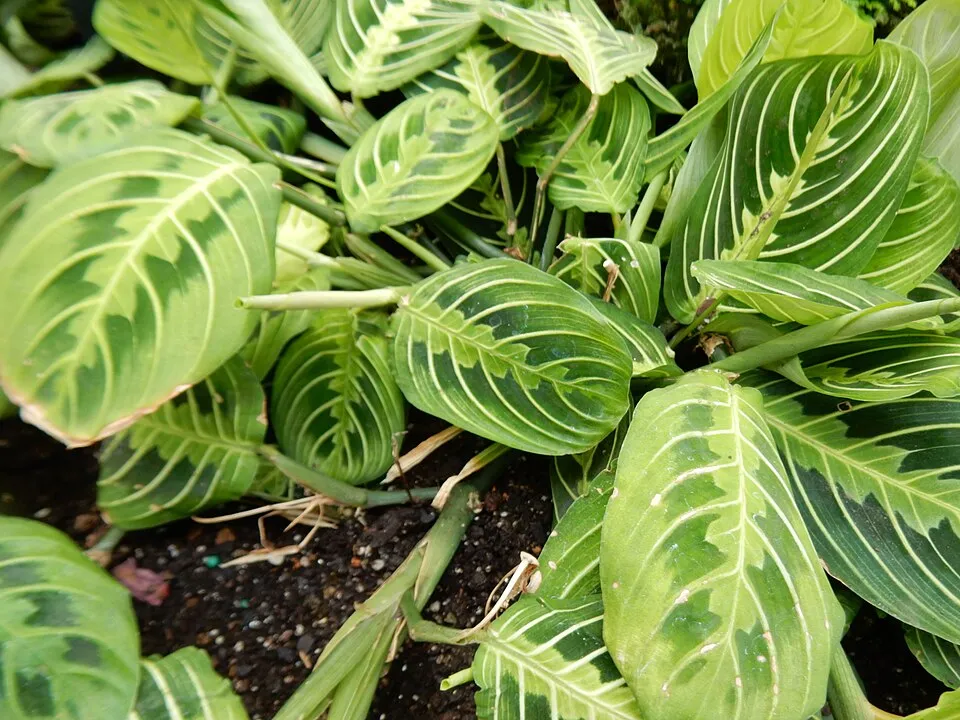
Maranta leuconeura 'Lemon Lime', commonly known as the Lemon Lime Prayer Plant, is an exquisitely variegated cultivar within the Marantaceae family, renowned for its striking ornamental appeal and unique nyctinastic leaf movements. This tropical perennial typically forms a dense, bushy clump, reaching a modest height of 12 to 18 inches (30-45 cm) and spreading similarly, making it an ideal choice for indoor cultivation. Its most distinguishing feature is its foliage: large, ovate to broadly lanceolate leaves, typically measuring 4 to 6 inches (10-15 cm) in length, which display a vibrant chartreuse green base intricately patterned with darker green splashes and veins that radiate from the central midrib. The leaf margins are gently undulated, adding a textural dimension to its visual appeal.
The underside of the leaves often presents a reddish-purple hue, providing a dramatic contrast, particularly when the leaves fold upwards at night, resembling hands in prayer – a characteristic behavior known as nyctinasty, driven by changes in turgor pressure in specialized motor cells (pulvini) at the base of the leaf petiole. While primarily cultivated for its foliage, Maranta 'Lemon Lime' can produce small, delicate flowers. These are typically white with subtle lavender or purple markings, borne on slender spikes during the warmer months if environmental conditions are sufficiently favorable, though they are often overshadowed by the leaves. The stems are smooth, generally green, and can develop a reddish tint, especially near the nodes.
Native to the humid understory of the Brazilian rainforests, this plant thrives in warm, consistently moist environments, mirroring its natural habitat where it grows as a groundcover beneath the dense canopy. Its natural range encompasses tropical regions of South America, particularly Brazil, where species of the genus Maranta are an integral part of the forest ecosystem. Taxonomically, it belongs to the genus Maranta, named after Bartolomeo Maranta, an Italian physician and botanist.
Trusted Scientific References
1. Authoritative external sources for Maranta leuconeura Lemon Lime
1.1 Wikipedia — Maranta leuconeura Lemon Lime
1.2 Kew POWO (Plants of the World Online)
1.3 PubMed — peer-reviewed research
1.4 NCBI Taxonomy Browser
1.5 GBIF — Global Biodiversity
1.1.Maranta Lemon Lime — Key Features
- ✓ <strong>Botanical Name</strong> — Maranta leuconeura 'Lemon Lime'
- ✓ <strong>Common Name</strong> — Lemon Lime Prayer Plant, Lemon Lime Maranta
- ✓ <strong>Family</strong> — Marantaceae
- ✓ <strong>Foliage</strong> — Vibrant chartreuse green base with dark green splashes and veins
- ✓ <strong>Leaf Movement</strong> — Nyctinastic (leaves fold upwards at night)
- ✓ <strong>Growth Habit</strong> — Dense, bushy, compact perennial
- ✓ <strong>Mature Size</strong> — Typically 12-18 inches (30-45 cm) tall and wide
- ✓ <strong>Light Preference</strong> — Bright, indirect light; intolerant of direct sun
- ✓ <strong>Humidity Needs</strong> — High humidity (above 60%) is essential for optimal health
- ✓ <strong>Pet Safety</strong> — Non-toxic to cats, dogs, and humans
1.2.Maranta Lemon Lime — Quick Summary
- ✓ Striking ornamental foliage with vibrant 'Lemon Lime' variegation.
- ✓ Exhibits unique nyctinastic 'prayer' leaf movements, folding at night.
- ✓ Thrives in bright, indirect light and high humidity, mimicking rainforest habitat.
- ✓ Generally considered non-toxic to humans and pets, safe for homes.
- ✓ Easy to care for, making it suitable for both novice and experienced plant enthusiasts.
- ✓ Native to the humid understory of Brazilian rainforests, favoring warm, moist conditions.
2.Maranta Lemon Lime — Scientific Identity
3.Maranta Lemon Lime — Quick Facts
4.Maranta Lemon Lime — Appearance & Identification
5.Maranta Lemon Lime — Native Habitat
6.Maranta Lemon Lime — Water Requirements
- ✓ Light — Requires bright, indirect light; direct sun can scorch leaves. Tolerates lower light but may lose some vibrancy.
- ✓ Soil — Thrives in moist, well-draining, slightly acidic to neutral soil. A standard houseplant mix amended with perlite or coco coir is ideal.
- ✓ Water — Keep soil consistently moist but never soggy. Water thoroughly when the top inch of soil feels dry, reducing frequency in winter dormancy.
- ✓ Temperature & Humidity — Prefers warm conditions (60-80°F / 15-27°C) and high humidity (above 60%). Mist regularly, use a pebble tray, or place near a humidifier.
- ✓ Fertilizer — Feed a balanced, water-soluble houseplant fertilizer diluted to half-strength every 2-4 weeks during spring and summer; reduce to monthly in winter.
- ✓ Propagation — Easily propagated by division during repotting, ensuring each section has roots and at least a few stems. Stem cuttings can also be rooted in water or moist soil.
- ✓ Repotting — Repot every 1-2 years or when root-bound, choosing a pot only slightly larger than the previous one to prevent overwatering.
- ✓ Pest Management — Monitor for spider mites (especially in dry conditions) and fungus gnats (if soil is too wet). Treat promptly with neem oil or insecticidal soap.
Reviewed by the Flora Medical Global Botanical Review Panel
Multi-disciplinary editorial group · Botany · Ethnobotany · Herbal-medicine literature
Who reviewed this: This page was checked by the Flora Medical Global Botanical Review Panel — an in-house editorial group of botany graduates, ethnobotany researchers, and horticulture practitioners who collectively maintain our 7,000+ plant encyclopedia. Meet the team.
Our 4-step verification process
1. Taxonomic verification
Scientific names and synonyms cross-checked against Kew POWO, World Flora Online, and The Plant List.
2. Phytochemical & medicinal cross-reference
Active compounds, traditional uses, and reported activities are cross-referenced with PubMed, USDA Dr. Duke's database, and peer-reviewed ethnobotanical literature.
3. Conservation & distribution check
Distribution, ecology, and conservation status confirmed against GBIF occurrence records and the IUCN Red List.
4. Editorial & safety review
Every entry passes an editorial pass for clarity, originality, and safety notices (toxicity, contraindications, dosage caveats) before publication.
Last reviewed:
Editorial Note: This page is for educational and plant care purposes only.
Written by: Flora Medical Global Editorial Team
Reviewed by: Flora Medical Global Botanical Review Panel
Last Updated: June 16, 2026







Maranta Lemon Lime — Comments & Community Reviews
Rate this plant