
Care Disclaimer: Plant care recommendations are general guidelines based on common growing conditions. Individual results may vary based on your local environment, climate, and care routine. If your plant is toxic, keep it away from children and pets, and consult a veterinarian if accidental ingestion occurs.
1.Maudiae Orchid — Overview
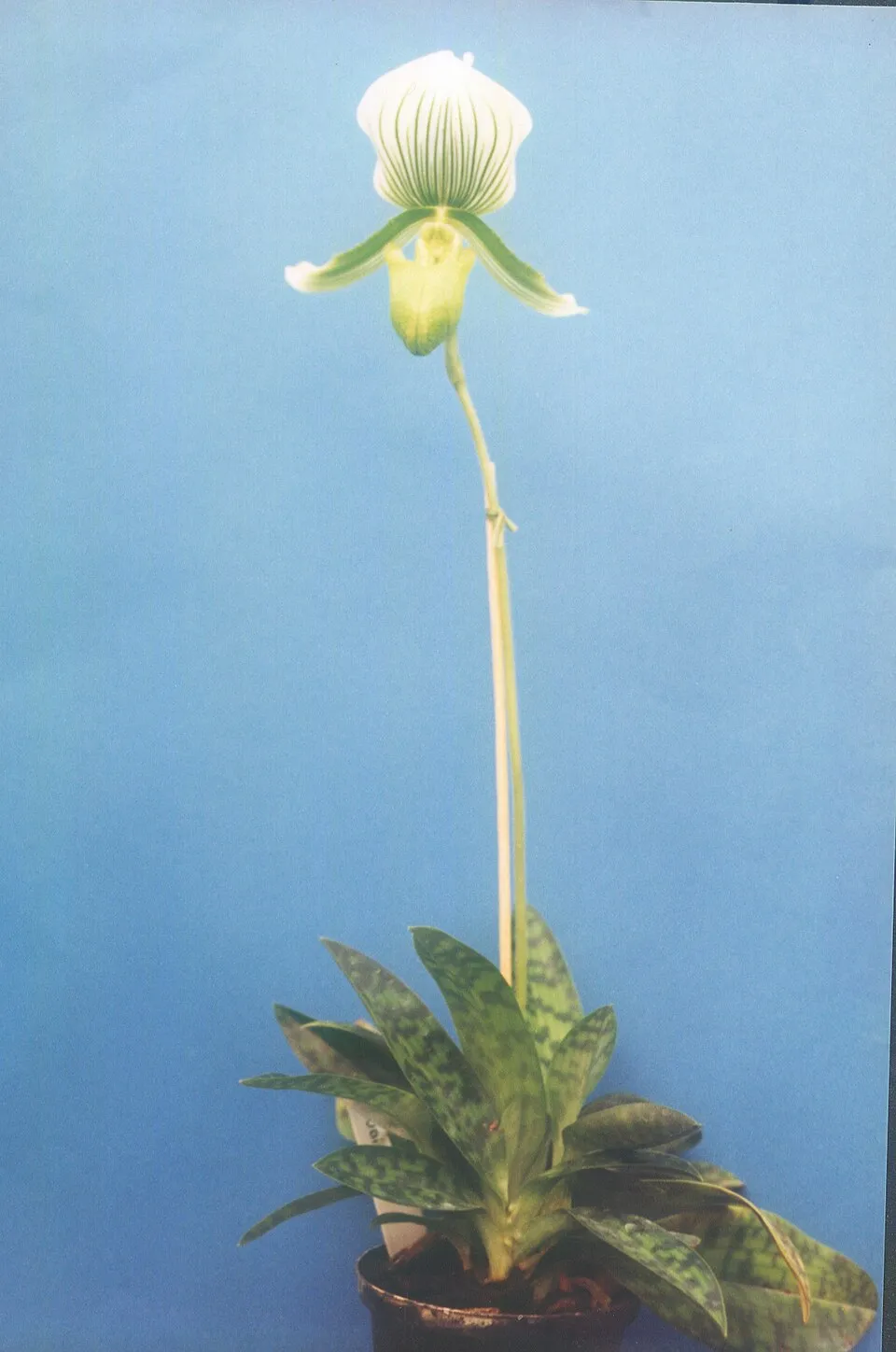
Paphiopedilum Maudiae, widely known as the Maudiae Orchid or Slipper Orchid, is an exquisite primary hybrid within the extensive Orchidaceae family, deriving its captivating traits from its parent species, Paphiopedilum callosum and Paphiopedilum lawrenceanum. This captivating terrestrial orchid typically reaches a modest height of 30 to 45 centimeters, making it an exemplary choice for indoor cultivation. Its defining characteristic is its glossy, ovate-lanceolate leaves, elegantly arranged in a basal rosette. Each leaf, extending up to 20 centimeters, is strikingly adorned with a tessellated pattern of mottled dark green and lighter, often silvery-green patches, providing continuous visual interest.
The root system consists of thick, fleshy, and adventitious roots crucial for anchoring the plant and absorbing nutrients and water from its substrate. As a terrestrial herb, it lacks prominent bark. The flowers, the true spectacle, emerge singularly or in pairs on an upright scape, typically measuring 8 to 12 centimeters across. They exhibit the genus's highly specialized structure, featuring a prominent, often inflated, slipper-like labellum (pouch) designed to trap pollinators.
The erect, ovate dorsal sepal is a striking feature, patterned with bold, contrasting stripes of deep reddish-brown or burgundy against a pristine white or pale green background. The lateral sepals are fused into a synsepalum, usually lighter green, positioned beneath the labellum. The petals typically extend horizontally or slightly downward, often with a twisted or undulate margin, and can be green, white, or flushed with darker hues, complementing the dorsal sepal. Paphiopedilum Maudiae thrives in environments mimicking the understory of tropical rainforests, preferring shaded, humid conditions where its parent species naturally grow in leaf litter or on mossy rocks in Southeast Asia.
Trusted Scientific References
1. Authoritative external sources for Paphiopedilum Maudiae
1.1 Wikipedia — Paphiopedilum Maudiae
1.2 Kew POWO (Plants of the World Online)
1.3 PubMed — peer-reviewed research
1.4 NCBI Taxonomy Browser
1.5 GBIF — Global Biodiversity
1.1.Maudiae Orchid — Key Features
- ✓ <strong>Striking Mottled Foliage</strong> — Features a tessellated pattern of dark and silvery-green on its leaves.
- ✓ <strong>Slipper</strong> — like Labellum — Possesses the characteristic pouch-shaped lower petal of the Paphiopedilum genus.
- ✓ <strong>Compact Growth Habit</strong> — Typically grows 30-45 cm tall, making it ideal for indoor cultivation.
- ✓ <strong>Terrestrial Orchid Species</strong> — Naturally grows in leaf litter or on mossy rocks, not epiphytically.
- ✓ <strong>Long</strong> — lasting Blooms — Flowers are durable and provide extended periods of visual enjoyment.
- ✓ <strong>Relatively Easy Care</strong> — Considered one of the more forgiving Paphiopedilum varieties for home growers.
- ✓ <strong>Hybrid Origin</strong> — A primary hybrid of Paphiopedilum callosum and Paphiopedilum lawrenceanum.
- ✓ <strong>Shade</strong> — loving Plant — Prefers indirect or dappled light, mimicking its natural understory habitat.
- ✓ <strong>High Humidity Preference</strong> — Thrives in environments with moderate to high humidity and good air movement.
- ✓ <strong>Ornamental Value</strong> — Highly prized in horticulture for its unique beauty and elegant appearance.
1.2.Maudiae Orchid — Quick Summary
- ✓ Paphiopedilum Maudiae is an exquisite Slipper Orchid hybrid, celebrated for its unique mottled foliage and distinctive pouch-like flowers.
- ✓ Primarily an ornamental plant, it thrives indoors with specific care requirements for light, temperature, water, and humidity.
- ✓ Its terrestrial nature and preference for a moisture-retentive, well-draining, and often calcareous substrate are key to its successful cultivation.
- ✓ While offering aesthetic and horticultural therapeutic benefits, specific medicinal uses for this hybrid are not documented.
- ✓ Requires consistent care, including regular fertilization and periodic repotting, to maintain its health and promote blooming.
2.Maudiae Orchid — Scientific Identity
3.Maudiae Orchid — Quick Facts
4.Maudiae Orchid — Appearance & Identification
5.Maudiae Orchid — Native Habitat
6.Maudiae Orchid — Water Requirements
- ✓ Light — Provide 2-3 hours of shaded sunlight daily; east, north, or west-facing windows are ideal, or use artificial lights emitting >10,000 lumens per square yard.
- ✓ Temperature — Maintain night temperatures between 12.7-22.2°C (55-72°F) and day temperatures between 21.1-29.4°C (70-85°F), protecting from extreme cold or heat.
- ✓ Water — Keep the potting medium consistently moist but never waterlogged; water daily in greenhouses, and when the medium starts to dry indoors.
- ✓ Humidity — Ensure moderate humidity levels of 40-50%, supplemented by good air movement to prevent fungal issues; use a gravel tray with water indoors.
- ✓ Fertilization — Fertilize year-round with a weak solution (e.g., 5-5-5 to 10-10-10) at full strength, or a stronger fertilizer at ¼ strength; flush the medium monthly to quarterly to prevent salt buildup.
- ✓ Potting — Repot every two years, or annually for seedlings, using a well-draining, moisture-retentive mix containing fine/medium fir bark, perlite, sphagnum moss, and potentially calcareous additives like marble or oyster shells for its 'limey' preference.
- ✓ Repotting Technique — When repotting, divide large plants into clumps of 3-5 growths, spreading roots over a small amount of medium and burying the root-stem junction about ½ inch deep.
- ✓ Air Movement — Crucial for preventing fungal diseases, especially in high humidity; ensure good air circulation around the plants.
Reviewed by the Flora Medical Global Botanical Review Panel
Multi-disciplinary editorial group · Botany · Ethnobotany · Herbal-medicine literature
Who reviewed this: This page was checked by the Flora Medical Global Botanical Review Panel — an in-house editorial group of botany graduates, ethnobotany researchers, and horticulture practitioners who collectively maintain our 7,000+ plant encyclopedia. Meet the team.
Our 4-step verification process
1. Taxonomic verification
Scientific names and synonyms cross-checked against Kew POWO, World Flora Online, and The Plant List.
2. Phytochemical & medicinal cross-reference
Active compounds, traditional uses, and reported activities are cross-referenced with PubMed, USDA Dr. Duke's database, and peer-reviewed ethnobotanical literature.
3. Conservation & distribution check
Distribution, ecology, and conservation status confirmed against GBIF occurrence records and the IUCN Red List.
4. Editorial & safety review
Every entry passes an editorial pass for clarity, originality, and safety notices (toxicity, contraindications, dosage caveats) before publication.
Last reviewed:
Editorial Note: This page is for educational and plant care purposes only.
Written by: Flora Medical Global Editorial Team
Reviewed by: Flora Medical Global Botanical Review Panel
Last Updated: June 16, 2026







Maudiae Orchid — Comments & Community Reviews
Rate this plant