
Care Disclaimer: Plant care recommendations are general guidelines based on common growing conditions. Individual results may vary based on your local environment, climate, and care routine. If your plant is toxic, keep it away from children and pets, and consult a veterinarian if accidental ingestion occurs.
1.Pearls and Jade Pothos — Overview
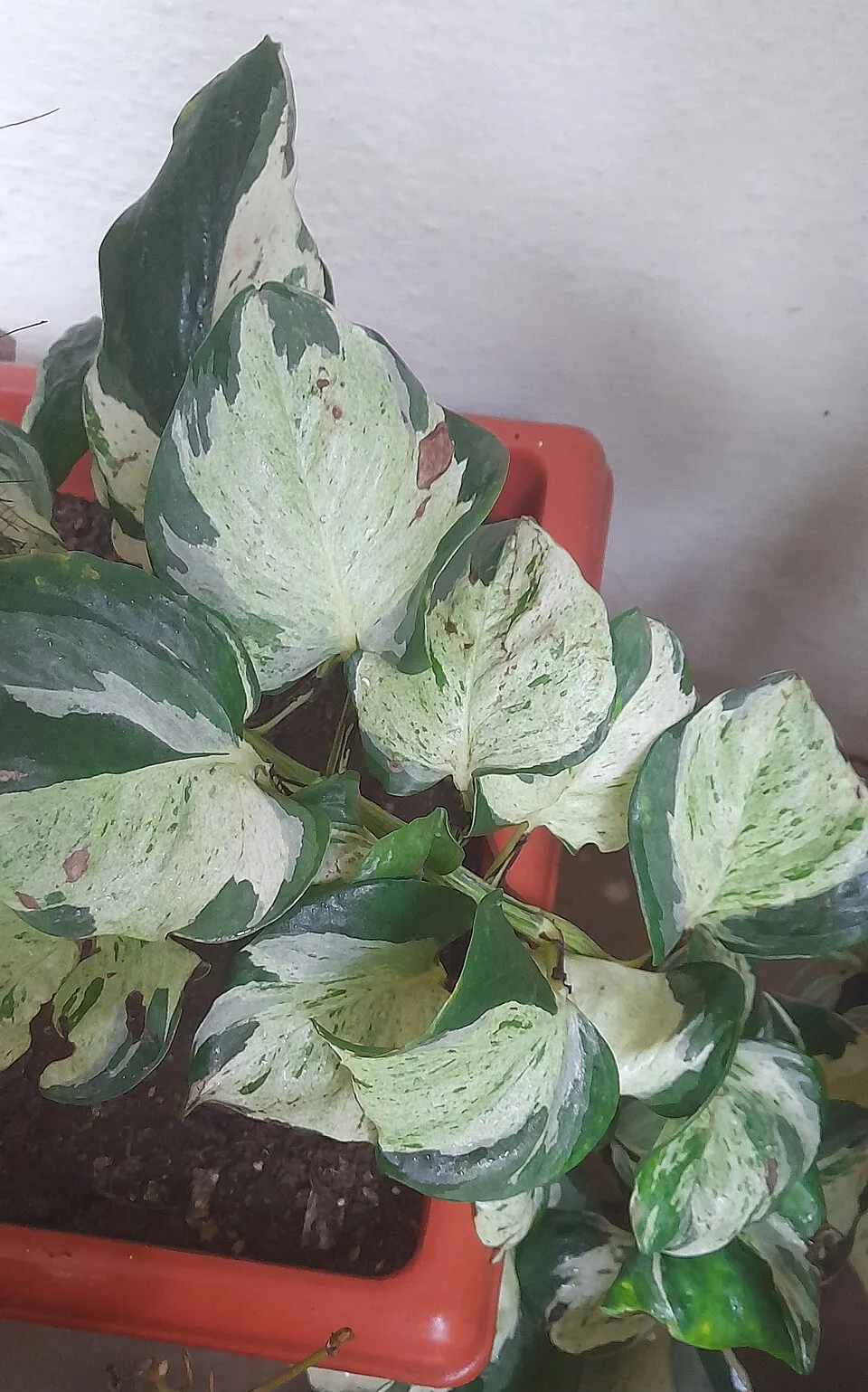
Epipremnum aureum 'Pearls and Jade' is a highly prized compact cultivar of the widely popular Pothos, a member of the Araceae family. This distinctive variety typically reaches an indoor height of 3 to 4 feet (0.91 to 1.22 meters), presenting a graceful trailing or climbing habit. Its most striking feature is its small, heart-shaped leaves, usually measuring 2 to 4 inches (5 to 10 cm) in length, which display an intricate and captivating variegation.
The foliage exhibits a unique marbling pattern of white, light green, and darker green shades, often concentrated around the leaf margins, giving it a lavish and eye-catching appearance that distinguishes it from other Pothos varieties like 'Marble Queen' or 'Golden Pothos' by having smaller, thinner leaves. The stems are characteristically sturdy, smooth, and greenish, adaptable for training on poles or allowing to cascade from hanging baskets.
Native to the tropical Solomon Islands, 'Pearls and Jade' Pothos thrives remarkably well in indoor environments globally, adapting to a range of lighting conditions but preferring bright, indirect sunlight to maintain its vibrant variegation. While it rarely flowers when cultivated indoors, its ornamental value lies entirely in its stunning foliage. Taxonomically, this cultivar was developed by the University of Florida in 2009.
Beyond its aesthetic appeal, a significant attribute of Epipremnum aureum, including the 'Pearls and Jade' cultivar, is its proven ability to filter common indoor air pollutants, as notably identified by NASA research. This ease of care, combined with its decorative charm and air-purifying properties, makes it an ideal houseplant for both novice and experienced plant enthusiasts.
Trusted Scientific References
Authoritative external sources for Epipremnum aureum Pearls and Jade:
Wikipedia — Epipremnum aureum Pearls and Jade
Kew POWO (Plants of the World Online)
PubMed — peer-reviewed research
NCBI Taxonomy Browser
GBIF — Global Biodiversity
Pearls and Jade Pothos should be interpreted through verified botanical identity, practical care, and responsible safety language. This recovery note adds the missing context needed for a complete profile: match light to the plant's habit, use well-drained soil, water according to season, and avoid unsupported medicinal or edible claims.
For publishing, the plant can be presented as a source-backed indoor plant with clear care guidance, common problem diagnosis, and conservative safety wording.
1.1.Pearls and Jade Pothos — Key Features
- ✓ <strong>Botanical Name</strong> — Epipremnum aureum 'Pearls and Jade'
- ✓ <strong>Family</strong> — Araceae
- ✓ <strong>Striking Variegation</strong> — Distinctive white, light green, and dark green marbling on heart-shaped leaves.
- ✓ <strong>Air Purification Power</strong> — NASA-rated for effectively removing indoor air pollutants like formaldehyde and benzene.
- ✓ <strong>Low Maintenance</strong> — Considered an easy-care houseplant, suitable for beginners.
- ✓ <strong>Versatile Growth Habit</strong> — Can be grown as a trailing plant in hanging baskets or trained to climb.
- ✓ <strong>Compact Size</strong> — Generally smaller leaves and overall growth compared to other Pothos varieties.
- ✓ <strong>Non</strong> — Flowering Indoors — Primarily cultivated and valued for its decorative foliage.
- ✓ <strong>Toxic Nature</strong> — Contains calcium oxalate, making it harmful if ingested by humans or pets.
- ✓ <strong>Mood Enhancer</strong> — Contributes to a calming and positive indoor environment, reducing stress.
1.2.Pearls and Jade Pothos — Quick Summary
- ✓ Epipremnum aureum 'Pearls and Jade' is a compact, variegated Pothos cultivar.
- ✓ Features stunning white, light green, and dark green marbled foliage.
- ✓ Renowned for its significant indoor air purification capabilities, removing common toxins.
- ✓ Contributes positively to psychological well-being, reducing stress and enhancing mood.
- ✓ Contains calcium oxalate crystals, making all parts toxic if ingested by humans or pets.
- ✓ An exceptionally easy-to-care-for houseplant, ideal for all levels of plant enthusiasts.
2.Pearls and Jade Pothos — Scientific Identity
3.Pearls and Jade Pothos — Quick Facts
4.Pearls and Jade Pothos — Appearance & Identification
5.Pearls and Jade Pothos — Native Habitat
6.Pearls and Jade Pothos — Water Requirements
- ✓ Light — Provide bright, indirect light; direct sunlight can scorch its delicate variegated leaves, while too little light can diminish variegation.
- ✓ Soil — Use a rich, airy, and well-draining potting mix, ideally a blend of equal parts potting soil, perlite, and orchid bark, to prevent root rot.
- ✓ Water — Water thoroughly when the top 1 to 2 inches of soil feels dry to the touch; reduce watering frequency in fall and winter months.
- ✓ Temperature & Humidity — Maintain standard household temperatures between 65-80°F (18-27°C) and moderate to slightly high humidity; avoid temperatures below 50°F (10°C).
- ✓ Fertilizer — Fertilize monthly during the active growing seasons of spring and summer with a balanced liquid houseplant fertilizer, following product instructions, and cease feeding in fall/winter.
- ✓ Pruning — Trim back leggy stems in spring or summer to encourage a bushier growth habit and maintain desired shape, never removing more than one-third of the plant at once.
- ✓ Propagation — Easily propagate via stem cuttings with 3-5 nodes, rooted in water until roots are 2-3 inches long, then transfer to well-draining soil.
- ✓ Potting — Repot into a slightly larger container with good drainage when the plant becomes root-bound, typically every 1-2 years.
Reviewed by the Flora Medical Global Botanical Review Panel
Multi-disciplinary editorial group · Botany · Ethnobotany · Herbal-medicine literature
Who reviewed this: This page was checked by the Flora Medical Global Botanical Review Panel — an in-house editorial group of botany graduates, ethnobotany researchers, and horticulture practitioners who collectively maintain our 7,000+ plant encyclopedia. Meet the team.
Our 4-step verification process
1. Taxonomic verification
Scientific names and synonyms cross-checked against Kew POWO, World Flora Online, and The Plant List.
2. Phytochemical & medicinal cross-reference
Active compounds, traditional uses, and reported activities are cross-referenced with PubMed, USDA Dr. Duke's database, and peer-reviewed ethnobotanical literature.
3. Conservation & distribution check
Distribution, ecology, and conservation status confirmed against GBIF occurrence records and the IUCN Red List.
4. Editorial & safety review
Every entry passes an editorial pass for clarity, originality, and safety notices (toxicity, contraindications, dosage caveats) before publication.
Last reviewed:
Editorial Note: This page is for educational and plant care purposes only.
Written by: Flora Medical Global Editorial Team
Reviewed by: Flora Medical Global Botanical Review Panel
Last Updated: June 16, 2026







Pearls and Jade Pothos — Comments & Community Reviews
Rate this plant