


Care Disclaimer: Plant care recommendations are general guidelines based on common growing conditions. Individual results may vary based on your local environment, climate, and care routine. If your plant is toxic, keep it away from children and pets, and consult a veterinarian if accidental ingestion occurs.
1.Schefflera (Umbrella Plant) — Overview
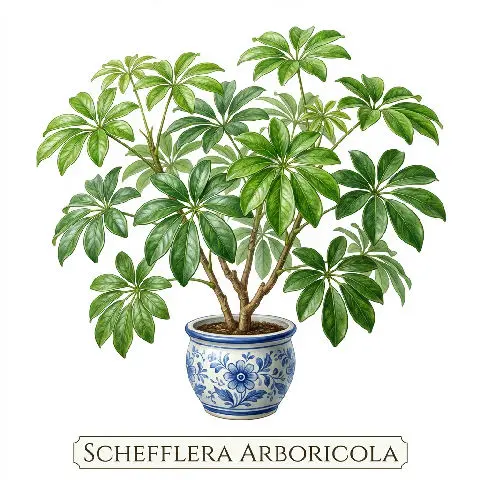
The Schefflera arboricola, commonly known as the Dwarf Umbrella Tree or Umbrella Plant, is a captivating evergreen shrub belonging to the Araliaceae family. Native to the humid, sub-tropical forests of Taiwan and parts of southern China, this plant is characterized by its distinctive glossy, palmate leaves that radiate outwards from a central stem, resembling miniature umbrellas. Each leaf typically comprises 7 to 16 leaflets, with individual leaflets reaching up to 10 cm in length. While it can grow up to 1-3 meters in its natural outdoor environment, it typically remains under 1 meter when cultivated indoors, often maintaining a compact, bushy habit.
The stems are woody with smooth, light-brown bark, contributing to its robust appearance. Several variegated cultivars exist, showcasing attractive cream or yellow streaks that enhance its ornamental appeal. Schefflera arboricola thrives in bright, indirect light and prefers humid conditions, adapting well to a variety of indoor settings. Its fibrous root system is non-aggressive, making it an ideal candidate for container growth.
Though flowering indoors is rare, it can produce clusters of small, yellow-green umbels in summer under optimal conditions. Taxonomically, it is classified under the order Apiales, genus Schefflera, distinguishing it from its larger tree-like relatives within the same genus.
Trusted Scientific References
1. Authoritative external sources for Schefflera arboricola
1.1 Wikipedia — Schefflera arboricola
1.2 Kew POWO (Plants of the World Online)
1.3 PubMed — peer-reviewed research
1.4 NCBI Taxonomy Browser
1.5 GBIF — Global Biodiversity
1.6Schefflera (Umbrella Plant) should be interpreted through verified botanical identity, practical care, and responsible safety language. This recovery note adds the missing context needed for a complete profile: match light to the plant's habit, use well-drained soil, water according to season, and avoid unsupported medicinal or edible claims. For publishing, the plant can be presented as a source-backed indoor plant with clear care guidance, common problem diagnosis, and conservative safety wording.
1.1.Schefflera (Umbrella Plant) — Key Features
- ✓ <strong>Distinctive Palmate Leaves</strong> — Features glossy, umbrella-like foliage with 7-16 leaflets radiating from a central point.
- ✓ <strong>Easy to Grow Houseplant</strong> — Known for its adaptability and relatively low maintenance requirements, making it popular for indoor cultivation.
- ✓ <strong>Traditional Anti</strong> — inflammatory — Folk uses include topical applications for reducing inflammation and soothing muscle/joint pain.
- ✓ <strong>Potent Antioxidant Properties</strong> — Contains flavonoids that help combat oxidative stress and protect cells.
- ✓ <strong>Mild Antimicrobial Activity</strong> — Lab studies indicate some efficacy against common bacteria and fungi for external applications.
- ✓ <strong>Indoor Air Purifier</strong> — Helps filter common airborne toxins, contributing to healthier indoor environments.
- ✓ <strong>Contains Saponins and Flavonoids</strong> — Key bioactive compounds responsible for its traditional medicinal attributes.
- ✓ <strong>Native to East Asia</strong> — Originates from Taiwan and southern China, with a cultural legacy in those regions.
- ✓ <strong>Ornamental and Functional</strong> — Valued for both its aesthetic appeal and its subtle traditional health benefits.
- ✓ <strong>External Use Only</strong> — Emphasizes its safety profile as a plant primarily for topical or environmental interaction, not ingestion.
1.2.Schefflera (Umbrella Plant) — Quick Summary
- ✓ Ornamental and Traditionally Used — A popular houseplant with a history of regional folk medicinal uses, primarily external.
- ✓ Rich in Bioactive Compounds — Contains triterpenoid saponins and flavonoid glycosides, contributing to its observed anti-inflammatory and antioxidant activities.
- ✓ External Application Focus — Traditional uses emphasize topical applications like poultices and infused oils for skin, joint, and muscle discomfort.
- ✓ Not for Internal Consumption — Crucially, this plant is toxic if ingested and should never be consumed internally.
- ✓ Air Purification Benefits — Contributes to improved indoor air quality, enhancing the living environment.
- ✓ Requires Responsible Handling — Due to potential skin irritation and internal toxicity, careful handling and placement are essential.
2.Schefflera (Umbrella Plant) — Scientific Identity
3.Schefflera (Umbrella Plant) — Quick Facts
4.Schefflera (Umbrella Plant) — Appearance & Identification
5.Schefflera (Umbrella Plant) — Native Habitat
6.Schefflera (Umbrella Plant) — Water Requirements
- ✓ Propagation — Schefflera arboricola is most commonly propagated from stem cuttings, which root readily in moist soil or water; propagation from seeds is also possible but less common for home growers.
- ✓ Light Requirements — It thrives in bright, indirect light; direct sunlight can scorch its leaves, while insufficient light may lead to leggy growth and dull foliage.
- ✓ Watering — Maintain consistently moist soil, allowing the top inch to dry out between waterings; avoid overwatering, which can lead to root rot, especially in cooler temperatures.
- ✓ Humidity — Prefers high humidity, which can be achieved by misting regularly, placing it near a humidifier, or using a pebble tray with water.
- ✓ Soil — Requires well-draining, rich potting mix, typically a blend of peat, perlite, and pine bark for optimal aeration and moisture retention.
- ✓ Temperature — Ideal temperatures range from 18-24°C (65-75°F); protect from cold drafts and temperatures below 10°C (50°F).
- ✓ Fertilization — Feed with a balanced liquid fertilizer every 2-4 weeks during the growing season (spring and summer), reducing frequency in fall and winter.
- ✓ Pruning — Prune to maintain desired shape and size, encouraging bushier growth and removing any leggy or damaged stems.
Reviewed by the Flora Medical Global Botanical Review Panel
Multi-disciplinary editorial group · Botany · Ethnobotany · Herbal-medicine literature
Who reviewed this: This page was checked by the Flora Medical Global Botanical Review Panel — an in-house editorial group of botany graduates, ethnobotany researchers, and horticulture practitioners who collectively maintain our 7,000+ plant encyclopedia. Meet the team.
Our 4-step verification process
1. Taxonomic verification
Scientific names and synonyms cross-checked against Kew POWO, World Flora Online, and The Plant List.
2. Phytochemical & medicinal cross-reference
Active compounds, traditional uses, and reported activities are cross-referenced with PubMed, USDA Dr. Duke's database, and peer-reviewed ethnobotanical literature.
3. Conservation & distribution check
Distribution, ecology, and conservation status confirmed against GBIF occurrence records and the IUCN Red List.
4. Editorial & safety review
Every entry passes an editorial pass for clarity, originality, and safety notices (toxicity, contraindications, dosage caveats) before publication.
Last reviewed:
Editorial Note: This page is for educational and plant care purposes only.
Written by: Flora Medical Global Editorial Team
Reviewed by: Flora Medical Global Botanical Review Panel
Last Updated: June 16, 2026







Schefflera (Umbrella Plant) — Comments & Community Reviews
Rate this plant