
Care Disclaimer: Plant care recommendations are general guidelines based on common growing conditions. Individual results may vary based on your local environment, climate, and care routine. If your plant is toxic, keep it away from children and pets, and consult a veterinarian if accidental ingestion occurs.
1.Senecio Blue Chalk — Overview
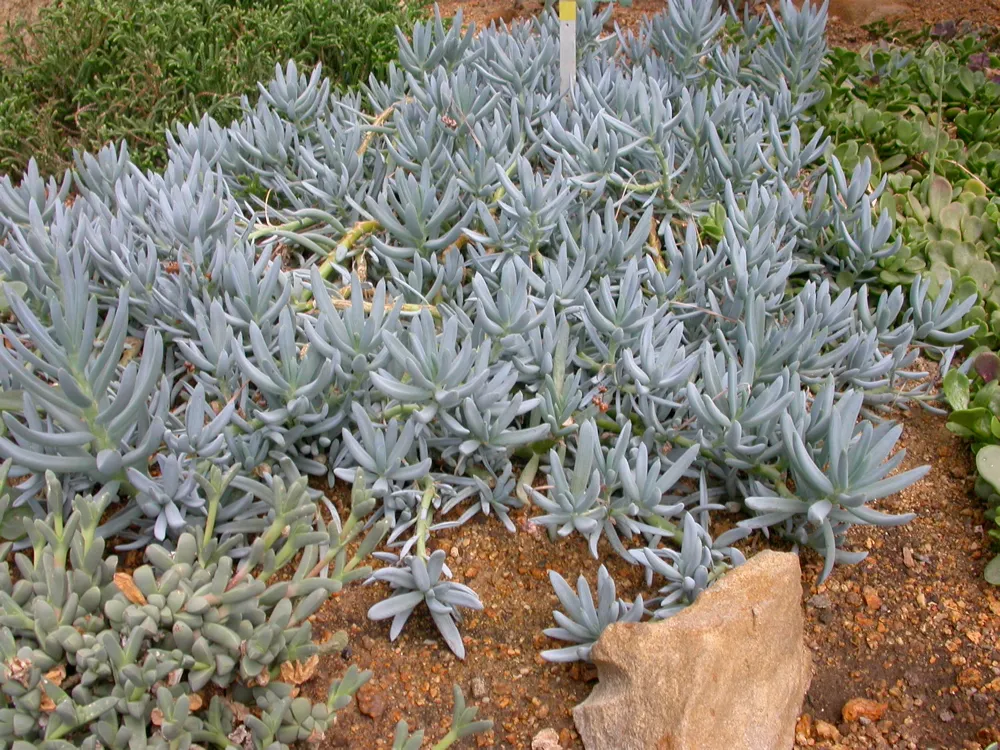
Senecio serpens, commonly known as Blue Chalksticks or Blue Chalk, is a distinctive succulent perennial belonging to the expansive Asteraceae family. This botanical marvel is primarily celebrated for its captivating ornamental qualities, particularly its unique foliage. The plant typically forms low-growing, spreading mats, usually reaching a height of 12 to 24 inches (30 to 60 cm) and spreading 2-3 feet wide, making it an excellent choice for groundcover, rock gardens, or container displays. Its most striking feature is the cylindrical, pencil-like leaves, which are characteristically coated in a powdery, glaucous blue-gray wax, giving rise to its 'Blue Chalk' moniker.
These succulent leaves, typically 1 to 2 inches (2.5 to 5 cm) in length, are arranged densely along smooth, waxy stems that share the characteristic coloration. This waxy cuticle on both leaves and stems serves a crucial physiological function, minimizing water loss and enabling the plant to thrive in arid conditions. While primarily valued for its foliage, Senecio serpens can produce small, inconspicuous daisy-like white flowers, usually appearing in late spring to summer or even fall under optimal growing conditions. These subtle blooms do not overshadow the plant's primary aesthetic appeal.
Native to the arid and rocky regions of the Western Cape Province in South Africa, Blue Chalksticks is perfectly adapted to environments with well-drained, sandy soils and intense sunlight. Its natural habitat underscores its resilience and pronounced drought-tolerant nature, making it a favorite among xeriscape enthusiasts and succulent collectors worldwide. Taxonomically, Senecio serpens is part of the vast and diverse Senecio genus, though it is sometimes classified under the genus Curio (Curio repens), reflecting ongoing botanical reclassification within the family.
Trusted Scientific References
1. Authoritative external sources for Senecio serpens
1.1 Wikipedia — Senecio serpens
1.2 Kew POWO (Plants of the World Online)
1.3 PubMed — peer-reviewed research
1.4 NCBI Taxonomy Browser
1.5 GBIF — Global Biodiversity
1.1.Senecio Blue Chalk — Key Features
- ✓ <strong>Glaucous Blue</strong> — Gray Foliage — Distinctive cylindrical, waxy, pencil-like leaves.
- ✓ <strong>Succulent Perennial</strong> — Stores water efficiently in its fleshy leaves and stems.
- ✓ <strong>Low</strong> — Growing Groundcover — Forms dense, spreading mats, ideal for landscape coverage.
- ✓ <strong>Drought</strong> — Tolerant — Highly adapted to arid conditions with minimal water requirements.
- ✓ <strong>Full Sun Lover</strong> — Thrives best in intense, direct sunlight for optimal growth and color.
- ✓ <strong>South African Native</strong> — Originates from the Western Cape Province of South Africa.
- ✓ <strong>Asteraceae Family</strong> — Member of the extensive daisy and sunflower family.
- ✓ <strong>Pyrrolizidine Alkaloid Content</strong> — Contains toxic compounds harmful upon ingestion.
- ✓ <strong>Minimal Maintenance</strong> — Easy to care for once established, requiring little intervention.
- ✓ <strong>Ornamental Value</strong> — Primarily cultivated for its aesthetic appeal in gardens and containers.
1.2.Senecio Blue Chalk — Quick Summary
- ✓ Senecio serpens, or Blue Chalksticks, is a popular, drought-tolerant succulent.
- ✓ Valued primarily for its unique glaucous blue-gray, pencil-like foliage and groundcover habit.
- ✓ Native to the arid regions of South Africa, thriving in full sun and well-drained soil.
- ✓ Contains toxic pyrrolizidine alkaloids, making it unsafe for any form of consumption.
- ✓ Primarily used as an ornamental plant in xeriscapes, rock gardens, and containers.
- ✓ Requires minimal watering and is hardy to around 20-25°F.
2.Senecio Blue Chalk — Scientific Identity
3.Senecio Blue Chalk — Quick Facts
4.Senecio Blue Chalk — Appearance & Identification
5.Senecio Blue Chalk — Native Habitat
6.Senecio Blue Chalk — Water Requirements
- Senecio serpens is a resilient succulent that thrives with minimal care when its specific environmental needs are met.
- ✓ Soil Requirements — Prefers extremely well-drained, sandy, or gritty soil mixes; avoid heavy clay soils to prevent root rot.
- ✓ Light Exposure — Requires full sun exposure, ideally 6-8 hours of direct sunlight daily, to maintain its vibrant blue coloration and compact growth.
- ✓ Watering — Low water needs; allow the soil to dry out completely between waterings, especially during cooler, dormant periods.
- ✓ Temperature & Hardiness — Hardy to approximately 20-25°F (-6 to -4°C); protect from prolonged freezing temperatures and severe frost.
- ✓ Propagation — Easily propagated from stem cuttings; allow cuttings to callus for a few days before planting in well-drained soil.
- ✓ Maintenance — Requires minimal pruning to remove any leggy stems or spent flower stalks; generally resistant to most pests and diseases.
- ✓ Ideal Uses — Excellent as a groundcover, in rock gardens, succulent arrangements, container plantings, and xeriscapes.
Reviewed by the Flora Medical Global Botanical Review Panel
Multi-disciplinary editorial group · Botany · Ethnobotany · Herbal-medicine literature
Who reviewed this: This page was checked by the Flora Medical Global Botanical Review Panel — an in-house editorial group of botany graduates, ethnobotany researchers, and horticulture practitioners who collectively maintain our 7,000+ plant encyclopedia. Meet the team.
Our 4-step verification process
1. Taxonomic verification
Scientific names and synonyms cross-checked against Kew POWO, World Flora Online, and The Plant List.
2. Phytochemical & medicinal cross-reference
Active compounds, traditional uses, and reported activities are cross-referenced with PubMed, USDA Dr. Duke's database, and peer-reviewed ethnobotanical literature.
3. Conservation & distribution check
Distribution, ecology, and conservation status confirmed against GBIF occurrence records and the IUCN Red List.
4. Editorial & safety review
Every entry passes an editorial pass for clarity, originality, and safety notices (toxicity, contraindications, dosage caveats) before publication.
Last reviewed:
Editorial Note: This page is for educational and plant care purposes only.
Written by: Flora Medical Global Editorial Team
Reviewed by: Flora Medical Global Botanical Review Panel
Last Updated: June 16, 2026







Senecio Blue Chalk — Comments & Community Reviews
Rate this plant