
Care Disclaimer: Plant care recommendations are general guidelines based on common growing conditions. Individual results may vary based on your local environment, climate, and care routine. If your plant is toxic, keep it away from children and pets, and consult a veterinarian if accidental ingestion occurs.
1.Stapelia Grandiflora — Overview
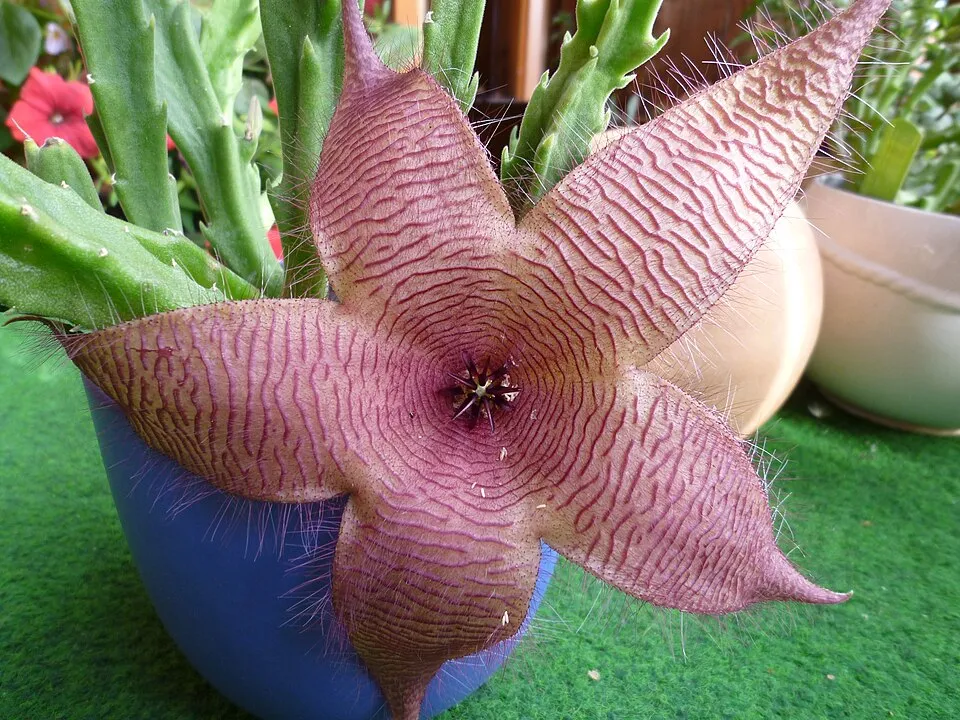
Stapelia grandiflora, widely recognized as the Carrion Flower or Starfish Flower, is a distinctive succulent perennial belonging to the Apocynaceae family. Native to the arid and semi-arid regions of Southern Africa, particularly South Africa and Namibia, this plant is remarkably adapted to harsh, dry conditions. It typically grows to a height of 12 to 18 inches (30 to 46 cm), featuring robust, fleshy stems that can reach up to 2 inches (5 cm) in thickness.
These greenish-brown stems are characterized by prominent, raised ridges and a rough texture, providing both structural integrity and visual interest. The leaves are highly reduced to rudimentary spines, a common xerophytic adaptation that minimizes water loss and contributes to the plant's leafless appearance. The most striking feature of Stapelia grandiflora is its large, star-shaped flowers, which can span an impressive 10 inches (25 cm) in diameter.
These blooms exhibit stunning shades of deep maroon or chocolate brown, often accentuated with creamy yellow markings. Their unique coloration and texture, combined with a strong, pungent odor resembling decaying flesh, are specialized adaptations designed to attract specific pollinators, primarily flies. This fascinating plant thrives in well-draining, sandy soils and requires minimal water, making it a popular choice for succulent enthusiasts and xeriscaping.
Trusted Scientific References
1. Authoritative external sources for Stapelia grandiflora
1.1 Wikipedia — Stapelia grandiflora
1.2 Kew POWO (Plants of the World Online)
1.3 PubMed — peer-reviewed research
1.4 NCBI Taxonomy Browser
1.5 GBIF — Global Biodiversity
1.6Stapelia Grandiflora should be interpreted through verified botanical identity, practical care, and responsible safety language. This recovery note adds the missing context needed for a complete profile: match light to the plant's habit, use well-drained soil, water according to season, and avoid unsupported medicinal or edible claims. For publishing, the plant can be presented as a source-backed indoor plant with clear care guidance, common problem diagnosis, and conservative safety wording.
1.1.Stapelia Grandiflora — Key Features
- ✓ <strong>Common Names</strong> — Carrion Flower, Starfish Flower, Giant Toad Plant.
- ✓ <strong>Botanical Family</strong> — Apocynaceae, known for its diverse succulents and milkweeds.
- ✓ <strong>Succulent Morphology</strong> — Features thick, fleshy, ridged stems adapted for efficient water retention.
- ✓ <strong>Striking Flowers</strong> — Produces large, star-shaped blooms, often deep maroon or chocolate brown with creamy markings.
- ✓ <strong>Distinctive Scent</strong> — Emits a strong carrion odor, a unique adaptation to attract specific fly pollinators.
- ✓ <strong>Arid Habitat Adaptation</strong> — Highly drought-tolerant and prefers well-draining soils, indicative of its native Southern African habitat.
- ✓ <strong>Topical Traditional Use</strong> — Historically used for minor skin abrasions and irritations in some African traditions.
- ✓ <strong>Ornamental Value</strong> — Highly prized for its unusual aesthetic and dramatic flowering in cultivation.
- ✓ <strong>Low Water Needs</strong> — An excellent choice for water-wise gardening and xeriscaping.
- ✓ <strong>Easy Propagation</strong> — Readily grows from stem cuttings, making it simple to propagate new plants.
1.2.Stapelia Grandiflora — Quick Summary
- ✓ Ornamental Succulent — Valued primarily for its striking, carrion-scented, star-shaped flowers.
- ✓ Native to Southern Africa — Thrives in arid, well-draining conditions with minimal water.
- ✓ Limited Traditional Medicinal Use — Primarily topical for minor skin issues in some indigenous practices.
- ✓ Unique Pollination Strategy — Attracts flies with its distinctive scent and decaying flesh mimicry.
- ✓ Low Maintenance Plant — Ideal for xeriscaping and succulent enthusiasts due to its resilience.
- ✓ Contains Alkaloids & Flavonoids — Chemical profile warrants caution; internal use is not advised.
2.Stapelia Grandiflora — Scientific Identity
3.Stapelia Grandiflora — Quick Facts
4.Stapelia Grandiflora — Appearance & Identification
5.Stapelia Grandiflora — Native Habitat
6.Stapelia Grandiflora — Water Requirements
- ✓ Soil Requirements — Thrives in extremely well-draining, gritty succulent potting mix, often composed of pumice, perlite, and a small amount of organic matter, with an ideal pH between 6.0 and 7.0 to prevent root rot.
- ✓ Light Conditions — Prefers bright, indirect sunlight or partial shade; exposure to intense, direct afternoon sun can lead to scorching of its fleshy stems, while insufficient light may inhibit flowering.
- ✓ Watering Schedule — Water sparingly and deeply, allowing the soil to dry out completely between waterings. Reduce watering significantly during the cooler, dormant winter months to prevent fungal issues.
- ✓ Temperature and Humidity — Best grown in warm conditions, with ideal temperatures ranging from 60-80°F (15-27°C). It tolerates low humidity well, reflecting its native arid habitat.
- ✓ Fertilization — Apply a diluted, balanced succulent fertilizer (e.g., 5-10-10 or 10-10-10) once or twice during the active growing season (spring and summer), avoiding over-fertilization which can harm the plant.
- ✓ Propagation — Easily propagated from stem cuttings, which should be allowed to callus for several days in a dry, shaded area before being planted in well-draining soil to encourage rooting.
- ✓ Pest and Disease Management — Generally resilient to pests, but can occasionally be susceptible to mealybugs and scale insects if conditions are too humid or crowded. Root rot is the primary disease concern, caused by overwatering.
- ✓ Repotting — Repot only when the plant has outgrown its container, typically every 2-3 years, using fresh succulent mix to replenish nutrients and ensure continued good drainage.
Reviewed by the Flora Medical Global Botanical Review Panel
Multi-disciplinary editorial group · Botany · Ethnobotany · Herbal-medicine literature
Who reviewed this: This page was checked by the Flora Medical Global Botanical Review Panel — an in-house editorial group of botany graduates, ethnobotany researchers, and horticulture practitioners who collectively maintain our 7,000+ plant encyclopedia. Meet the team.
Our 4-step verification process
1. Taxonomic verification
Scientific names and synonyms cross-checked against Kew POWO, World Flora Online, and The Plant List.
2. Phytochemical & medicinal cross-reference
Active compounds, traditional uses, and reported activities are cross-referenced with PubMed, USDA Dr. Duke's database, and peer-reviewed ethnobotanical literature.
3. Conservation & distribution check
Distribution, ecology, and conservation status confirmed against GBIF occurrence records and the IUCN Red List.
4. Editorial & safety review
Every entry passes an editorial pass for clarity, originality, and safety notices (toxicity, contraindications, dosage caveats) before publication.
Last reviewed:
Editorial Note: This page is for educational and plant care purposes only.
Written by: Flora Medical Global Editorial Team
Reviewed by: Flora Medical Global Botanical Review Panel
Last Updated: June 16, 2026







Stapelia Grandiflora — Comments & Community Reviews
Rate this plant