
Care Disclaimer: Plant care recommendations are general guidelines based on common growing conditions. Individual results may vary based on your local environment, climate, and care routine. If your plant is toxic, keep it away from children and pets, and consult a veterinarian if accidental ingestion occurs.
1.Wandering Jew Silver — Overview
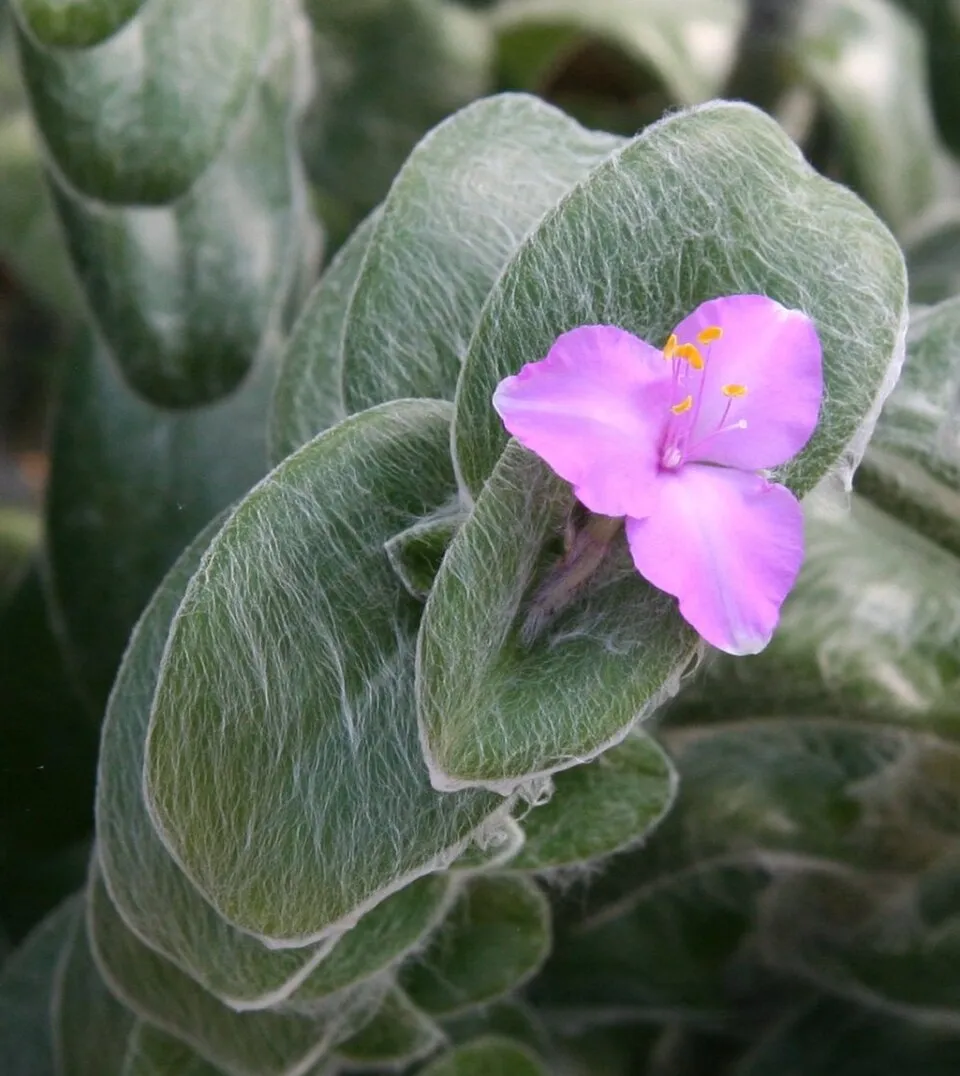
Tradescantia sillamontana, commonly known as Wandering Jew Silver or White Velvety Tradescantia, is a captivating perennial herbaceous plant belonging to the Commelinaceae family. Native to arid and semi-arid regions of northeastern Mexico, particularly the states of Nuevo León and Coahuila, this species thrives in dry, rocky crevices and sunny slopes, demonstrating remarkable resilience. It stands out in the vast Tradescantia genus for its distinctive morphological features, most notably the dense covering of soft, white, woolly hairs (trichomes) that completely envelop its stems and leaves, lending it a silvery-white, frosted appearance. This characteristic pubescence is not merely aesthetic; it serves as a crucial adaptation to its natural environment, enabling the plant to minimize water loss through transpiration and protect against intense solar radiation.
The plant exhibits a sprawling or trailing growth habit, making it an excellent choice for groundcover, hanging baskets, or terrariums where its cascading stems can be showcased. Historically, while other Tradescantia species have seen more extensive traditional medicinal applications, T. sillamontana has been less documented in major established pharmacopoeias. Its primary value initially stemmed from its horticultural appeal.
However, contemporary pharmacological interest in the broader Tradescantia genus, known for its rich phytochemical profile, has begun to extend to species like T. sillamontana, focusing on its potential for photoprotection due to its high concentration of pigments and its unique trichome structure.
Trusted Scientific References
1. Authoritative external sources for Tradescantia sillamontana
1.1 Wikipedia — Tradescantia sillamontana
1.2 Kew POWO (Plants of the World Online)
1.3 PubMed — peer-reviewed research
1.4 NCBI Taxonomy Browser
1.5 GBIF — Global Biodiversity
1.6Wandering Jew Silver should be interpreted through verified botanical identity, practical care, and responsible safety language. This recovery note adds the missing context needed for a complete profile: match light to the plant's habit, use well-drained soil, water according to season, and avoid unsupported medicinal or edible claims. For publishing, the plant can be presented as a source-backed indoor plant with clear care guidance, common problem diagnosis, and conservative safety wording.
1.1.Wandering Jew Silver — Key Features
- ✓ <strong>Scientific Name</strong> — Tradescantia sillamontana.
- ✓ <strong>Common Name</strong> — Wandering Jew Silver, White Velvety Tradescantia.
- ✓ <strong>Family</strong> — Commelinaceae (Spiderwort family).
- ✓ <strong>Origin</strong> — Northeastern Mexico.
- ✓ <strong>Unique Trait</strong> — Dense white woolly hairs covering stems and leaves, giving a frosted appearance.
- ✓ <strong>Growth Habit</strong> — Sprawling, trailing perennial.
- ✓ <strong>Primary Use</strong> — Ornamental horticulture and landscaping.
- ✓ <strong>Key Compounds</strong> — Flavonoids, phenolic acids, triterpenoids.
- ✓ <strong>Environmental Adaptation</strong> — Highly drought-tolerant and sun-loving due to trichomes.
- ✓ <strong>Medicinal Potential</strong> — Research interest in antioxidant, anti-inflammatory, and photoprotective properties.
1.2.Wandering Jew Silver — Quick Summary
- ✓ Distinctive silvery-white foliage due to a dense covering of woolly trichomes.
- ✓ Native to arid regions of northeastern Mexico, adapted to dry, sunny conditions.
- ✓ Primarily cultivated as an ornamental plant for groundcover, hanging baskets, or terrariums.
- ✓ Contains flavonoids, phenolic acids, and triterpenoids, suggesting antioxidant and anti-inflammatory potential.
- ✓ Limited traditional medicinal uses specifically for T. sillamontana; research is ongoing for its phytochemical properties and adaptations.
- ✓ Not recommended for internal consumption; potential for skin irritation in sensitive individuals upon contact.
2.Wandering Jew Silver — Scientific Identity
3.Wandering Jew Silver — Quick Facts
4.Wandering Jew Silver — Appearance & Identification
5.Wandering Jew Silver — Native Habitat
6.Wandering Jew Silver — Water Requirements
- ✓ Light — Tradescantia sillamontana thrives in bright, indirect light but can tolerate some direct morning sun, especially beneficial for enhancing its silvery appearance.
- ✓ Soil — Requires well-draining soil; a sandy loam or cactus mix is ideal to prevent root rot, mimicking its native arid conditions.
- ✓ Water — Drought-tolerant; water thoroughly only when the top inch or two of soil has completely dried out. Overwatering is a common cause of issues.
- ✓ Temperature — Prefers warm temperatures, ideally between 18-27°C (65-80°F); it is not frost-hardy and should be protected from cold.
- ✓ Humidity — Tolerates average household humidity levels and does not require additional misting.
- ✓ Propagation — Easily propagated from stem cuttings. Cuttings root readily in water or directly in moist, well-draining soil.
- ✓ Fertilizer — Benefits from light feeding with a balanced liquid fertilizer diluted to half strength every 2-4 weeks during the active growing season (spring and summer).
- ✓ Pests/Diseases — Generally robust, but occasionally susceptible to common houseplant pests like spider mites, mealybugs, or aphids; ensure good air circulation to prevent fungal issues.
Reviewed by the Flora Medical Global Botanical Review Panel
Multi-disciplinary editorial group · Botany · Ethnobotany · Herbal-medicine literature
Who reviewed this: This page was checked by the Flora Medical Global Botanical Review Panel — an in-house editorial group of botany graduates, ethnobotany researchers, and horticulture practitioners who collectively maintain our 7,000+ plant encyclopedia. Meet the team.
Our 4-step verification process
1. Taxonomic verification
Scientific names and synonyms cross-checked against Kew POWO, World Flora Online, and The Plant List.
2. Phytochemical & medicinal cross-reference
Active compounds, traditional uses, and reported activities are cross-referenced with PubMed, USDA Dr. Duke's database, and peer-reviewed ethnobotanical literature.
3. Conservation & distribution check
Distribution, ecology, and conservation status confirmed against GBIF occurrence records and the IUCN Red List.
4. Editorial & safety review
Every entry passes an editorial pass for clarity, originality, and safety notices (toxicity, contraindications, dosage caveats) before publication.
Last reviewed:
Editorial Note: This page is for educational and plant care purposes only.
Written by: Flora Medical Global Editorial Team
Reviewed by: Flora Medical Global Botanical Review Panel
Last Updated: June 16, 2026







Wandering Jew Silver — Comments & Community Reviews
Rate this plant