


Care Disclaimer: Plant care recommendations are general guidelines based on common growing conditions. Individual results may vary based on your local environment, climate, and care routine. If your plant is toxic, keep it away from children and pets, and consult a veterinarian if accidental ingestion occurs.
1.Wandering Jew (Tradescantia) — Overview
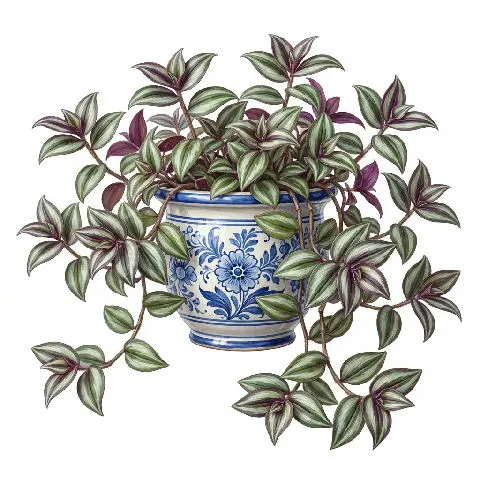
Tradescantia zebrina, commonly known as Wandering Jew, is a striking perennial herbaceous plant celebrated for its vibrant, variegated foliage. Native to the tropical and subtropical regions of Mexico, Central America, and South America, particularly Brazil and Argentina, it thrives as a ground cover or trailing plant in humid, shady forest understories. Its distinctive leaves typically display a rich purple underside and a silver-green upper surface with darker green or purple stripes, earning it common names like 'Inch Plant' or 'Spiderwort'.
The plant's vigorous, sprawling growth habit, where stems readily root at nodes upon contact with soil, contributes to its ability to 'wander' and spread effectively, hence its traditional moniker. Botanically, Tradescantia zebrina is a member of the Commelinaceae family, which encompasses over 600 species of monocotyledonous flowering plants. Historically, this species, along with other Tradescantia varieties, has been cultivated globally since at least the 17th century for its ornamental appeal and ease of propagation, becoming a popular houseplant worldwide.
While not a primary element in major pharmacopoeial systems like Ayurveda or Traditional Chinese Medicine, indigenous communities in its native range have long utilized Tradescantia zebrina in folk medicine for its perceived anti-inflammatory, antiseptic, and wound-healing properties. Contemporary scientific inquiry has begun to validate these traditional applications, revealing a rich phytochemical profile, including potent flavonoids, anthocyanins, and triterpenoids, which underpin its observed antioxidant, antimicrobial, and cytoprotective effects. It is important to note that the common name 'Wandering Jew' is increasingly being phased out due to its perceived insensitivity and historical connotations, with 'Inch Plant' or 'Spiderwort' often preferred.
Trusted Scientific References
1. Authoritative external sources for Tradescantia zebrina
1.1 Wikipedia — Tradescantia zebrina
1.2 Kew POWO (Plants of the World Online)
1.3 PubMed — peer-reviewed research
1.4 NCBI Taxonomy Browser
1.5 GBIF — Global Biodiversity
1.1.Wandering Jew (Tradescantia) — Key Features
- ✓ <strong>Distinctive variegated foliage</strong> — Distinctive variegated foliage with purple undersides and silver-green stripes.
- ✓ <strong>Fast</strong> — growing, trailing herbaceous perennial, often used as a ground cover or houseplant.
- ✓ <strong>Native to tropical</strong> — Native to tropical and subtropical regions of the Americas.
- ✓ <strong>Belongs to the</strong> — Belongs to the Commelinaceae family, known for its spiderworts.
- ✓ <strong>Reproduces easily from</strong> — Reproduces easily from stem cuttings, rooting readily at nodes.
- ✓ <strong>Contains potent phytochemicals</strong> — Contains potent phytochemicals including flavonoids, anthocyanins, and triterpenoids.
- ✓ <strong>Exhibits significant antioxidant</strong> — Exhibits significant antioxidant and antibacterial activities.
- ✓ <strong>Employed in traditional medicine for anti</strong> — inflammatory and wound-healing benefits.
- ✓ <strong>Requires bright, indirect</strong> — Requires bright, indirect light and consistently moist, well-draining soil.
- ✓ <strong>Important to note</strong> — Primarily for external use; internal ingestion is toxic.
1.2.Wandering Jew (Tradescantia) — Quick Summary
- ✓ Tradescantia zebrina is a vibrant, fast-growing perennial native to the Americas.
- ✓ Traditionally used in folk medicine for its anti-inflammatory and antiseptic properties.
- ✓ Rich in antioxidants like flavonoids and anthocyanins, with proven antibacterial activity.
- ✓ Primarily used topically as poultices or washes for skin ailments and minor wounds.
- ✓ Easy to cultivate as an ornamental plant in bright, indirect light.
- ✓ Caution: Primarily for external use; ingestion is toxic and can cause skin irritation.
2.Wandering Jew (Tradescantia) — Scientific Identity
3.Wandering Jew (Tradescantia) — Quick Facts
4.Wandering Jew (Tradescantia) — Appearance & Identification
5.Wandering Jew (Tradescantia) — Native Habitat
6.Wandering Jew (Tradescantia) — Water Requirements
- ✓ Light — Prefers bright, indirect light; direct sunlight can scorch its leaves, while too little light diminishes variegation.
- ✓ Soil — Thrives in well-draining, fertile potting mix, ideally with a slightly acidic to neutral pH.
- ✓ Watering — Keep soil consistently moist but not waterlogged; allow the top inch of soil to dry out between waterings.
- ✓ Humidity — Prefers high humidity, mimicking its tropical native habitat; misting or a pebble tray can be beneficial.
- ✓ Temperature — Ideal temperatures range from 18-27°C (65-80°F); protect from cold drafts and temperatures below 10°C (50°F).
- ✓ Propagation — Easily propagated from stem cuttings placed in water or directly into moist soil, rooting quickly at nodes.
- ✓ Fertilizing — Feed monthly during the growing season (spring/summer) with a balanced liquid fertilizer diluted to half strength.
- ✓ Pruning — Pinch back leggy stems regularly to encourage bushier growth and maintain its compact form.
Reviewed by the Flora Medical Global Botanical Review Panel
Multi-disciplinary editorial group · Botany · Ethnobotany · Herbal-medicine literature
Who reviewed this: This page was checked by the Flora Medical Global Botanical Review Panel — an in-house editorial group of botany graduates, ethnobotany researchers, and horticulture practitioners who collectively maintain our 7,000+ plant encyclopedia. Meet the team.
Our 4-step verification process
1. Taxonomic verification
Scientific names and synonyms cross-checked against Kew POWO, World Flora Online, and The Plant List.
2. Phytochemical & medicinal cross-reference
Active compounds, traditional uses, and reported activities are cross-referenced with PubMed, USDA Dr. Duke's database, and peer-reviewed ethnobotanical literature.
3. Conservation & distribution check
Distribution, ecology, and conservation status confirmed against GBIF occurrence records and the IUCN Red List.
4. Editorial & safety review
Every entry passes an editorial pass for clarity, originality, and safety notices (toxicity, contraindications, dosage caveats) before publication.
Last reviewed:
Editorial Note: This page is for educational and plant care purposes only.
Written by: Flora Medical Global Editorial Team
Reviewed by: Flora Medical Global Botanical Review Panel
Last Updated: June 16, 2026







Wandering Jew (Tradescantia) — Comments & Community Reviews
Rate this plant