
Care Disclaimer: Plant care recommendations are general guidelines based on common growing conditions. Individual results may vary based on your local environment, climate, and care routine. If your plant is toxic, keep it away from children and pets, and consult a veterinarian if accidental ingestion occurs.
1.Watermelon Begonia — Overview
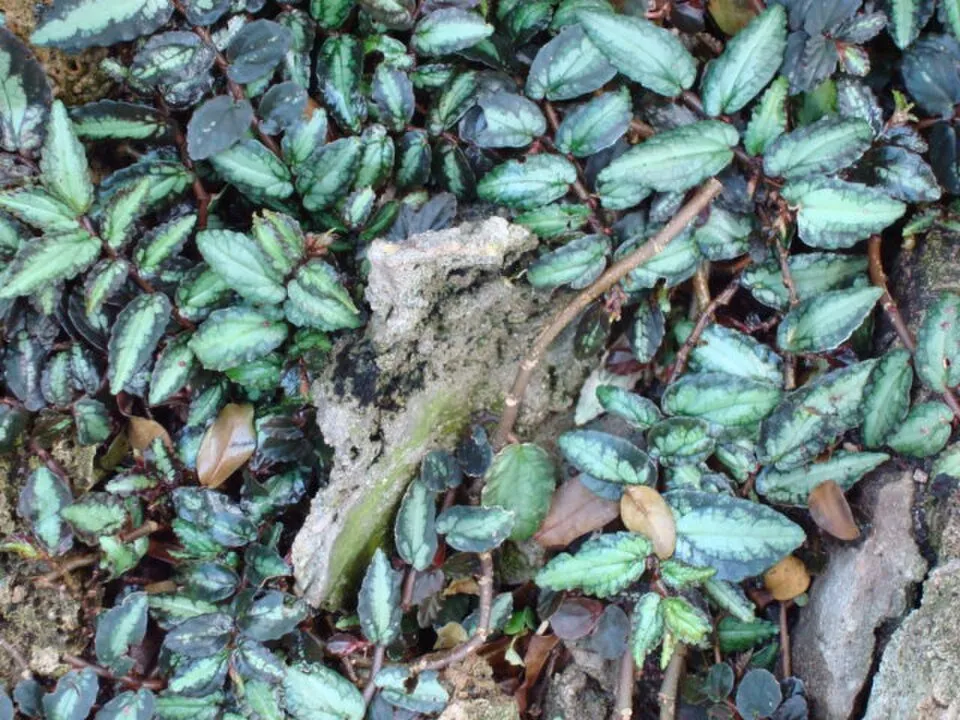
Pellionia repens, widely recognized as Watermelon Begonia, is a captivating herbaceous perennial native to the tropical and subtropical regions of Southeast Asia, specifically found thriving across Vietnam, Malaysia, and parts of China. Despite its popular moniker, it taxonomically belongs to the Urticaceae family, commonly known as the nettle family, rather than the Begonia genus. Its misleading common name is derived from the striking resemblance of its uniquely patterned foliage to the characteristic markings on a watermelon rind.
This plant flourishes in the humid, shaded understories of rainforests, typically adopting a prostrate to decumbent growth habit, creeping along the forest floor or gracefully cascading over rocks. This makes it an exceptional choice for groundcover in tropical gardens or as an elegant trailing plant for indoor hanging baskets and terrariums.
Botanically, Pellionia repens is distinguished by its slender, often reddish stems that readily root at the nodes when they come into contact with moist soil, facilitating its spreading nature. The leaves are undoubtedly its most prominent feature: ovate to elliptic in shape, generally measuring between 2-5 cm in length, and exhibiting a remarkable bicolar variegated pattern. The central vein area and surrounding regions typically display a lustrous silvery-green or pale green, providing a stark and beautiful contrast with the darker green or reddish-brown margins, which together create the distinctive 'watermelon' effect.
Furthermore, the undersides of the leaves often present a rich purplish-red hue, adding another layer of visual interest and depth to its aesthetic appeal. While the plant does produce small, inconspicuous, greenish-white flowers arranged in tiny cymes in the leaf axils, these are not the primary reason for its cultivation; its vibrant and uniquely patterned foliage is its true ornamental draw.
Trusted Scientific References
1. Authoritative external sources for Pellionia repens
1.1 Wikipedia — Pellionia repens
1.2 Kew POWO (Plants of the World Online)
1.3 PubMed — peer-reviewed research
1.4 NCBI Taxonomy Browser
1.5 GBIF — Global Biodiversity
1.1.Watermelon Begonia — Key Features
- ✓ <strong>Scientific Name</strong> — Pellionia repens
- ✓ <strong>Common Names</strong> — Watermelon Begonia, Trailing Watermelon Begonia
- ✓ <strong>Plant Family</strong> — Urticaceae (Nettle Family)
- ✓ <strong>Native Region</strong> — Southeast Asia (Vietnam, Malaysia, China)
- ✓ <strong>Growth Habit</strong> — Creeping, prostrate to decumbent evergreen perennial
- ✓ <strong>Distinctive Foliage</strong> — Ovate leaves with silvery-green centers and contrasting dark green/reddish margins, purplish undersides
- ✓ <strong>Traditional Uses</strong> — Topical anti-inflammatory, relief for minor skin irritations and abrasions
- ✓ <strong>Cultivation</strong> — Popular ornamental houseplant, terrarium plant, or tropical groundcover
- ✓ <strong>Toxicity</strong> — Generally considered non-toxic to humans and pets
- ✓ <strong>Aesthetic Appeal</strong> — Primarily valued for its vibrant and uniquely patterned foliage rather than its inconspicuous flowers
1.2.Watermelon Begonia — Quick Summary
- ✓ Watermelon Begonia (Pellionia repens) is a decorative herbaceous perennial from Southeast Asia, belonging to the Urticaceae family.
- ✓ It is highly prized for its striking, variegated foliage that distinctly resembles a watermelon rind, despite not being a true Begonia.
- ✓ Traditionally, it has been utilized in regional folk medicine for its potential topical anti-inflammatory properties and for soothing minor skin irritations.
- ✓ The plant is believed to contain beneficial phytochemicals such as flavonoids and tannins, which contribute to its purported therapeutic effects.
- ✓ Pellionia repens thrives in humid, indirect light conditions, making it an excellent choice for an ornamental houseplant, terrarium plant, or groundcover.
- ✓ Considered non-toxic to humans and pets, its applications are primarily external, with a recommended patch test to ensure no individual sensitivities.
2.Watermelon Begonia — Scientific Identity
3.Watermelon Begonia — Quick Facts
4.Watermelon Begonia — Appearance & Identification
5.Watermelon Begonia — Native Habitat
6.Watermelon Begonia — Water Requirements
- ✓ Light Requirements — Provide bright, indirect light; direct sunlight can scorch the delicate leaves, while too little light can cause the plant to become leggy and lose its vibrant coloration.
- ✓ Soil Composition — Utilize a well-draining, rich potting mix, ideally a peat-based or coco-coir blend amended with perlite or coarse sand to ensure good aeration and prevent waterlogging.
- ✓ Watering Schedule — Keep the soil consistently moist but never waterlogged; water when the top inch of the soil feels dry to the touch, and reduce frequency during the cooler winter months.
- ✓ Humidity Needs — Watermelon Begonia thrives in high humidity, mirroring its native tropical environment; increase humidity by placing the pot on a pebble tray with water or using a room humidifier.
- ✓ Temperature Range — Maintain indoor temperatures around 18-24°C (65-75°F); protect the plant from sudden temperature drops and cold drafts, as it is sensitive to cold.
- ✓ Fertilization — During the active growing season (spring through summer), feed the plant every four weeks with a balanced, water-soluble fertilizer diluted to half the recommended strength.
- ✓ Pruning and Propagation — Prune back leggy stems to encourage bushier, more compact growth; Watermelon Begonia is easily propagated from stem cuttings, which root readily at the nodes in moist soil or water.
Reviewed by the Flora Medical Global Botanical Review Panel
Multi-disciplinary editorial group · Botany · Ethnobotany · Herbal-medicine literature
Who reviewed this: This page was checked by the Flora Medical Global Botanical Review Panel — an in-house editorial group of botany graduates, ethnobotany researchers, and horticulture practitioners who collectively maintain our 7,000+ plant encyclopedia. Meet the team.
Our 4-step verification process
1. Taxonomic verification
Scientific names and synonyms cross-checked against Kew POWO, World Flora Online, and The Plant List.
2. Phytochemical & medicinal cross-reference
Active compounds, traditional uses, and reported activities are cross-referenced with PubMed, USDA Dr. Duke's database, and peer-reviewed ethnobotanical literature.
3. Conservation & distribution check
Distribution, ecology, and conservation status confirmed against GBIF occurrence records and the IUCN Red List.
4. Editorial & safety review
Every entry passes an editorial pass for clarity, originality, and safety notices (toxicity, contraindications, dosage caveats) before publication.
Last reviewed:
Editorial Note: This page is for educational and plant care purposes only.
Written by: Flora Medical Global Editorial Team
Reviewed by: Flora Medical Global Botanical Review Panel
Last Updated: June 16, 2026







Watermelon Begonia — Comments & Community Reviews
Rate this plant