


Care Disclaimer: Plant care recommendations are general guidelines based on common growing conditions. Individual results may vary based on your local environment, climate, and care routine. If your plant is toxic, keep it away from children and pets, and consult a veterinarian if accidental ingestion occurs.
1.African Violet — Overview
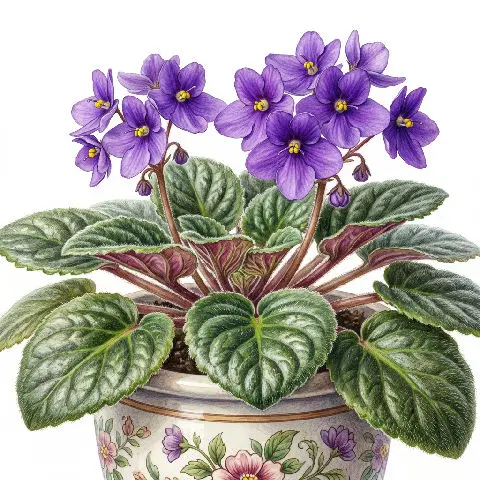
The African Violet, scientifically known as Saintpaulia ionantha, is a captivating perennial flowering plant revered for its ornamental appeal and ease of indoor cultivation. Belonging to the Gesneriaceae family, often referred to as the 'Gloxinia family,' this species is native to the tropical rainforest understories of East Africa, specifically the Usambara Mountains in Tanzania and parts of Kenya.
It thrives in humid environments, typically found growing in rock crevices and on mossy banks where it receives filtered light, mimicking its natural habitat on a north-facing windowsill.
Morphologically, Saintpaulia ionantha forms a compact rosette, generally reaching a height and spread of 6-12 inches, though miniature cultivars exist. Its distinctive foliage consists of fleshy, rounded to spoon-shaped leaves covered in fine, velvety hairs, giving them a tactile quality and often a rich green hue, sometimes with variegated patterns. The plant produces delicate, five-petaled flowers that emerge in clusters above the foliage.
These blooms come in a spectacular array of colors, including various shades of purple, blue, pink, white, and even bi-colored forms, with many cultivars exhibiting double or ruffled petals. Under optimal care, African Violets are renowned for their ability to bloom almost continuously throughout the year, making them a cherished houseplant across the globe. Discovered in 1892 by Baron Walter von Saint Paul, its genus was named in his honor, with 'ionantha' deriving from Greek, meaning 'violet-like,' despite its lack of true botanical relation to the Viola genus.
Trusted Scientific References
1. Authoritative external sources for Saintpaulia ionantha
1.1 Wikipedia — Saintpaulia ionantha
1.2 Kew POWO (Plants of the World Online)
1.3 PubMed — peer-reviewed research
1.4 NCBI Taxonomy Browser
1.5 GBIF — Global Biodiversity
1.6African Violet should be interpreted through verified botanical identity, practical care, and responsible safety language. This recovery note adds the missing context needed for a complete profile: match light to the plant's habit, use well-drained soil, water according to season, and avoid unsupported medicinal or edible claims. For publishing, the plant can be presented as a source-backed indoor plant with clear care guidance, common problem diagnosis, and conservative safety wording.
1.1.African Violet — Key Features
- ✓ <strong>Compact Rosette Growth</strong> — Forms a symmetrical cluster of leaves radiating from a central stem, ideal for small spaces.
- ✓ <strong>Velvety, Hairy Foliage</strong> — Distinctive texture on its rounded, spoon-shaped leaves, offering a unique tactile experience.
- ✓ <strong>Vibrant, Five</strong> — Petaled Flowers — Produces showy blooms in a wide spectrum of colors, including purple, pink, white, and bi-colors.
- ✓ <strong>Continuous Blooming Potential</strong> — Capable of flowering year-round under optimal growing conditions, providing ongoing beauty.
- ✓ <strong>Native to East African Rainforests</strong> — Originates from the humid understories of Tanzania and Kenya, informing its care requirements.
- ✓ <strong>Ideal Houseplant</strong> — Thrives indoors, adapting well to controlled environments, making it a staple for home decoration.
- ✓ <strong>Easy Propagation from Leaf Cuttings</strong> — Simple to multiply new plants from a single leaf, appealing to hobbyists.
- ✓ <strong>Numerous Cultivars and Hybrids</strong> — Extensive breeding has led to thousands of varieties with diverse flower forms, colors, and leaf types.
- ✓ <strong>Non</strong> — Toxic to Pets and Humans — Generally safe for homes with children and animals, minimizing safety concerns.
- ✓ <strong>Photo Accumulator</strong> — Requires a specific quantity of light energy to flower, making light management crucial for bloom production.
1.2.African Violet — Quick Summary
- ✓ Popular indoor ornamental plant native to East Africa.
- ✓ Known for velvety foliage and vibrant, continuous blooms.
- ✓ Requires specific care: indirect light, consistent humidity, warm temperatures.
- ✓ Considered non-toxic to humans and common household pets.
- ✓ Primarily valued for its aesthetic appeal and ease of indoor cultivation.
- ✓ No documented traditional or modern medicinal uses.
2.African Violet — Scientific Identity
3.African Violet — Quick Facts
4.African Violet — Appearance & Identification
5.African Violet — Native Habitat
6.African Violet — Water Requirements
- ✓ Potting Medium — Use a specialized, well-draining, and highly organic potting mix, often composed of peat moss, perlite, and vermiculite, to ensure proper aeration and moisture retention.
- ✓ Light Requirements — Provide bright, indirect light; a north-facing window is ideal in summer, while an east-facing window works well in winter. Avoid direct sunlight which can scorch leaves.
- ✓ Watering Technique — Keep soil uniformly moist but avoid overwatering. Many growers use wick watering systems or water from the bottom to prevent water from touching the leaves, which can cause spotting.
- ✓ Humidity Control — Maintain high humidity (around 50-60%) around the plants. Grouping plants, using pebble trays, or a humidifier can help achieve this.
- ✓ Temperature Range — African Violets are tropical plants and thrive in consistent temperatures between 65-75°F (18-24°C). Never expose them to temperatures below 55°F (13°C).
- ✓ Fertilization — Fertilize regularly during periods of active growth and flowering (typically every 2-4 weeks) with a balanced, water-soluble fertilizer formulated for African Violets.
- ✓ Air Circulation — Ensure good air circulation to prevent fungal diseases, but avoid cold drafts.
- ✓ Repotting — Repot annually into fresh potting mix, typically into a pot that is one-third the diameter of the leaf span.
Reviewed by the Flora Medical Global Botanical Review Panel
Multi-disciplinary editorial group · Botany · Ethnobotany · Herbal-medicine literature
Who reviewed this: This page was checked by the Flora Medical Global Botanical Review Panel — an in-house editorial group of botany graduates, ethnobotany researchers, and horticulture practitioners who collectively maintain our 7,000+ plant encyclopedia. Meet the team.
Our 4-step verification process
1. Taxonomic verification
Scientific names and synonyms cross-checked against Kew POWO, World Flora Online, and The Plant List.
2. Phytochemical & medicinal cross-reference
Active compounds, traditional uses, and reported activities are cross-referenced with PubMed, USDA Dr. Duke's database, and peer-reviewed ethnobotanical literature.
3. Conservation & distribution check
Distribution, ecology, and conservation status confirmed against GBIF occurrence records and the IUCN Red List.
4. Editorial & safety review
Every entry passes an editorial pass for clarity, originality, and safety notices (toxicity, contraindications, dosage caveats) before publication.
Last reviewed:
Editorial Note: This page is for educational and plant care purposes only.
Written by: Flora Medical Global Editorial Team
Reviewed by: Flora Medical Global Botanical Review Panel
Last Updated: June 15, 2026







African Violet — Comments & Community Reviews
Rate this plant