


Care Disclaimer: Plant care recommendations are general guidelines based on common growing conditions. Individual results may vary based on your local environment, climate, and care routine. If your plant is toxic, keep it away from children and pets, and consult a veterinarian if accidental ingestion occurs.
1.Alocasia Black Velvet — Overview
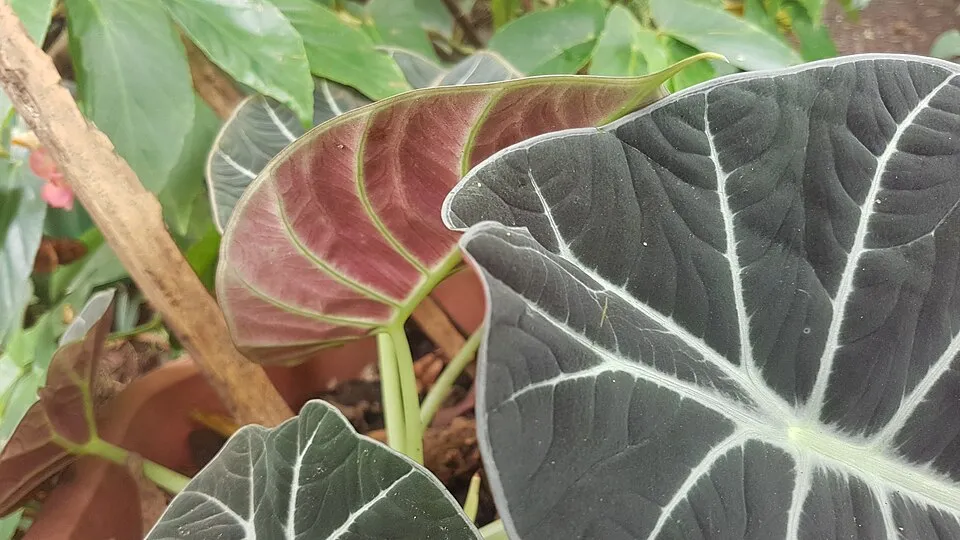
Alocasia reginula, colloquially known as 'Alocasia Black Velvet' or 'Black Velvet Elephant Ear', is a captivating and relatively petite herbaceous perennial belonging to the extensive Araceae family. Native to the lush, humid tropical rainforests of Borneo, its specific epithet 'reginula' derives from Latin, meaning 'little queen,' a fitting descriptor for its compact yet regal stature, typically remaining under 30 centimeters in height. This makes it a highly sought-after specimen for indoor cultivation, terrariums, and small botanical displays, distinguishing it from many of its larger Alocasia relatives often referred to as 'Elephant Ears.' The plant’s most arresting feature lies in its foliage: deeply dark, almost black-green leaves with a distinct velvety texture, dramatically contrasted by prominent, silvery-white veins that create an intricate, almost iridescent pattern across the leaf surface. The undersides of these exquisite leaves exhibit a rich purplish-red hue, further enhancing its visual allure and adding depth to its aesthetic.
This unique morphology is an adaptation to its natural habitat as an understory plant, thriving in the dappled light and consistently high humidity characteristic of rainforest floors. Ecologically, Alocasia Black Velvet's preference for warm, humid conditions and protection from direct, intense sunlight directly reflects its evolutionary niche. Its slow-growing nature and infrequent, rather inconspicuous white inflorescences mean it is primarily cultivated for its striking ornamental leaves rather than its blooms. In its native range, Alocasia species have historically held a place in various traditional medicine systems across Southeast Asia, including practices akin to Ayurveda or local indigenous healing.
While specific traditional documentation for A. reginula is less extensive compared to its more widespread and larger Alocasia cousins, general Alocasia species are recognized for potential anti-inflammatory and wound-healing properties. These applications typically involve external poultices prepared from crushed rhizomes or leaves, always with an essential prerequisite of careful detoxification due to the plant's inherent content of calcium oxalate crystals, which can be highly irritating if ingested or applied without proper preparation. Modern pharmacological investigations into other Alocasia varieties have begun to identify various phytochemicals, such as flavonoids, terpenoids, and saponins, which are bel ...[CURRENT TEXT EXISTS: 2838 chars]
1.1.Alocasia Black Velvet — Key Features
- ✓ <strong>Botanical Name</strong> — Alocasia reginula A.Hay.
- ✓ <strong>Common Names</strong> — Alocasia Black Velvet, Black Velvet Elephant Ear, Jewel Alocasia.
- ✓ <strong>Family</strong> — Araceae.
- ✓ <strong>Native Range</strong> — Tropical rainforests of Borneo, Southeast Asia.
- ✓ <strong>Leaf Morphology</strong> — Velvety, dark green to almost black leaves with prominent silvery-white veins.
- ✓ <strong>Leaf Underside</strong> — Rich purplish-red.
- ✓ <strong>Plant Size</strong> — Compact, typically under 30 cm (1.5 ft) tall, distinguishing it as a 'Jewel Alocasia'.
- ✓ <strong>Habitat Preference</strong> — Understory plant, thriving in dappled light and high humidity.
- ✓ <strong>Toxicity</strong> — HIGHLY TOXIC to humans and pets due to calcium oxalate content.
- ✓ <strong>Traditional Uses</strong> — Limited for A. reginula specifically, but general Alocasia species used externally for anti-inflammatory and wound healing after detoxification.
- ✓ <strong>Phytochemicals</strong> — Contains flavonoids, terpenoids, saponins, and calcium oxalate.
- ✓ <strong>Ornamental Value</strong> — Highly prized as an indoor ornamental plant for its striking foliage.
- ✓ <strong>Care Requirements</strong> — Demands consistent warmth, high humidity, indirect light, and well-draining soil.
- ✓ <strong>Propagation</strong> — Primarily by rhizome division or corms.
1.2.Alocasia Black Velvet — Quick Summary
- ✓ Alocasia Black Velvet is a striking, compact tropical plant known for its dark, velvety leaves and silver veins.
- ✓ Native to Borneo, it thrives in high humidity and indirect light, making it a popular houseplant.
- ✓ All parts of the plant are highly toxic due to calcium oxalate crystals, making it unsafe for ingestion by humans or pets.
- ✓ Traditionally, some Alocasia species were used externally for anti-inflammatory and wound-healing purposes, but only after rigorous detoxification.
- ✓ Modern research identifies flavonoids, terpenoids, and saponins in Alocasia species, contributing to their biological activities.
- ✓ Requires careful cultivation, including specific soil, watering, and humidity conditions.
- ✓ Emphasize extreme caution and professional guidance for any traditional medicinal application due to its inherent toxicity.
2.Alocasia Black Velvet — Scientific Identity
3.Alocasia Black Velvet — Quick Facts
4.Alocasia Black Velvet — Appearance & Identification
5.Alocasia Black Velvet — Native Habitat
6.Alocasia Black Velvet — Water Requirements
- ✓ Light Requirements — Provide bright, indirect light; mimicking its understory habitat, a north or east-facing window is ideal, avoiding harsh direct sun.
- ✓ Soil Composition — Use a loose, well-draining tropical potting mix, ideally incorporating bark, sand, and loam, while minimizing absorbent peat moss or coco coir.
- ✓ Watering Schedule — Water thoroughly when the top 20% of the soil feels dry, allowing excess liquid to drain completely; reduce frequency significantly in winter to prevent root rot.
- ✓ Humidity Levels — Maintain high humidity, ideally above 50%, through misting, using a pebble tray with water, a humidifier, or by growing in a terrarium.
- ✓ Temperature Range — Thrives in warm conditions, preferring temperatures above 70°F (21°C) and tolerating lows no colder than 60°F (15°C).
- ✓ Fertilization Regime — Feed every two to four weeks during the growing season (spring/summer) with a balanced liquid houseplant fertilizer, but avoid heavy feeding as it is a slow grower.
- ✓ Pruning Practices — Trim away any dead or yellowing foliage to direct nutrients to new growth and remove inconspicuous flowers to conserve plant energy for leaf development.
- ✓ Propagation Method — Propagate primarily by dividing rhizomes or potting corms in spring, ensuring high humidity and warmth for successful rooting.
- ✓ Potting & Repotting — Repot only every couple of years or when dividing, as Alocasia Black Velvet prefers to be slightly rootbound.
- ✓ Pest Management — Monitor for spider mites, which thrive in dry conditions; maintaining high humidity can act as a preventative measure.
Reviewed by the Flora Medical Global Botanical Review Panel
Multi-disciplinary editorial group · Botany · Ethnobotany · Herbal-medicine literature
Who reviewed this: This page was checked by the Flora Medical Global Botanical Review Panel — an in-house editorial group of botany graduates, ethnobotany researchers, and horticulture practitioners who collectively maintain our 7,000+ plant encyclopedia. Meet the team.
Our 4-step verification process
1. Taxonomic verification
Scientific names and synonyms cross-checked against Kew POWO, World Flora Online, and The Plant List.
2. Phytochemical & medicinal cross-reference
Active compounds, traditional uses, and reported activities are cross-referenced with PubMed, USDA Dr. Duke's database, and peer-reviewed ethnobotanical literature.
3. Conservation & distribution check
Distribution, ecology, and conservation status confirmed against GBIF occurrence records and the IUCN Red List.
4. Editorial & safety review
Every entry passes an editorial pass for clarity, originality, and safety notices (toxicity, contraindications, dosage caveats) before publication.
Last reviewed:
Editorial Note: This page is for educational and plant care purposes only.
Written by: Flora Medical Global Editorial Team
Reviewed by: Flora Medical Global Botanical Review Panel
Last Updated: June 15, 2026







Alocasia Black Velvet — Comments & Community Reviews
Rate this plant