


Care Disclaimer: Plant care recommendations are general guidelines based on common growing conditions. Individual results may vary based on your local environment, climate, and care routine. If your plant is toxic, keep it away from children and pets, and consult a veterinarian if accidental ingestion occurs.
1.Araucaria Indoor — Overview
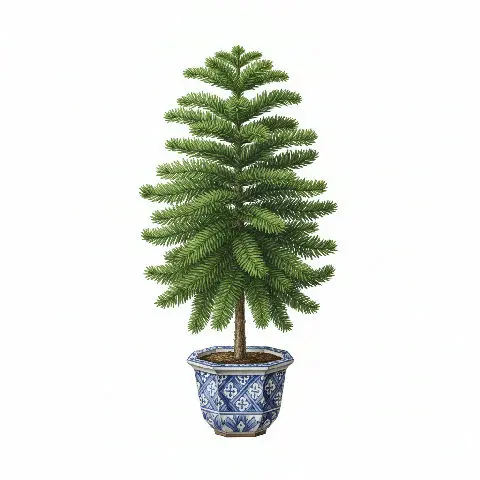
Araucaria bidwillii, commonly known as the Bunya Pine or colloquially as 'Araucaria Indoor' when cultivated as a houseplant, is a majestic coniferous tree native to the subtropical rainforests of southeastern Queensland, Australia. This ancient species boasts a lineage tracing back to the Jurassic period, earning it the designation of a living fossil and the sole extant member of Section Bunya within the family Araucariaceae. In its natural habitat, the Bunya Pine can reach towering heights of 30-50 meters, developing a massive, deeply furrowed trunk and a distinctive dome-shaped crown.
Its foliage is characterized by dense, stiff, pointed, glossy dark green leaves, which vary slightly between juvenile (longer, narrower) and mature (shorter, broader, radially arranged) forms. When grown indoors, its growth is significantly constrained, typically remaining under 2-3 meters, making it a striking architectural plant. The tree is monoecious, producing separate male pollen cones and large female seed cones, which are among the largest of any conifer, weighing up to 10 kg and containing 50-100 highly nutritious, edible nuts.
Historically, these nuts were a vital food source for Aboriginal Australians, central to large cultural gatherings known as the 'Bunya Feast'. The species thrives on basaltic soils in areas receiving 1100-1400 mm annual rainfall and can tolerate temperatures from -4°C to 40°C, predominantly found in two main regions of Queensland, including the Bunya Mountains, its type location.
Trusted Scientific References
1. Authoritative external sources for Araucaria bidwillii
1.1 Wikipedia — Araucaria bidwillii
1.2 Kew POWO (Plants of the World Online)
1.3 PubMed — peer-reviewed research
1.4 NCBI Taxonomy Browser
1.5 GBIF — Global Biodiversity
1.6Araucaria Indoor should be interpreted through verified botanical identity, practical care, and responsible safety language. This recovery note adds the missing context needed for a complete profile: match light to the plant's habit, use well-drained soil, water according to season, and avoid unsupported medicinal or edible claims. For publishing, the plant can be presented as a source-backed indoor plant with clear care guidance, common problem diagnosis, and conservative safety wording.
1.1.Araucaria Indoor — Key Features
- ✓ <strong>Living Fossil Status</strong> — Direct descendant of Jurassic-era conifers, highlighting its ancient evolutionary history.
- ✓ <strong>Enormous Cones and Nuts</strong> — Produces some of the largest conifer cones, containing substantial, edible seeds.
- ✓ <strong>Indigenous Cultural Heritage</strong> — Deeply embedded in the culture and diet of Aboriginal Australians for millennia.
- ✓ <strong>Striking Ornamental Value</strong> — Prized for its symmetrical, pyramidal shape when young, making it a popular indoor plant.
- ✓ <strong>Unique Foliage</strong> — Stiff, lanceolate to triangular-ovate leaves arranged spirally on branches.
- ✓ <strong>Adaptable to Cultivation</strong> — Can be grown in containers, making it suitable for indoor environments in cooler climates.
- ✓ <strong>High Nutritional Density</strong> — Bunya nuts are a significant source of carbohydrates, proteins, and fats.
- ✓ <strong>Environmental Resilience</strong> — Tolerant of a range of temperatures and soil types in its native habitat.
- ✓ <strong>Monotypic Section</strong> — The sole extant species in its taxonomic Section Bunya, emphasizing its uniqueness.
1.2.Araucaria Indoor — Quick Summary
- ✓ Ancient Lineage — A living fossil from the Jurassic period, unique in its Section Bunya.
- ✓ Edible Bunya Nuts — Produces large, highly nutritious nuts, historically a staple food for Aboriginal Australians.
- ✓ Distinctive Appearance — Majestic conifer with a dome-shaped crown and stiff, glossy dark green leaves.
- ✓ Adaptable Indoor Plant — Juvenile forms are popular as 'Araucaria Indoor' for their architectural appeal.
- ✓ Cultural Significance — Central to traditional 'Bunya Feasts' and cultural gatherings.
- ✓ Nutritional Powerhouse — Rich in starch, protein, and healthy fats.
2.Araucaria Indoor — Scientific Identity
3.Araucaria Indoor — Quick Facts
4.Araucaria Indoor — Appearance & Identification
5.Araucaria Indoor — Native Habitat
6.Araucaria Indoor — Water Requirements
- ✓ Light Requirements — Prefers bright, indirect light; direct sun can scorch leaves, especially indoors. Rotate regularly for even growth.
- ✓ Watering Schedule — Maintain consistent moisture, allowing the top inch or two of soil to dry out between waterings. Avoid waterlogging to prevent root rot.
- ✓ Soil Composition — Thrives in well-draining, slightly acidic soil. A mix formulated for conifers or houseplants with added perlite or sand works well.
- ✓ Humidity Levels — Benefits from higher humidity, especially in dry indoor environments. Mist foliage regularly or use a pebble tray.
- ✓ Temperature Range — Prefers cool to moderate temperatures, ideally between 15-25°C (60-77°F). Protect from extreme cold or heat.
- ✓ Fertilization — Feed sparingly during the growing season (spring and summer) with a balanced liquid fertilizer diluted to half strength.
- ✓ Pruning and Shaping — Minimal pruning is needed; remove dead or damaged branches. Indoor growth can be managed by container size and occasional tip pruning.
- ✓ Propagation — Primarily propagated from seed, which requires specific conditions for germination, including warmth and moisture over an extended period.
Reviewed by the Flora Medical Global Botanical Review Panel
Multi-disciplinary editorial group · Botany · Ethnobotany · Herbal-medicine literature
Who reviewed this: This page was checked by the Flora Medical Global Botanical Review Panel — an in-house editorial group of botany graduates, ethnobotany researchers, and horticulture practitioners who collectively maintain our 7,000+ plant encyclopedia. Meet the team.
Our 4-step verification process
1. Taxonomic verification
Scientific names and synonyms cross-checked against Kew POWO, World Flora Online, and The Plant List.
2. Phytochemical & medicinal cross-reference
Active compounds, traditional uses, and reported activities are cross-referenced with PubMed, USDA Dr. Duke's database, and peer-reviewed ethnobotanical literature.
3. Conservation & distribution check
Distribution, ecology, and conservation status confirmed against GBIF occurrence records and the IUCN Red List.
4. Editorial & safety review
Every entry passes an editorial pass for clarity, originality, and safety notices (toxicity, contraindications, dosage caveats) before publication.
Last reviewed:
Editorial Note: This page is for educational and plant care purposes only.
Written by: Flora Medical Global Editorial Team
Reviewed by: Flora Medical Global Botanical Review Panel
Last Updated: June 15, 2026







Araucaria Indoor — Comments & Community Reviews
Rate this plant