


Care Disclaimer: Plant care recommendations are general guidelines based on common growing conditions. Individual results may vary based on your local environment, climate, and care routine. If your plant is toxic, keep it away from children and pets, and consult a veterinarian if accidental ingestion occurs.
1.Arrowhead Plant — Overview
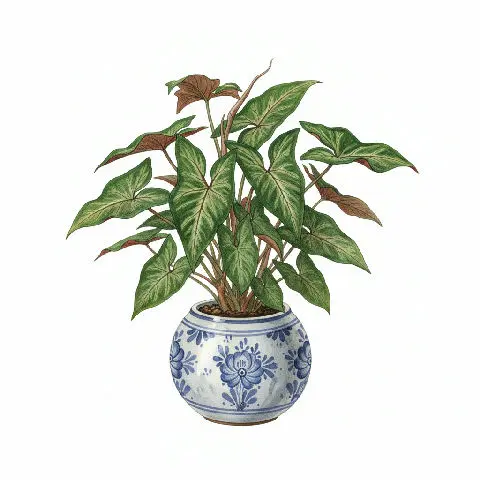
The Arrowhead Plant, scientifically known as Syngonium erythrophyllum, is a distinctive and sought-after member of the Araceae family, originating from the humid tropical rainforests of Central and South America, particularly in regions like Costa Rica and Panama. This vining or climbing perennial stands apart from its more common relative, Syngonium podophyllum, through its consistently striking foliage. Its leaves typically maintain a deeply lobed, hastate (arrowhead-shaped) to sagittate form throughout their development, characterized by pronounced basal lobes that often overlap. The upper surface of young leaves displays a dark green hue with prominent, often reddish-purple veins, a coloration that deepens with maturity, while the undersides frequently exhibit a vibrant reddish-purple.
Its growth habit allows it to elegantly trail from hanging baskets or ascend supports by means of aerial roots. Historically, Syngonium erythrophyllum has not been a primary subject in traditional medicinal systems such as Ayurveda, Traditional Chinese Medicine (TCM), or Unani, largely due to its geographical origins outside their endemic regions. Consequently, specific ethnobotanical applications are scarce. Like many plants within the Araceae family, it contains calcium oxalate crystals, necessitating caution upon contact or ingestion due to potential irritation.
In contemporary horticulture, S. erythrophyllum is highly prized as an ornamental indoor plant, valued for its unique aesthetic appeal, vibrant coloration, and relative adaptability to indoor environments. Scientific inquiry into this species has predominantly focused on its botanical classification, propagation techniques, and its general role in indoor air purification research, rather than extensive phytochemistry or pharmacological studies.
Trusted Scientific References
1. Authoritative external sources for Syngonium erythrophyllum
1.1 Wikipedia — Syngonium erythrophyllum
1.2 Kew POWO (Plants of the World Online)
1.3 PubMed — peer-reviewed research
1.4 NCBI Taxonomy Browser
1.5 GBIF — Global Biodiversity
1.1.Arrowhead Plant — Key Features
- ✓ <strong>Striking Arrowhead</strong> — Shaped Leaves — Consistent hastate to sagittate leaf form with overlapping basal lobes.
- ✓ <strong>Vibrant Reddish</strong> — Purple Undersides — Distinctive coloration on the leaf undersides and veins, deepening with maturity.
- ✓ <strong>Vining/Climbing Growth Habit</strong> — Adaptable for hanging baskets or climbing supports with aerial roots.
- ✓ <strong>Tropical Rainforest Origin</strong> — Native to humid regions of Central and South America.
- ✓ <strong>Low Maintenance Houseplant</strong> — Relatively easy to care for, suitable for various indoor environments.
- ✓ <strong>Calcium Oxalate Content</strong> — Contains irritating and toxic calcium oxalate crystals in all plant parts.
- ✓ <strong>Primarily Ornamental Value</strong> — Cultivated for its aesthetic appeal, not for medicinal use.
- ✓ <strong>Potential Indoor Air Purifier</strong> — May contribute to filtering common airborne toxins.
- ✓ <strong>Distinct from S. podophyllum</strong> — Maintains consistent leaf shape and coloration throughout its life cycle.
- ✓ <strong>Evergreen Perennial</strong> — Provides year-round foliage interest.
1.2.Arrowhead Plant — Quick Summary
- ✓ Distinctive ornamental houseplant with striking foliage.
- ✓ Native to tropical Central and South America, Araceae family.
- ✓ Contains toxic calcium oxalate crystals; not safe for ingestion.
- ✓ Primarily valued for aesthetic appeal and potential air purification.
- ✓ Requires bright, indirect light and consistent moisture, easy to care for.
- ✓ Absolutely no traditional or modern internal medicinal uses.
2.Arrowhead Plant — Scientific Identity
3.Arrowhead Plant — Quick Facts
4.Arrowhead Plant — Appearance & Identification
5.Arrowhead Plant — Native Habitat
6.Arrowhead Plant — Water Requirements
- ✓ Light Requirements — Prefers bright, indirect light; direct sun can scorch leaves. Green varieties tolerate more shade, while variegated types may need slightly brighter conditions.
- ✓ Watering Schedule — Water thoroughly when the top few inches of soil feel dry, typically once a week in summer and less frequently in winter. Avoid overwatering to prevent root rot.
- ✓ Soil Composition — Thrives in a well-draining potting mix, ideally with a slightly acidic to neutral pH (6.0-7.0).
- ✓ Humidity Needs — As a tropical plant, it appreciates high humidity but adapts well to average indoor humidity levels. Misting or pebble trays can provide a boost.
- ✓ Fertilization — Feed monthly during the growing season (spring through early fall) with a balanced liquid fertilizer diluted to half strength. Withhold fertilizer during dormancy.
- ✓ Repotting Frequency — Repot annually or every two years in spring to prevent root-bound conditions and encourage vigorous growth.
- ✓ Pruning for Shape — Trim long stems and vines back to a leaf node using sterilized shears to maintain a bushy shape and manage size.
- ✓ Propagation Method — Easily propagated from 4-6 inch stem cuttings taken at a leaf node, rooted in water or moist potting mix, especially effective in spring or summer.
Reviewed by the Flora Medical Global Botanical Review Panel
Multi-disciplinary editorial group · Botany · Ethnobotany · Herbal-medicine literature
Who reviewed this: This page was checked by the Flora Medical Global Botanical Review Panel — an in-house editorial group of botany graduates, ethnobotany researchers, and horticulture practitioners who collectively maintain our 7,000+ plant encyclopedia. Meet the team.
Our 4-step verification process
1. Taxonomic verification
Scientific names and synonyms cross-checked against Kew POWO, World Flora Online, and The Plant List.
2. Phytochemical & medicinal cross-reference
Active compounds, traditional uses, and reported activities are cross-referenced with PubMed, USDA Dr. Duke's database, and peer-reviewed ethnobotanical literature.
3. Conservation & distribution check
Distribution, ecology, and conservation status confirmed against GBIF occurrence records and the IUCN Red List.
4. Editorial & safety review
Every entry passes an editorial pass for clarity, originality, and safety notices (toxicity, contraindications, dosage caveats) before publication.
Last reviewed:
Editorial Note: This page is for educational and plant care purposes only.
Written by: Flora Medical Global Editorial Team
Reviewed by: Flora Medical Global Botanical Review Panel
Last Updated: June 15, 2026







Arrowhead Plant — Comments & Community Reviews
Rate this plant