
Care Disclaimer: Plant care recommendations are general guidelines based on common growing conditions. Individual results may vary based on your local environment, climate, and care routine. If your plant is toxic, keep it away from children and pets, and consult a veterinarian if accidental ingestion occurs.
1.Aspidistra Milky Way — Overview
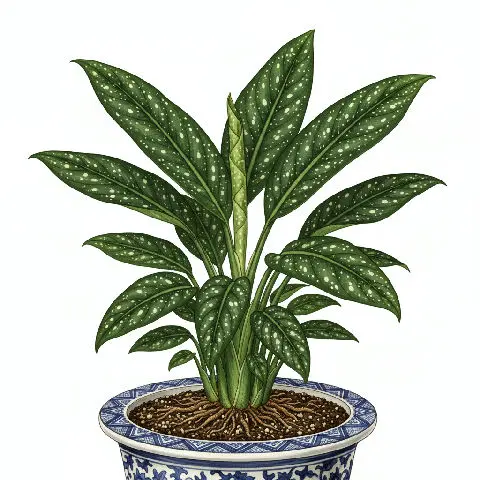
The Aspidistra elatior 'Milky Way', a captivating cultivar of the renowned Cast Iron Plant, is a testament to botanical resilience and aesthetic appeal. This perennial herbaceous plant, native to the shaded forest floors of East Asia, particularly China and Japan, belongs to the Asparagaceae family.
Unlike its standard green-leaved parent, 'Milky Way' distinguishes itself with stunning, deep green foliage liberally adorned with creamy-white or pale yellow speckles, creating a celestial, star-dusted appearance. These lanceolate to broadly ovate leaves emerge directly from a subterranean rhizome, growing upright to about 18-24 inches (45-60 cm) in height and spreading through clonal growth.
Its taxonomy places it within the Liliales order, highlighting its ancient lineage. The genus name 'Aspidistra' is derived from the Greek 'aspidion', meaning 'little shield', a reference to the shape of its stigma.
The species epithet 'elatior' is Latin for 'taller', describing its relatively erect growth habit. The 'Milky Way' epithet specifically denotes its unique variegation pattern, a stable genetic trait that makes each leaf a miniature work of natural art.
Historically, the broader Aspidistra elatior species gained immense popularity in Victorian England for its extraordinary hardiness, surviving the challenging indoor conditions of urban homes with low light, poor air quality, and infrequent care. The 'Milky Way' cultivar continues this legacy, offering an ornamental variant that maintains the species' famed toughness while adding significant visual interest.
Its robust rhizomatous root system allows it to persist and spread, making it an enduring and low-maintenance choice for deep shade gardens or as a resilient indoor plant, revered for its ability to thrive where many other plants fail.
Trusted Scientific References
1. Authoritative external sources for Aspidistra elatior milky way
1.1 Wikipedia — Aspidistra elatior milky way
1.2 Kew POWO (Plants of the World Online)
1.3 PubMed — peer-reviewed research
1.4 NCBI Taxonomy Browser
1.5 GBIF — Global Biodiversity
1.1.Aspidistra Milky Way — Key Features
- ✓ <strong>Unique 'Milky Way' Variegation</strong> — Distinctive creamy-white speckles on dark green leaves.
- ✓ <strong>Exceptional Hardiness</strong> — Nicknamed 'Cast Iron Plant' for its robust nature.
- ✓ <strong>Low Light Tolerance</strong> — Thrives in deep shade, making it ideal for challenging indoor spaces.
- ✓ <strong>Evergreen Foliage</strong> — Maintains lush, attractive leaves year-round.
- ✓ <strong>Drought Resistance</strong> — Can tolerate periods of dryness, forgiving of infrequent watering.
- ✓ <strong>Pest Resistance</strong> — Generally resistant to common houseplant pests.
- ✓ <strong>Air Purification Properties</strong> — Contributes to improved indoor air quality (characteristic of the species).
- ✓ <strong>Rhizomatous Growth</strong> — Spreads slowly via underground rhizomes, forming clumps.
- ✓ <strong>Architectural Form</strong> — Upright, structural leaves add a sophisticated touch to interiors.
- ✓ <strong>Historical Significance</strong> — Popularized in Victorian homes for its resilience and elegance.
1.2.Aspidistra Milky Way — Quick Summary
- ✓ Aspidistra 'Milky Way' is a highly resilient, variegated houseplant.
- ✓ Features unique speckled, dark green foliage resembling a starry night.
- ✓ The species Aspidistra elatior has traditional medicinal uses in TCM, particularly its rhizome.
- ✓ Known as the 'Cast Iron Plant' for its exceptional tolerance to low light and neglect.
- ✓ Primarily valued as an ornamental plant, offering enduring beauty with minimal care.
2.Aspidistra Milky Way — Scientific Identity
3.Aspidistra Milky Way — Quick Facts
4.Aspidistra Milky Way — Appearance & Identification
5.Aspidistra Milky Way — Native Habitat
6.Aspidistra Milky Way — Water Requirements
- ✓ Light — Thrives in low to medium indirect light; direct sunlight can scorch its unique variegated foliage.
- ✓ Watering — Water moderately, allowing the top inch or two of soil to dry out between waterings; overwatering can lead to rhizome rot.
- ✓ Soil — Prefers well-draining, rich potting mix, ideally with organic matter to retain some moisture.
- ✓ Temperature — Tolerates a wide range of indoor temperatures but prefers consistent warmth between 60-75°F (15-24°C).
- ✓ Humidity — Highly adaptable to average household humidity levels, no special requirements are typically needed.
- ✓ Fertilization — Feed sparingly during the growing season (spring to early autumn) with a balanced liquid fertilizer, diluted to half strength.
- ✓ Propagation — Easily propagated by dividing the rhizome, ensuring each section has at least one leaf and a healthy root system.
- ✓ Pests and Diseases — Generally robust and resistant to most pests and diseases; occasional issues might include spider mites or scale in very dry conditions.
Reviewed by the Flora Medical Global Botanical Review Panel
Multi-disciplinary editorial group · Botany · Ethnobotany · Herbal-medicine literature
Who reviewed this: This page was checked by the Flora Medical Global Botanical Review Panel — an in-house editorial group of botany graduates, ethnobotany researchers, and horticulture practitioners who collectively maintain our 7,000+ plant encyclopedia. Meet the team.
Our 4-step verification process
1. Taxonomic verification
Scientific names and synonyms cross-checked against Kew POWO, World Flora Online, and The Plant List.
2. Phytochemical & medicinal cross-reference
Active compounds, traditional uses, and reported activities are cross-referenced with PubMed, USDA Dr. Duke's database, and peer-reviewed ethnobotanical literature.
3. Conservation & distribution check
Distribution, ecology, and conservation status confirmed against GBIF occurrence records and the IUCN Red List.
4. Editorial & safety review
Every entry passes an editorial pass for clarity, originality, and safety notices (toxicity, contraindications, dosage caveats) before publication.
Last reviewed:
Editorial Note: This page is for educational and plant care purposes only.
Written by: Flora Medical Global Editorial Team
Reviewed by: Flora Medical Global Botanical Review Panel
Last Updated: June 15, 2026







Aspidistra Milky Way — Comments & Community Reviews
Rate this plant