
Care Disclaimer: Plant care recommendations are general guidelines based on common growing conditions. Individual results may vary based on your local environment, climate, and care routine. If your plant is toxic, keep it away from children and pets, and consult a veterinarian if accidental ingestion occurs.
1.Asplenium Crispy Wave — Overview
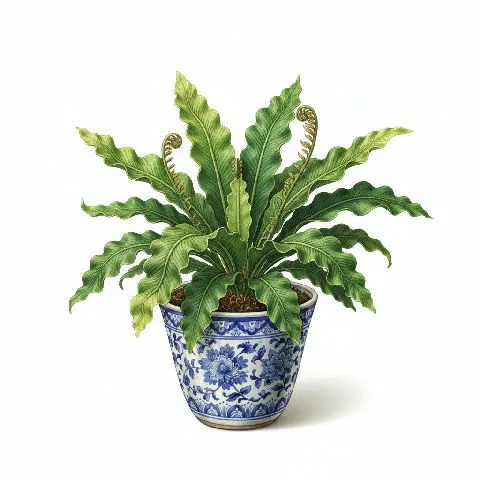
The Asplenium nidus 'Crispy Wave', commonly known as the Crispy Wave Fern, is a highly sought-after cultivar of the widely recognized Bird's Nest Fern, Asplenium nidus. Its name precisely reflects its most distinctive feature: strikingly ruffled, crisp, and undulating fronds that create a visually dynamic texture, differentiating it from the typically smoother-leaved parent species. This unique morphology gives the plant an architectural elegance, making it a prominent feature in interior design and a favorite among houseplant enthusiasts globally. The parent species, Asplenium nidus, is indigenous to the tropical and subtropical regions across Asia, Africa, and Australia, where it primarily thrives as an epiphyte, anchoring itself to the trunks and branches of trees in humid, shaded forest understories.
It can also be found growing lithophytically on rocks or terrestrially in rich organic matter. The 'Crispy Wave' cultivar likely emerged through selective breeding or a spontaneous genetic mutation, underscoring human influence in cultivating aesthetically pleasing plant forms. While the broader Asplenium nidus has a notable history in traditional medicine systems such as Ayurveda, Traditional Chinese Medicine (TCM), and Unani, particularly for its mucilaginous properties used in respiratory and gastrointestinal remedies, the 'Crispy Wave' itself is predominantly valued for its ornamental appeal. Its vibrant, apple-green, deeply crinkled leaves form a sculptural rosette, with new fronds unfurling from a central 'nest-like' crown.
This natural formation not only contributes to its distinctive appearance but also, in its native habitat, aids in collecting water and decaying organic matter to provide nutrients. Furthermore, like its parent species and many common houseplants, it contributes positively to indoor air quality by filtering airborne toxins, a benefit highlighted by various studies.
Trusted Scientific References
1. Authoritative external sources for Asplenium nidus crispy wave
1.1 Wikipedia — Asplenium nidus crispy wave
1.2 Kew POWO (Plants of the World Online)
1.3 PubMed — peer-reviewed research
1.4 NCBI Taxonomy Browser
1.5 GBIF — Global Biodiversity
1.1.Asplenium Crispy Wave — Key Features
- ✓ <strong>Distinctive Ruffled Fronds</strong> — Features unique, deeply crinkled, wavy leaves that give it its characteristic 'Crispy Wave' appearance.
- ✓ <strong>Rosette Growth Habit</strong> — Fronds unfurl from a central, nest-like crown, which naturally collects water and decaying organic matter.
- ✓ <strong>Vibrant Apple</strong> — Green Color — Displays bright, lively green foliage that adds a fresh and natural aesthetic to any indoor setting.
- ✓ <strong>Compact Size</strong> — Typically grows to an average height and spread of 1 to 2 feet indoors, suitable for various spaces from desks to shelves.
- ✓ <strong>Epiphytic Nature</strong> — Adapts well to growing on other surfaces, which informs its specific requirements for soil aeration and moisture.
- ✓ <strong>Air Purification Capabilities</strong> — Known to help remove airborne toxins from indoor environments, enhancing overall air quality.
- ✓ <strong>Low Maintenance (with proper care)</strong> — Relatively easy to care for once its specific humidity, light, and watering needs are understood and met.
- ✓ <strong>Architectural Beauty</strong> — Offers a sculptural, textured effect that is highly appealing to plant enthusiasts and interior designers.
- ✓ <strong>Non</strong> — Toxic — Considered safe for households with children and common household pets.
- ✓ <strong>Tropical Origin</strong> — Thrives in warm, humid conditions, reflecting its native habitat in tropical and subtropical regions.
1.2.Asplenium Crispy Wave — Quick Summary
- ✓ Ornamental Fern with Ruffled Fronds — Prized for its unique, deeply crinkled, apple-green foliage and architectural form.
- ✓ Air Purifying Qualities — Contributes to improved indoor air quality by effectively filtering common airborne toxins.
- ✓ Tropical Epiphyte — Naturally grows on trees, requiring high humidity and well-aerated, consistently moist substrate.
- ✓ Low Light & High Humidity Lover — Thrives in bright, indirect light and demands consistent moisture without direct central watering.
- ✓ Non-Toxic Houseplant — Generally considered safe for homes with both pets and children.
- ✓ Parent Species in Traditional Medicine — While the cultivar is ornamental, its wild parent, Asplenium nidus, has historical uses for respiratory and gastrointestinal issues.
2.Asplenium Crispy Wave — Scientific Identity
3.Asplenium Crispy Wave — Quick Facts
4.Asplenium Crispy Wave — Appearance & Identification
5.Asplenium Crispy Wave — Native Habitat
6.Asplenium Crispy Wave — Water Requirements
- ✓ Indirect Light — Prefers bright, indirect light; avoid harsh, direct sunlight, especially from south-facing windows, to prevent frond burn.
- ✓ High Humidity — Thrives in 60-90% humidity; misting daily, particularly in dry indoor environments, or using a pebble tray or humidifier is highly beneficial.
- ✓ Evenly Moist Soil — Keep the substrate consistently moist but never waterlogged; allow the top inch of soil to feel slightly dry before re-watering.
- ✓ Aerated Substrate — Requires a highly porous, well-draining soil mix, ideally a specialty blend for epiphytes or ferns, to ensure root aeration and prevent rot.
- ✓ Consistent Temperature — Maintain stable indoor temperatures between 60-72°F (15-22°C); protect the plant from drafts, sudden temperature fluctuations, and direct heat sources.
- ✓ Avoid Central Watering — Do not water directly into the central 'nest' of the fern, as this can lead to crown rot and stagnation; water the soil around the base instead.
- ✓ Proper Potting — Use pots with adequate drainage holes; repotting with a fresh, airy mix when root-bound helps promote healthy growth.
- ✓ Pruning Dead Fronds — Carefully trim off any entirely brown or dead fronds at their base to redirect the plant's energy towards new, healthy growth.
Reviewed by the Flora Medical Global Botanical Review Panel
Multi-disciplinary editorial group · Botany · Ethnobotany · Herbal-medicine literature
Who reviewed this: This page was checked by the Flora Medical Global Botanical Review Panel — an in-house editorial group of botany graduates, ethnobotany researchers, and horticulture practitioners who collectively maintain our 7,000+ plant encyclopedia. Meet the team.
Our 4-step verification process
1. Taxonomic verification
Scientific names and synonyms cross-checked against Kew POWO, World Flora Online, and The Plant List.
2. Phytochemical & medicinal cross-reference
Active compounds, traditional uses, and reported activities are cross-referenced with PubMed, USDA Dr. Duke's database, and peer-reviewed ethnobotanical literature.
3. Conservation & distribution check
Distribution, ecology, and conservation status confirmed against GBIF occurrence records and the IUCN Red List.
4. Editorial & safety review
Every entry passes an editorial pass for clarity, originality, and safety notices (toxicity, contraindications, dosage caveats) before publication.
Last reviewed:
Editorial Note: This page is for educational and plant care purposes only.
Written by: Flora Medical Global Editorial Team
Reviewed by: Flora Medical Global Botanical Review Panel
Last Updated: June 15, 2026







Asplenium Crispy Wave — Comments & Community Reviews
Rate this plant