


Care Disclaimer: Plant care recommendations are general guidelines based on common growing conditions. Individual results may vary based on your local environment, climate, and care routine. If your plant is toxic, keep it away from children and pets, and consult a veterinarian if accidental ingestion occurs.
1.Baby Rubber Plant — Overview
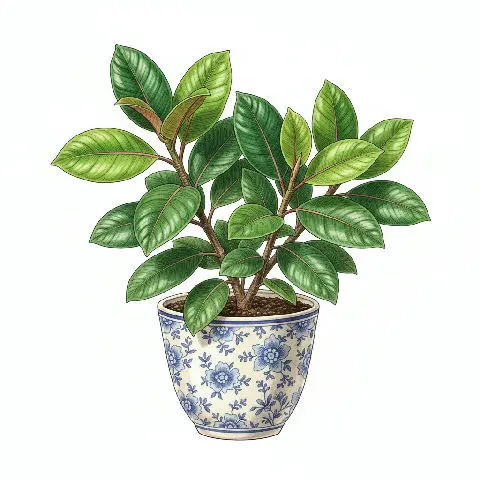
The Baby Rubber Plant, scientifically known as Peperomia obtusifolia, is an appealing and robust evergreen herbaceous perennial belonging to the extensive Piperaceae family, which notably includes black pepper. Native to the humid, subtropical climates of Florida, Mexico, the Caribbean, and parts of South America, this species has long been cherished for its ornamental qualities.
It typically grows as an erect, bushy shrub, reaching up to 2 feet in height, characterized by its distinctive, thick, glossy, and cupped obovate leaves with rounded tips—a feature reflected in its botanical name 'obtusifolia,' meaning 'blunt-leaved.'
Its stems are typically branched, often tinged with pink or red, and feature sub-peltate leaf attachment. While sometimes confused with the larger Ficus elastica, the true Rubber Plant, Peperomia obtusifolia is a distinct species with its own unique charm. In its natural habitat, it thrives as an understory plant, frequently growing epiphytically on trees or lithophytically on rocks, benefiting from filtered sunlight and high ambient humidity.
This preference translates well to its cultivation as a popular houseplant, where it appreciates bright, indirect light and well-draining, yet moisture-retentive, soil. Its adaptability to varied light conditions and its compact growth habit made it a favorite in Victorian parlors, and its resilience and vibrant green luster continue to contribute to its widespread appeal in modern indoor gardening. The plant produces inconspicuous cream-colored flower spikes as its inflorescence.
Trusted Scientific References
1. Authoritative external sources for Peperomia obtusifolia
1.1 Wikipedia — Peperomia obtusifolia
1.2 Kew POWO (Plants of the World Online)
1.3 PubMed — peer-reviewed research
1.4 NCBI Taxonomy Browser
1.5 GBIF — Global Biodiversity
1.6Baby Rubber Plant should be interpreted through verified botanical identity, practical care, and responsible safety language. This recovery note adds the missing context needed for a complete profile: match light to the plant's habit, use well-drained soil, water according to season, and avoid unsupported medicinal or edible claims. For publishing, the plant can be presented as a source-backed indoor plant with clear care guidance, common problem diagnosis, and conservative safety wording.
1.1.Baby Rubber Plant — Key Features
- ✓ <strong>Botanical Name</strong> — Peperomia obtusifolia.
- ✓ <strong>Family</strong> — Piperaceae (Pepper Family).
- ✓ <strong>Common Names</strong> — Baby Rubber Plant, American Rubber Plant, Oval Leaf Peperomia.
- ✓ <strong>Native Range</strong> — Florida, Mexico, Caribbean, and parts of South America.
- ✓ <strong>Foliage</strong> — Thick, glossy, dark green, obovate leaves with rounded tips; variegated cultivars exist.
- ✓ <strong>Growth Habit</strong> — Erect, bushy herbaceous perennial, typically reaching up to 2 feet in height.
- ✓ <strong>Light Preference</strong> — Thrives in bright, indirect light; tolerates lower light conditions.
- ✓ <strong>Water Needs</strong> — Prefers soil to dry out between waterings; highly susceptible to overwatering.
- ✓ <strong>Toxicity</strong> — Non-toxic to humans, cats, dogs, and horses.
- ✓ <strong>Horticultural Value</strong> — Prized for its ornamental beauty, ease of care, and adaptability as an indoor plant.
1.2.Baby Rubber Plant — Quick Summary
- ✓ Peperomia obtusifolia is a popular, low-maintenance houseplant.
- ✓ Features glossy, succulent-like, obovate leaves and a compact growth habit.
- ✓ Belongs to the Piperaceae family, native to subtropical Americas.
- ✓ Generally considered non-toxic and pet-friendly, ideal for indoor environments.
- ✓ Limited direct medicinal research, but phytochemicals suggest potential general wellness benefits.
- ✓ Valued primarily for its aesthetic appeal and contribution to indoor air quality.
2.Baby Rubber Plant — Scientific Identity
3.Baby Rubber Plant — Quick Facts
4.Baby Rubber Plant — Appearance & Identification
5.Baby Rubber Plant — Native Habitat
6.Baby Rubber Plant — Water Requirements
- ✓ Light Requirement — Prefers bright, indirect light; direct sunlight can scorch its glossy leaves, while it tolerates lower light conditions for extended periods.
- ✓ Soil Composition — Thrives in a well-draining, aerated potting mix, typically a blend of peat moss, perlite, and pine bark, to prevent waterlogged roots.
- ✓ Watering Practice — Allow the top 1-2 inches of soil to dry out completely between waterings; overwatering is the most common cause of root rot.
- ✓ Humidity Needs — Adapts well to average indoor humidity levels but appreciates slightly higher humidity; avoid overly dry or drafty environments.
- ✓ Temperature Range — Ideal temperatures are between 65-75°F (18-24°C); protect from cold drafts and sudden temperature fluctuations.
- ✓ Fertilization Schedule — Feed sparingly with a balanced liquid fertilizer diluted to half strength during the active growing season (spring and summer), typically once a month.
- ✓ Propagation Technique — Easily propagated from stem or leaf cuttings placed in water or directly into moist potting mix, rooting within a few weeks.
- ✓ Pruning for Form — Pinch back leggy stems to encourage a bushier, more compact growth habit and maintain desired shape.
Reviewed by the Flora Medical Global Botanical Review Panel
Multi-disciplinary editorial group · Botany · Ethnobotany · Herbal-medicine literature
Who reviewed this: This page was checked by the Flora Medical Global Botanical Review Panel — an in-house editorial group of botany graduates, ethnobotany researchers, and horticulture practitioners who collectively maintain our 7,000+ plant encyclopedia. Meet the team.
Our 4-step verification process
1. Taxonomic verification
Scientific names and synonyms cross-checked against Kew POWO, World Flora Online, and The Plant List.
2. Phytochemical & medicinal cross-reference
Active compounds, traditional uses, and reported activities are cross-referenced with PubMed, USDA Dr. Duke's database, and peer-reviewed ethnobotanical literature.
3. Conservation & distribution check
Distribution, ecology, and conservation status confirmed against GBIF occurrence records and the IUCN Red List.
4. Editorial & safety review
Every entry passes an editorial pass for clarity, originality, and safety notices (toxicity, contraindications, dosage caveats) before publication.
Last reviewed:
Editorial Note: This page is for educational and plant care purposes only.
Written by: Flora Medical Global Editorial Team
Reviewed by: Flora Medical Global Botanical Review Panel
Last Updated: June 15, 2026







Baby Rubber Plant — Comments & Community Reviews
Rate this plant