


Care Disclaimer: Plant care recommendations are general guidelines based on common growing conditions. Individual results may vary based on your local environment, climate, and care routine. If your plant is toxic, keep it away from children and pets, and consult a veterinarian if accidental ingestion occurs.
1.Bamboo Palm — Overview
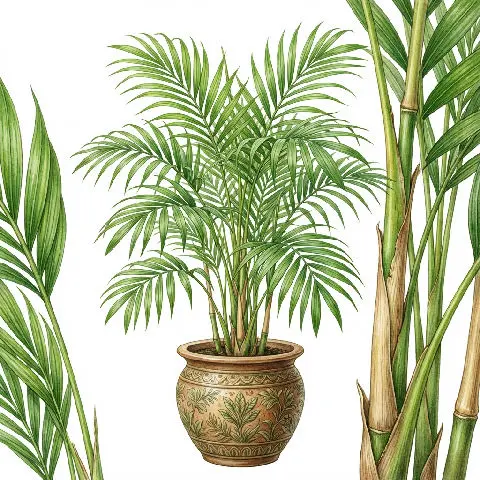
The Bamboo Palm, scientifically known as Chamaedorea seifrizii, is a striking and popular palm species belonging to the Arecaceae family. Native to the humid, seasonally dry forests of Southern Mexico and Central America, specifically thriving in the understory of regions like the Yucatan Peninsula, Belize, Guatemala, and Honduras, this palm is well-adapted to dappled light conditions. Its common name is derived from its distinctive growth habit: slender, cane-like stems that closely resemble bamboo culms, which are typically green, smooth, and marked with prominent rings or nodes.
These stems emerge in a clumping fashion from the base, giving the plant an elegant, upright, yet spreading posture, often forming an inverted cone shape as it matures, reaching up to 7 feet (2.1 meters) in height indoors. The foliage consists of gracefully arching, pinnately compound fronds, each bearing 5-15 narrowly elliptical, dark green leaflets that are widest in the middle, sometimes with terminal pinnae fused or larger. Chamaedorea seifrizii is a dioecious species, meaning individual plants are either male or female.
It produces delicate inflorescences, with male flowers typically arranged in panicles and female flowers in spikes, both exhibiting a yellow-orange hue. Female plants, when pollinated, bear small, round fruits that mature to a bluish-black color, each containing a single seed. While primarily valued for its ornamental appeal in tropical landscapes and as a favored houseplant, its botanical characteristics highlight its resilience and adaptability to various environments.
Trusted Scientific References
1. Authoritative external sources for Chamaedorea seifrizii
1.1 Wikipedia — Chamaedorea seifrizii
1.2 Kew POWO (Plants of the World Online)
1.3 PubMed — peer-reviewed research
1.4 NCBI Taxonomy Browser
1.5 GBIF — Global Biodiversity
1.6Bamboo Palm should be interpreted through verified botanical identity, practical care, and responsible safety language. This recovery note adds the missing context needed for a complete profile: match light to the plant's habit, use well-drained soil, water according to season, and avoid unsupported medicinal or edible claims. For publishing, the plant can be presented as a source-backed indoor plant with clear care guidance, common problem diagnosis, and conservative safety wording.
1.1.Bamboo Palm — Key Features
- ✓ <strong>Clumping growth habit with slender, cane</strong> — like stems resembling bamboo.
- ✓ <strong>Graceful, pinnately compound</strong> — Graceful, pinnately compound fronds with numerous narrowly elliptical leaflets.
- ✓ <strong>Exceptional tolerance for low</strong> — light conditions, making it suitable for interiors.
- ✓ <strong>Dioecious species, requiring</strong> — Dioecious species, requiring separate male and female plants for fruit production.
- ✓ <strong>Produces small, round, bluish</strong> — black fruits on female plants when pollinated.
- ✓ <strong>Recognized by NASA</strong> — Recognized by NASA for its effectiveness in removing indoor air pollutants.
- ✓ <strong>Native to the</strong> — Native to the rainforest understories of Southern Mexico and Central America.
- ✓ <strong>Relatively slow</strong> — growing, typically reaching up to 7 feet (2.1 meters) in indoor settings.
- ✓ <strong>Low maintenance requirements,</strong> — Low maintenance requirements, ideal for both novice and experienced plant enthusiasts.
- ✓ <strong>Adds a distinctive</strong> — Adds a distinctive tropical and sophisticated aesthetic to any indoor or outdoor space.
1.2.Bamboo Palm — Quick Summary
- ✓ Elegant indoor palm renowned for its air-purifying capabilities.
- ✓ Features distinctive bamboo-like stems and lush, pinnate fronds.
- ✓ Native to the understories of Central American rainforests, thriving in dappled light.
- ✓ Low maintenance, making it an ideal houseplant for various indoor settings.
- ✓ Fruits contain oxalic acid, which can cause mild skin irritation upon contact.
- ✓ Primarily valued for its aesthetic appeal and significant contribution to indoor air quality.
2.Bamboo Palm — Scientific Identity
3.Bamboo Palm — Quick Facts
4.Bamboo Palm — Appearance & Identification
5.Bamboo Palm — Native Habitat
6.Bamboo Palm — Water Requirements
- ✓ Light Requirements — Prefers medium to dappled indirect light, mimicking its native understory habitat; tolerates low light but growth may slow.
- ✓ Soil & Potting Mix — Thrives in a well-draining, peat-based potting mix that retains some moisture, ideally with a slightly acidic to neutral pH.
- ✓ Watering Schedule — Water thoroughly when the top 1-2 inches of soil feel dry to the touch; avoid overwatering to prevent root rot, ensuring good drainage.
- ✓ Humidity Levels — Benefits from high humidity, ideally above 50%; misting, pebble trays, or humidifiers can supplement dry indoor air.
- ✓ Temperature Range — Prefers consistent temperatures between 65-80°F (18-27°C) and is sensitive to cold drafts or temperatures below 50°F (10°C).
- ✓ Fertilization — Feed with a balanced liquid fertilizer diluted to half strength every 2-4 weeks during the active growing season (spring and summer).
- ✓ Propagation Method — Primarily propagated by division of its clumping stems, carefully separating offsets with roots, or less commonly by seed.
- ✓ Pest Management — Regularly inspect for common houseplant pests like spider mites, mealybugs, and scale insects, treating promptly with insecticidal soap if detected.
Reviewed by the Flora Medical Global Botanical Review Panel
Multi-disciplinary editorial group · Botany · Ethnobotany · Herbal-medicine literature
Who reviewed this: This page was checked by the Flora Medical Global Botanical Review Panel — an in-house editorial group of botany graduates, ethnobotany researchers, and horticulture practitioners who collectively maintain our 7,000+ plant encyclopedia. Meet the team.
Our 4-step verification process
1. Taxonomic verification
Scientific names and synonyms cross-checked against Kew POWO, World Flora Online, and The Plant List.
2. Phytochemical & medicinal cross-reference
Active compounds, traditional uses, and reported activities are cross-referenced with PubMed, USDA Dr. Duke's database, and peer-reviewed ethnobotanical literature.
3. Conservation & distribution check
Distribution, ecology, and conservation status confirmed against GBIF occurrence records and the IUCN Red List.
4. Editorial & safety review
Every entry passes an editorial pass for clarity, originality, and safety notices (toxicity, contraindications, dosage caveats) before publication.
Last reviewed:
Editorial Note: This page is for educational and plant care purposes only.
Written by: Flora Medical Global Editorial Team
Reviewed by: Flora Medical Global Botanical Review Panel
Last Updated: June 15, 2026







Bamboo Palm — Comments & Community Reviews
Rate this plant