


Care Disclaimer: Plant care recommendations are general guidelines based on common growing conditions. Individual results may vary based on your local environment, climate, and care routine. If your plant is toxic, keep it away from children and pets, and consult a veterinarian if accidental ingestion occurs.
1.Beaucarnea Recurvata — Overview
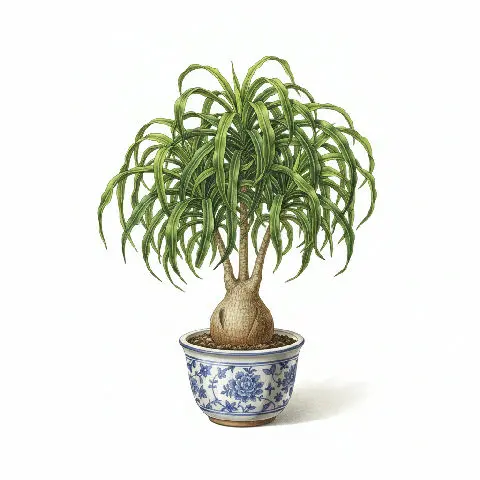
The Beaucarnea recurvata, widely recognized as the Ponytail Palm or Elephant's Foot, is a distinctive, slow-growing evergreen perennial belonging to the Asparagaceae family. Native to the semi-desert regions of southeastern Mexico, it is also found in Belize and Guatemala. Despite its common name, it is not a true palm but rather a succulent monocot. Its striking morphology is characterized by a greatly swollen, woody caudex at its base, which efficiently stores water, giving it a unique, bottle-like appearance and the 'Elephant's Foot' moniker.
From this robust caudex, one or more slender, upright stems emerge, each topped with a dense rosette of long, strap-like, recurved (curling downwards) green leaves, gracefully cascading like a ponytail. This specialized structure allows Beaucarnea recurvata to thrive in arid conditions, making it an exceptionally resilient and drought-tolerant plant. Historically, indigenous Mesoamerican cultures may have utilized parts of this plant for various purposes, though concrete ethnobotanical records for specific medicinal applications are scarce. Its primary significance traditionally and currently lies in its ornamental value due to its unique architectural form and remarkably low maintenance requirements.
Botanically, it was formally described by Charles Lemaire in 1861, with the genus name 'Beaucarnea' honoring Belgian horticulturist Jean-Baptiste Beaucarne, and 'recurvata' specifically denoting its characteristic recurved leaves. In contemporary horticulture, it is highly prized as an indoor houseplant globally, celebrated for its aesthetic appeal, recognized air-purifying qualities, and remarkable ability to withstand neglect. Scientific research into its specific pharmacological properties remains limited, with most studies focusing on its general phytochemical composition, which is considered relatively simple compared to many potent medicinal plants. While it does not feature prominently in complex herbal formulations of traditional systems like Ayurveda or TCM, its resilience and impressive longevity hold symbolic significance in diverse cultures.
Trusted Scientific References
1. Authoritative external sources for Beaucarnea recurvata
1.1 Wikipedia — Beaucarnea recurvata
1.2 Kew POWO (Plants of the World Online)
1.3 PubMed — peer-reviewed research
1.4 NCBI Taxonomy Browser
1.5 GBIF — Global Biodiversity
1.1.Beaucarnea Recurvata — Key Features
- ✓ <strong>Unique Swollen Caudex</strong> — Base of the trunk swells dramatically, storing water and giving it an 'Elephant's Foot' appearance.
- ✓ <strong>Long, Recurved Leaves</strong> — Strap-like, leathery green leaves gracefully arch downwards from the stem apex, resembling a ponytail.
- ✓ <strong>Extreme Drought Tolerance</strong> — Highly adapted to arid environments, surviving extended periods without water due to its caudex.
- ✓ <strong>Low Maintenance</strong> — Requires minimal care, making it an excellent choice for beginner plant enthusiasts and busy individuals.
- ✓ <strong>Air</strong> — Purifying Qualities — Contributes to improved indoor air quality by absorbing common airborne toxins.
- ✓ <strong>Architectural Form</strong> — Offers a striking, sculptural aesthetic that serves as a focal point in interior and landscape designs.
- ✓ <strong>Exceptional Longevity</strong> — Can live for many decades, even centuries, becoming a long-term living investment.
- ✓ <strong>Non</strong> — Toxic to Pets & Humans — Generally considered safe for households with children and domestic animals.
- ✓ <strong>Not a True Palm</strong> — Despite its common name, it is a succulent belonging to the Asparagaceae family, not Arecaceae.
- ✓ <strong>Slow Growing</strong> — Exhibits a slow growth rate, especially when confined to containers, maintaining a manageable size indoors.
1.2.Beaucarnea Recurvata — Quick Summary
- ✓ Beaucarnea recurvata, or Ponytail Palm, is a distinctive succulent from the Asparagaceae family.
- ✓ Native to Mexico, characterized by a swollen caudex for water storage and cascading recurved leaves.
- ✓ Highly valued as a resilient, low-maintenance ornamental houseplant with air-purifying qualities.
- ✓ Symbolizes longevity and endurance due to its ability to thrive in harsh conditions and its extreme lifespan.
- ✓ Scientific research into its medicinal properties is limited, and it is generally considered non-toxic to humans and pets.
- ✓ Requires bright light, well-drained soil, and infrequent watering to prevent root rot.
2.Beaucarnea Recurvata — Scientific Identity
3.Beaucarnea Recurvata — Quick Facts
4.Beaucarnea Recurvata — Appearance & Identification
5.Beaucarnea Recurvata — Native Habitat
6.Beaucarnea Recurvata — Water Requirements
- ✓ Light — Requires bright, indirect to full sun exposure for optimal growth; place in a window receiving ample light, or outdoors in a sunny spot during warm months.
- ✓ Soil — Thrives in well-drained soil mixes, ideally a cactus or succulent blend amended with sharp sand or gravel to prevent waterlogging.
- ✓ Watering — Water deeply but infrequently; allow the soil to dry out completely between waterings, especially reducing frequency during winter dormancy to prevent root rot.
- ✓ Temperature & Humidity — Prefers warm temperatures (60-80°F / 15-27°C) and tolerates average indoor humidity; avoid cold drafts.
- ✓ Fertilization — Fertilize sparingly, once or twice during the active growing season (spring and summer) with a balanced liquid fertilizer diluted to half strength.
- ✓ Propagation — Primarily propagated by seed, which can be slow and uncommon for home growers; offsets that emerge from the caudex can be removed, but rarely root successfully.
- ✓ Repotting — Repot infrequently, typically every 2-3 years or when root-bound, to a pot only slightly larger than the previous one, allowing for slower growth.
- ✓ Pruning — Remove yellowing or dry lower leaves to maintain appearance; branching can be encouraged by cutting the main stem when the plant is young.
Reviewed by the Flora Medical Global Botanical Review Panel
Multi-disciplinary editorial group · Botany · Ethnobotany · Herbal-medicine literature
Who reviewed this: This page was checked by the Flora Medical Global Botanical Review Panel — an in-house editorial group of botany graduates, ethnobotany researchers, and horticulture practitioners who collectively maintain our 7,000+ plant encyclopedia. Meet the team.
Our 4-step verification process
1. Taxonomic verification
Scientific names and synonyms cross-checked against Kew POWO, World Flora Online, and The Plant List.
2. Phytochemical & medicinal cross-reference
Active compounds, traditional uses, and reported activities are cross-referenced with PubMed, USDA Dr. Duke's database, and peer-reviewed ethnobotanical literature.
3. Conservation & distribution check
Distribution, ecology, and conservation status confirmed against GBIF occurrence records and the IUCN Red List.
4. Editorial & safety review
Every entry passes an editorial pass for clarity, originality, and safety notices (toxicity, contraindications, dosage caveats) before publication.
Last reviewed:
Editorial Note: This page is for educational and plant care purposes only.
Written by: Flora Medical Global Editorial Team
Reviewed by: Flora Medical Global Botanical Review Panel
Last Updated: June 15, 2026







Beaucarnea Recurvata — Comments & Community Reviews
Rate this plant